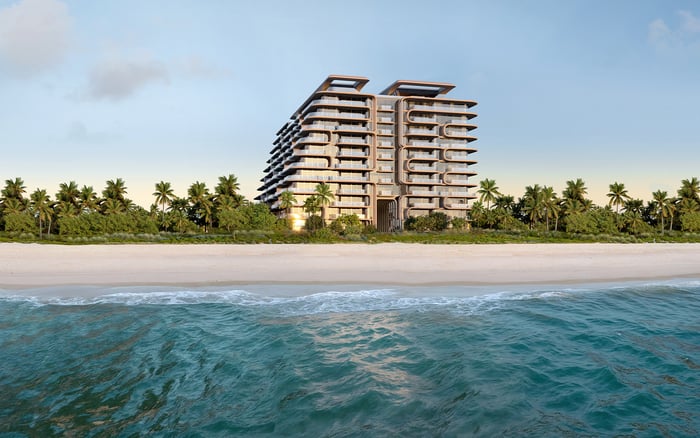
A discreet acquisition framework for Rivage Bal Harbour, separating project facts and published deposit milestones from recommended family-office approvals, funding documentation, and wire-verification controls.

An oceanfront acquisition should feel effortless to the family, not informal to those responsible for its capital. At Rivage Bal Harbour, the private-client task is to separate the residence's appeal from the authority, documentation, and payment controls that make the purchase executable.
The development occupies 10245 Collins Avenue, Bal Harbour, Florida 33154, and is marketed as 56 residences. Its development partnership comprises Related Group, Rockpoint, and Two Roads Development. Groundbreaking took place in September 2024, with Coastal Construction as general contractor. Delivery is targeted for 2027; that year is not a guaranteed completion date.
For a family office, three files deserve separate ownership: acquisition approval, funding records, and payment authorization. The framework below is a recommended internal discipline, not a statement of Rivage-specific requirements. Confirm contract terms, document requests, and escrow procedures directly with counsel and the authorized transaction parties.
Skidmore, Owings & Merrill is responsible for architecture, with Rottet Studio handling interiors. Those credentials belong in the acquisition narrative, but they do not replace residence-specific diligence. The approval memorandum should identify the proposed residence, intended family use, purchasing entity, approved expenditure, and individuals authorized to sign and release funds.
Distinguish the publicly marketed development partnership from the legal offering entity. Carlton Terrace Owner LLC is the condominium's Developer or Offeror. Counsel should reconcile that identity with the agreement and related transaction documents rather than assume a familiar development brand is the contractual counterparty.
For families also considering Oceana Bal Harbour, the same approval format can bring discipline to the comparison. Each property's documentation should stand on its own; neither branding nor neighborhood proximity establishes equivalent contractual protections.
Rivage's published deposit schedule is 20% at contract, 10% at groundbreaking, 10% at top-off, and 60% at closing. It allocates 40% of the purchase price before closing and 60% at closing. This is marketing information, not a substitute for the executed agreement.
On an illustrative $10 million purchase, the installments would be $2 million, $1 million, $1 million, and $6 million, excluding contract-specific adjustments and charges. The $10 million figure is also a historical starting-price reference from September 2024, not a current quotation or valuation. Obtain a current, residence-specific price before approving the commitment.
Because groundbreaking has already occurred, a new buyer should not assume the original milestone sequence creates a fresh payment timetable. Counsel should confirm which installments are due at signing, the evidence required for subsequent milestones, applicable deadlines, and contractual escrow arrangements.
The family office's approval should distinguish the total purchase commitment from authorization to release each installment. Record who may approve an amount, who may execute a transfer, and who must review any change. Reserve liquidity against the agreed obligations rather than treating the targeted delivery year as a fixed treasury date.
Source of funds and beneficial ownership answer different questions: where the purchase money comes from, and who ultimately owns or controls the purchasing entity. A well-organized internal file should make both clear without circulating unnecessary personal information.
As a recommended preparation step, assemble an ownership chart, entity authorization documents, and a concise narrative connecting the originating account to the purchaser. Depending on the transaction, supporting records might include account statements, distribution documentation, or evidence of an asset sale. These are preparation examples, not documents Rivage has confirmed it accepts or requires.
Ask the authorized recipient to specify the documents, delivery channel, and relevant period before assembling a large submission. If funds pass through several entities, explain each step and have counsel review any mismatch between the purchaser, account holder, and proposed remitter. An account balance alone should not be assumed to establish the payment's origin.
Limit access to sensitive identity records to those who need them for the transaction. For a private client, discretion should mean controlled disclosure, not an incomplete explanation of ownership or funding.
The residential-real-estate reporting framework uses a beneficial-owner definition that includes an individual who, at closing, exercises substantial control or owns or controls at least 25% of a transferee entity's ownership interests. Ownership percentage alone therefore does not complete the inquiry.
The framework also identifies information including full legal name, date of birth, current residential street address, and country or countries of citizenship. It permits collection from a transferee or representative who certifies accuracy in writing to the best of their knowledge.
These details are preparation points, not a conclusion that a particular purchase is reportable. Counsel should confirm current applicability, any relevant exclusions, and the responsible reporting party. The family office should identify who can certify the information and revisit it if ownership or control changes before closing.
A signed purchase approval should not automatically authorize a transfer to any account presented by email. The following controls are recommendations for the buyer's own treasury process, not verified Rivage policies or escrow-bank procedures.
First, establish the authorized payment recipient and a trusted contact route before a payment becomes urgent. Verify instructions through a callback using independently established contact details-not a number supplied only in the message carrying the instructions.
Second, separate preparation from release. Have one authorized person assemble the transfer and another review the beneficiary, account details, amount, and contractual obligation. Retain the verification record alongside the installment approval.
Third, treat changed instructions as a new authorization event. Pause the transfer, verify the change independently, and obtain renewed approval. A small test payment, if permitted and agreed with the bank and recipient, should never replace independent verification or dual authorization.
The same recommended discipline applies when a family's search extends to Ocean House Surfside. A project comparison should not carry payment instructions from one transaction into another.
Rivage's developers secured a $424 million construction loan from TYKO Capital in November 2024. That financing is relevant project context, not a buyer's completion guarantee or a substitute for reviewing contractual remedies.
Before signing, bring the residence selection, legal purchaser, funding path, installment calendar, and wire-approval process into one coordinated review. The objective is not more paperwork; it is fewer unresolved decisions when a substantial payment becomes due.
For a discreet conversation about Rivage Bal Harbour and your South Florida residence search, connect with MILLION.
If branded residences are on your mind — as a home or as an allocation — we would be glad to share what we are seeing, privately.
Begin a quiet conversationRivage Bal Harbour is an oceanfront condominium development at 10245 Collins Avenue, Bal Harbour, Florida 33154.
The project is marketed as 56 residences.
The development partnership comprises Related Group, Rockpoint, and Two Roads Development. Carlton Terrace Owner LLC is identified in the legal disclosures as the Developer or Offeror.
Skidmore, Owings & Merrill is responsible for architecture, and Rottet Studio is responsible for interiors.
The published schedule is 20% at contract, 10% at groundbreaking, 10% at top-off, and 60% at closing. The executed agreement should establish the buyer's applicable obligations and deadlines.
Illustratively, the published schedule produces payments of $2 million, $1 million, $1 million, and $6 million. This excludes contract-specific adjustments and charges and is not a current residence quotation.
2027 is the targeted delivery year, not a guaranteed completion date. Buyers should review timing provisions in their agreement with counsel.
No Rivage-specific document checklist is established here. Confirm requirements with the authorized transaction parties before submitting account records, entity documents, or evidence explaining the funding path.
No. The framework discussed also includes individuals exercising substantial control at closing, and counsel should confirm its current applicability to the transaction.
They are recommended buyer-side controls, not verified Rivage requirements. Establish the actual payment and escrow procedures with the authorized transaction parties.