An ownership-focused review of Fendi Château Residences Surfside, distinguishing reported EV availability from the charger capacity, energy costs and transferable rights buyers should confirm in writing.

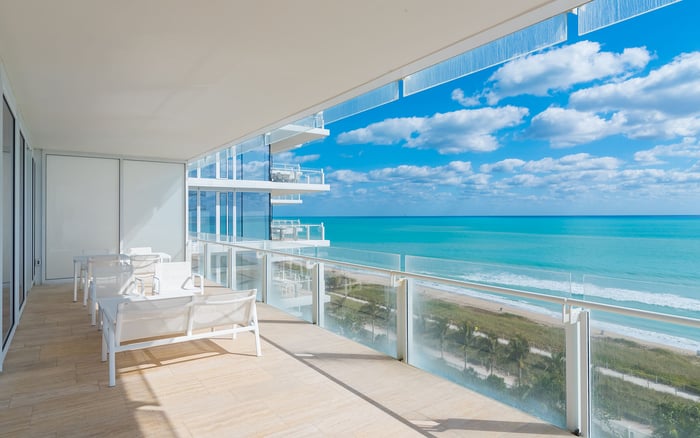
At Fendi Château Residences Surfside, the ownership proposition begins with an intimate oceanfront setting: 58 residences across 12 stories, approximately 300 linear feet of beachfront and an address at 9349 Collins Avenue. For a buyer who drives electric, however, everyday ease depends on details less visible than the architecture or arrival experience.
Assigned underground parking is established, and EV-charging stations are reported as an amenity. Neither establishes that a particular residence comes with a dedicated charger, a specified charging rate or a guaranteed right to expand charging access later.
The practical distinction is straightforward: parking access, charging performance and future electrical capacity are separate ownership questions. A disciplined purchase review should resolve each independently, then tie the answers to the residence being acquired.
Begin with the parking assignment, not the charging equipment. Obtain the declaration, parking exhibits and relevant amendments, then request written confirmation of the spaces associated with the residence and the basis for their use. General references to covered parking, garage parking and valet service do not establish a particular unit’s entitlement.
Next, determine how charging relates to those spaces. Whether stations are shared, assigned to individual spaces, resident-owned or separately operated remains unconfirmed. Request confirmation of who may use each charger, whether access requires registration and whether the seller’s current arrangement continues after a transfer.
For buyers also considering Arte Surfside, the same discipline provides a useful basis for comparison: evaluate the documented rights attached to each prospective residence rather than treating a building-level amenity as a unit-level benefit. This is a diligence standard, not a statement that the properties share charging arrangements.
Charger count, output in amps or kilowatts, connector type and simultaneous-use limits remain unconfirmed. Without those details, a buyer cannot confidently translate reported EV availability into an overnight charging expectation.
Request a current charger inventory, parking and EV plans, the electrical single-line diagram, any capacity study and the load-management policy. Ask management to distinguish equipment ratings from the power available during concurrent use. These are recommended document requests, not representations that a particular operating policy exists at the building.
A useful review should answer three practical questions:
What equipment can the buyer actually access, and is it compatible with the intended vehicle?
What charging output is available when other residents are charging?
What restrictions, reservations or operating hours, if any, govern that access?
Have a qualified electrical professional assess the technical materials where necessary. The aim is to understand charging performance under the buyer’s expected routine, including overnight parking and use of multiple vehicles, without assuming every assigned space can accommodate another charger.
Water, sewer and trash removal are identified as services included in association dues. In-unit electricity is not identified as an included service, but that omission does not establish separate metering, direct utility billing or any particular owner-payment arrangement.
EV billing is a separate question. Charging prices, billing methods and whether charging costs are included in assessments remain unconfirmed. Do not assume that household electricity and vehicle charging follow the same billing arrangement.
Request the current charging fee schedule and 12 months of available unit electricity and EV invoices. Review how consumption is measured, who issues the bill and whether charges attach to a resident account, parking space or unit. If invoices are unavailable, seek a written explanation of the actual billing arrangement rather than substituting an estimate.
Distinguish energy charges from any equipment, network, maintenance and common-area costs. Ask whether fees are fixed, usage-based or combined, and what written terms govern changes. These are possibilities to investigate, not confirmed charges at Fendi Château. The objective is a clear understanding of recurring costs that remains useful after closing.
Current access and future access are not interchangeable. A binding procedure for allocating additional chargers, charging rights or electrical capacity has not been established here.
Obtain the current EV rules, relevant board minutes and any adopted provisions addressing expansion. Ask whether an owner seeking another charger would face a queue, capacity review or other allocation mechanism. Do not presume that any of these mechanisms applies without written confirmation.
The most consequential questions concern priority and transferability. Does existing charging access continue with the residence, remain associated with a parking assignment or require a new application? If additional capacity becomes available, how would owners request it, and who would bear the related costs? Request the governing documents or written policy supporting each answer.
A buyer weighing The Surf Club Four Seasons Surfside alongside Fendi Château can use these same questions to keep the comparison precise. Evaluate present access and future flexibility separately at each property; do not assume equivalent charging capacity or allocation rules.
Before assigning value to an installed charger, establish who owns it and who must maintain, repair or replace it. Request written clarification of insurance obligations, installation approvals and any removal or restoration requirements. These responsibilities remain unconfirmed.
Financial diligence should extend to the association’s budgets, reserves, engineering assessments and any pending assessments relating to electrical infrastructure. No electrical-upgrade cost is established here, and charger availability alone does not demonstrate funded expansion capacity.
Ask management to distinguish adopted work from proposals or informal discussions. A possible upgrade is neither an approved obligation nor a promised improvement. Where future work could affect the purchase decision, have the buyer’s legal and technical advisers review its documented status and potential allocation of costs.
For a resale purchase, the most useful deliverable is a concise, unit-specific record: parking assignment, charging access, usable capacity, billing terms, equipment responsibilities and any documented transfer conditions. Support each point with the applicable documents rather than a general assurance that charging is available.
Do not rely on oral representations. Obtain the disclosure documents required under Section 718.503, Florida Statutes, secure the relevant written terms and have counsel assess their application to the transaction.
Fendi Château’s scale and beachfront setting frame the lifestyle decision. A documented charging arrangement clarifies the practical decision, allowing buyers to distinguish what they can rely on today from what requires future approval or investment.
For a discreet perspective on South Florida ownership decisions, explore MILLION.
If branded residences are on your mind — as a home or as an allocation — we would be glad to share what we are seeing, privately.
Begin a quiet conversationThe oceanfront condominium is at 9349 Collins Avenue in Surfside, Florida. It has 58 residences across 12 stories and approximately 300 linear feet of beachfront.
Assigned underground parking is established, but charging at every assigned space is not. Buyers should confirm access for the specific residence and parking assignment.
EV-charging stations are reported as a building amenity, but association-level confirmation of the current arrangement remains necessary. The amenity description does not establish individual access rights.
Charger count, output, connector type and simultaneous-use limits are not established by the available description. Request an inventory and technical documentation.
The available description does not establish whether chargers are shared, individually assigned, resident-owned or separately operated. Obtain written confirmation for the intended arrangement.
In-unit electricity is not listed among the included services, but that omission does not establish how it is metered or billed. Confirm the arrangement through management and unit invoices.
The available amenity description does not disclose whether EV charging is included in assessments. Request the current fee schedule and available charging invoices.
Transferability is not established by the available information. Review the declaration, parking exhibits, amendments and EV rules, and obtain unit-specific written confirmation.
A binding allocation procedure is not established by the available description. Request adopted EV policies and relevant board minutes addressing expansion and access.
Those responsibilities and any upgrade costs are not established here. Review equipment ownership terms, maintenance obligations, budgets and any pending electrical assessments.