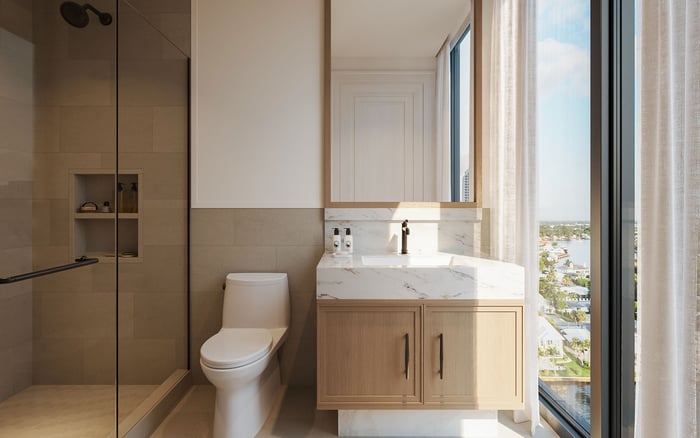
A disciplined framework for evaluating reported water-intrusion history, reviewing current building-envelope records, and clarifying maintenance and funding responsibilities before purchase.

A careful purchase review at The Ritz-Carlton Residences® Fort Lauderdale should distinguish among reported historical concerns, documented repairs, and the property’s present physical condition. A buyer should not treat an allegation, prior complaint, or informal account as proof of a current defect.
The most useful approach is document-based. Ask for records that identify what was observed, where it occurred, how it was investigated, whether repairs were recommended, and whether completed work was later verified. The objective is to establish a clear sequence from observation through resolution rather than rely on assumptions about past or present conditions.
A building-envelope review may address exterior systems and junctions intended to manage wind and water, including roofs, windows, exterior doors, terraces, waterproofing, sealants, transitions, and connected common elements. The appropriate scope depends on the residence, available access, and the records provided.
Request available engineering or envelope reports, moisture surveys, testing protocols, photographs, repair scopes, contractor invoices, permits, warranties, and closeout materials. Leak logs, board minutes, insurance information, and records of follow-up work may also help a buyer understand whether an issue was isolated, recurring, repaired, or still under review.
The supplied materials do not establish a current official envelope-testing report for this property. Buyers should request the latest available documentation and avoid assuming that testing occurred or covered every relevant assembly. When records are unavailable, incomplete, or dated, a qualified independent specialist can help assess accessible conditions within the limits of the transaction.
The existence of a report is not enough. Identify its date, inspected areas, methods, limitations, observations, recommendations, and any stated need for additional investigation. A test involving one opening or location should not be assumed to address a different elevation, roof transition, terrace assembly, or concealed condition.
Match recommendations to supporting records such as invoices, permits, photographs, warranties, and completion documents. If repairs were performed, ask whether the work was merely observed or was followed by additional testing. Also determine whether later records identify concerns in the same area.
This method can guide document review at other Broward branded residences, including Four Seasons Hotel & Private Residences Fort Lauderdale and St. Regis® Residences Bahia Mar Fort Lauderdale. Each property must be evaluated through its own records, systems, and governing documents; comparisons should improve the buyer’s questions, not imply equivalent conditions.
Physical review should be paired with analysis of the declaration, amendments, rules, budgets, reserve materials, and other governing records. Before closing, determine which party is responsible for maintaining, repairing, replacing, insuring, and funding windows, exterior doors, roofs, terraces, waterproofing, and related common or limited-common elements.
The classification of a component can affect both decision-making and cost allocation. Buyers and their advisers should compare the governing language with available maintenance and billing records, then identify any unresolved obligations, approved work, assessments, or insurance considerations that may affect the residence.
A useful closing file may include governing documents and amendments, current budgets, reserve materials, recent financial statements, assessment history, insurance information, engineering and envelope reports, leak logs, board minutes, permits, invoices, warranties, and proof that recommended work was completed.
The unit-specific inspection should address accessible signs that may warrant further inquiry, such as staining, elevated moisture, replaced finishes, or repairs near windows, doors, ceilings, terraces, and exterior walls. Buyers should review inspection access, disclosures, and technical findings with appropriately qualified legal, engineering, insurance, and financial advisers.
Historical water-intrusion concerns should be treated as a prompt for focused due diligence, not as a substitute for current evidence. The strongest purchase decision rests on recent documentation, a unit-specific inspection, a clear allocation of responsibility, and an understanding of how any recommended work will be funded and verified.
Does a reported water-intrusion history prove a current defect? No. A buyer should distinguish historical reports or allegations from documented present conditions.
What building-envelope records should a buyer request? Request available reports, testing records, leak logs, repair scopes, invoices, permits, warranties, photographs, and completion documents.
Is a current official envelope test established here? No. The supplied materials do not establish a current official envelope-testing report for this property.
What should a buyer check in an envelope report? Review the date, locations examined, methods, limitations, findings, recommendations, and any follow-up verification.
Can one limited test address the entire exterior? Not necessarily. Buyers should confirm precisely which openings, assemblies, elevations, or transitions were included.
Why compare repair recommendations with permits and invoices? Supporting records can help trace an observation through diagnosis, authorized work, completion, and verification.
Who is responsible for windows, exterior doors, or terraces? Responsibility should be determined from the governing documents and the classification of each component.
Should buyers review reserves and assessments? Yes. These materials can help clarify how contemplated or completed building work may be funded.
Does a residence inspection replace building-level document review? No. A unit inspection and a review of association or building records address different aspects of due diligence.
When might an independent specialist be useful? A qualified specialist may help when records are incomplete, dated, technically unclear, or limited in scope.
If you'd like a private walkthrough and a curated shortlist, connect with MILLION.
If branded residences are on your mind — as a home or as an allocation — we would be glad to share what we are seeing, privately.
Begin a quiet conversation