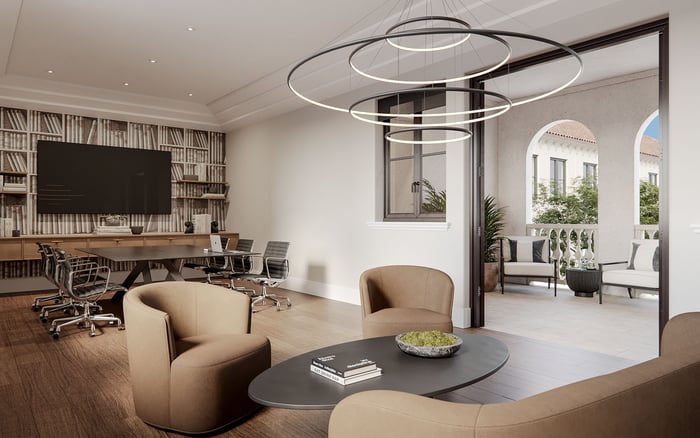
Ponce Park Coral Gables offers a boutique residential proposition, but family visits require a separate layer of diligence. Before valuing guest accommodation, buyers should establish whether a bookable suite exists and obtain written confirmation of reservation priorities, overnight-visitor rules and access permissions.

For a multigenerational household, the most meaningful luxury may be an effortless visit: grandparents arriving independently, adult children staying comfortably, and everyone retaining privacy. At Ponce Park Coral Gables, that ambition warrants a practical review before it becomes part of the purchase rationale.
The first distinction is essential: a dedicated, bookable guest suite has not been established, nor has a reservation hierarchy or booking window. Guest-suite priority is therefore a diligence question, not a verified benefit. That uncertainty is not proof that no accommodation or policy exists.
Hospitality services and guest-access rights are separate matters. A concierge may be an attractive service, but it does not establish permission for relatives to stay overnight, occupy a separate suite or use amenities without the owner.
Ponce Park is marketed as 58 residences in an 11-story tower at 3000 Ponce de Leon Blvd., Coral Gables. The advertised mix spans two- to five-bedroom homes and penthouses. That range gives buyers a starting point for assessing whether visiting family could stay within the residence itself, subject to applicable occupancy and visitor rules.
Allen Morris Company is the developer, with architecture by John Cunningham with Zyscovich and interiors by Meyer Davis. These design credentials frame the residential proposition, but they do not resolve operational questions about family use.
For buyers also considering Cora Merrick Park, apply the same discipline: evaluate the home first, then establish visitor permissions independently. Neither a project’s scale nor its address substitutes for written rules.
Before asking who receives booking priority, request written confirmation of whether a guest-accommodation facility is contemplated, committed or available. If one exists, establish who controls it, which owners may request it and whether access is discretionary or governed by a defined policy.
Then request its occupancy capacity, accessibility information and operating conditions. For grandparents, the route from arrival to accommodation may matter as much as the room itself. For adult children traveling with young children, ask whether permitted occupancy covers the full party. These are questions to resolve, not features to assume.
Keep three arrangements distinct: visitors sleeping inside your residence, visitors using a building-managed guest suite, and relatives occupying your home while you are away. Confirmation of one does not establish permission for the others. Request a written answer for each arrangement your family expects to use.
If a guest suite is confirmed, the practical question is whether it can accommodate your family’s calendar. A reservation window defines when requests may be submitted. A priority rule determines whose request prevails when dates compete. Neither necessarily guarantees a preferred stay.
Ask whether requests are handled on a first-come basis, through a lottery, by rotation or under another allocation system. These are possible policy structures to investigate, not established Ponce Park procedures. Confirm whether any owner category receives preference and whether repeat bookings, consecutive nights or annual usage are capped.
Request rules for holiday dates, waitlists, cancellations, deposits, cleaning charges and the release of unconfirmed reservations. Determine when a request becomes a confirmed booking and whether it can later be displaced. A useful test is to submit a hypothetical family itinerary and ask how the written policy would apply.
Start with grandparents visiting while the owner is home. Confirm registration requirements, maximum consecutive stays, permitted occupancy, amenity access and any visitor charges. If caregivers may accompany them, ask how those caregivers would be classified and authorized.
Next, consider adult children arriving before you. The critical questions are owner-presence requirements, approval procedures, identity verification and permission to receive keys or access credentials. Do not assume family status creates an exception to rules for unaccompanied guests.
Finally, consider a larger gathering with several visiting households. Request visitor-parking procedures, overnight vehicle permissions and any limits on simultaneous amenity use. Advertised valet service does not establish complimentary guest parking or an overnight parking entitlement.
For families weighing The Village at Coral Gables alongside Ponce Park, use these same scenarios rather than assuming equivalent visitor flexibility. The meaningful comparison is how each property’s documented rules accommodate the visit you intend to host.
Ponce Park’s advertised services include a doorman, hospitality-trained concierge, 24/7 valet and attended lobby, and 24-hour security. Other advertised services include mail delivery to residences, laundry and dry cleaning, and restaurant-reservation assistance. Current offerings and their terms require written confirmation.
These services may support a comfortable arrival, but they do not establish overnight-guest limits, approval procedures, fees, blackout dates or permission for unaccompanied visitors. Those policies remain unspecified.
Ask how services would operate for an authorized guest, including late arrivals, luggage handling and communication with the owner. Keep that operational discussion separate from the question of permission. Knowing who can assist your parents at the door is different from knowing whether they may remain for the planned stay.
Request the declaration, bylaws, current or proposed house rules, amenity policies and any written guest-accommodation procedures. Identify which documents are drafts, which govern the purchase and which policies remain subject to adoption or revision. Have your adviser or condominium counsel review the provisions central to your intended use.
The aim is not simply to collect assurances. Ask who can amend the relevant rules, how changes are communicated and what happens if operating policies differ from the family-use assumptions discussed during sales. A verbal description of flexibility is not a documented entitlement.
If visiting family is essential to the purchase, resolve these questions before assigning value to a guest suite or relying on future visitor permissions. Maintain a separate budget for alternative accommodation when availability cannot be assured.
Evaluate the residence under a conservative scenario: no assumed guest-suite availability, no presumed holiday priority and no unconfirmed right to host relatives in your absence. Then consider whether its layout and documented permissions still support the way your family intends to live.
The decision becomes clearer when the home works without relying on unresolved benefits. Treat any later-confirmed guest accommodation as an additional advantage, not a substitute for bedrooms, privacy or dependable arrangements elsewhere.
For a discreet conversation about matching a South Florida residence to your family’s needs, connect with MILLION.
If branded residences are on your mind — as a home or as an allocation — we would be glad to share what we are seeing, privately.
Begin a quiet conversationThe available project materials do not establish a dedicated bookable guest suite. Buyers should obtain written confirmation before treating one as an amenity.
No booking hierarchy or reservation window is established in the available materials. If a suite is confirmed, request its allocation and reservation policies.
The project is marketed as a boutique condominium with 58 residences in an 11-story tower.
The advertised mix includes two- to five-bedroom homes and penthouses. Buyers should assess their chosen layout alongside applicable occupancy and visitor rules.
The available marketing does not establish permission for unaccompanied guests. Obtain written confirmation of owner-presence requirements and approval procedures.
Advertised valet service does not establish overnight visitor-parking rights or complimentary parking. Ask for the applicable parking policy and charges.
Request the declaration, bylaws, current or proposed house rules, amenity policies and any written guest-accommodation procedures. Clarify which provisions are drafts and which are applicable.
If a suite exists, ask how competing dates are allocated, when bookings become confirmed and whether owner categories receive preference. Also confirm cancellation rules, usage caps and holiday restrictions.
Advertised services include a doorman, hospitality-trained concierge, 24/7 valet and attended lobby, and 24-hour security. These offerings require current confirmation and do not establish guest-access rights.
The development is marketed at 3000 Ponce de Leon Blvd., Coral Gables.