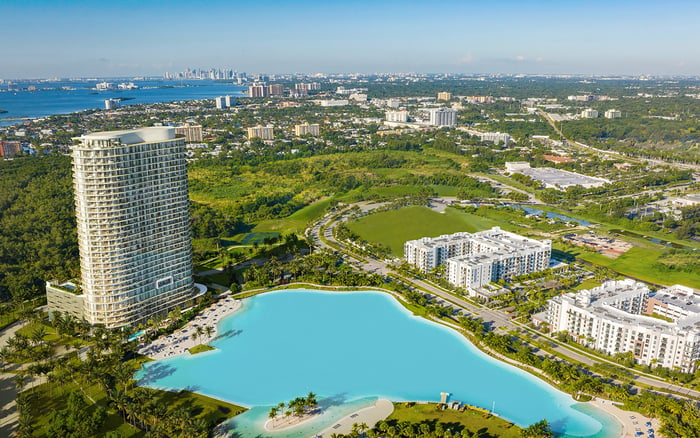
A clean estoppel confirms a unit’s current account, but it does not reveal every future cost. Buyers at One Park Tower should examine both condominium and master-community obligations, construction status, reserves, insurance, and contemplated projects before signing or closing.

At One Park Tower by Turnberry North Miami, the appeal is clear: a glass-forward condominium with wraparound balconies, resort amenities, and access to SoLé Mia’s 7-acre Crystal Lagoon and private beach. Yet the most consequential aspect of a purchase may be less visible: the allocation of present and future financial responsibility among the residence, condominium association, and wider master-planned community.
An estoppel certificate is valuable because it can establish the account status associated with a unit at a specific point in time. A clean certificate, however, should not be read as a comprehensive assessment of the building’s finances or future capital needs. It may not capture a project still under discussion, a proposal awaiting bids, a deferred repair, a budget change under consideration, or a master-community expense that has not yet become a formal unit charge.
For this reason, MILLION Buyer’s Guides treat an estoppel as one document within a broader diligence file-not as the file’s conclusion.
One Park Tower is planned as a 33-story luxury condominium at 2411 Laguna Circle in North Miami, within the 184-acre SoLé Mia community. Project specifications vary, with 292 residences overlooking the lagoon in one description and 303 units across 32 floors in another. These inconsistencies make the governing documents, current prospectus, and executed purchase contract the appropriate references for final specifications.
The tower topped out in April 2025, completing its principal vertical structural work rather than signaling finished delivery. Completion information also varies, from an anticipated summer 2026 completion to a 2028 delivery listing. Buyers should therefore obtain the current contractual schedule, permitted extensions, completion standards, and written construction disclosures.
This discipline is relevant throughout South Florida’s pre-construction market. Comparisons with Avenia Aventura or Turnberry Ocean Club Sunny Isles can help frame lifestyle and location, but each property has distinct legal, budgetary, and operational documents. Aventura or waterfront alternatives cannot establish the obligations attached to this purchase.
A buyer should not expect a unit estoppel, standing alone, to explain the adequacy of reserves, the scope of insurance, the condition of shared systems, or the likelihood of future assessments. Nor does a zero balance necessarily mean that every owner-authorized or developer-contemplated project has already been funded.
That distinction matters in a new-construction condominium. Early budgets may rest on assumptions that evolve as contracts are finalized, amenities begin operating, warranties are administered, and control ultimately transitions. One Park Tower also sits within a much larger community, creating a second layer of questions. Buyers should separately identify condominium-level and SoLé Mia master-level fees, reserve arrangements, maintenance duties, cost-sharing formulas, and assessment rights.
The practical inquiry is not simply, “Does this unit owe money today?” It is also, “What obligations are under consideration, who can approve them, how will costs be allocated, and when could payment become due?”
Request the condominium declaration and bylaws, together with the current or proposed operating budget, reserve schedule, insurance summary, material contracts, construction updates, and available board or developer meeting records. Review them for planned work, unfunded obligations, recurring service costs, developer-control provisions, warranties, turnover procedures, and the authority to levy assessments.
Then obtain the corresponding SoLé Mia master-association declaration, budget, reserve information, cost-sharing formula, and special-assessment provisions. Determine whether quoted monthly maintenance includes every mandatory lagoon, parking, amenity, tower, and master-community charge. A maintenance estimate of $1.20 per square foot monthly has been stated, but only the current budget and contract can define the buyer’s actual obligation.
Ask management and the developer in writing whether any capital projects are being discussed, approved, bid, postponed, or deferred, even if no assessment has been issued. Evaluate the response alongside meeting records, budgets, contracts, and construction disclosures. This is not merely an investment exercise. It helps a primary- or second-home buyer assess cash flow, timing, and the quality of the ownership experience.
The amenity program includes a fitness center, spa, golf simulator, co-working and business areas, children’s facilities, sports courts, a pool deck, and lagoon access. Residences are offered in one-, two-, and three-bedroom configurations, plus penthouses, with a stated size range of approximately 962 to 2,131 square feet.
Asking prices and stated policies vary. Pricing has ranged from $850,000 to $2 million, while another starting figure has been $1.385 million. A 30-day minimum rental period, with rentals permitted up to 12 times annually, has also been stated. Inventory, prices, rental rights, and fees should all be confirmed in current controlling documents rather than treated as fixed marketing terms.
Buyers comparing the broader waterfront corridor might also consider Solana Bay North Miami. Such comparisons are useful for evaluating design, setting, and amenity priorities, but the strongest offer strategy remains document-specific: identify the exact residence, contractual schedule, mandatory charges, governance structure, and potential capital exposure before committing.
First, reconcile the unit count, floor count, residence plan, parking rights, delivery timetable, and included finishes against the contract and condominium materials. Second, separate tower expenses from master-community expenses. Third, match estoppel information to budgets, reserves, insurance, meeting records, and written answers about pending work. Finally, have qualified Florida legal, financial, insurance, and inspection professionals assess the documents within applicable review periods.
The objective is not to diminish the appeal of One Park Tower. It is to understand precisely what accompanies the view, amenities, and place within SoLé Mia. Luxury ownership is most persuasive when its future obligations are considered as carefully as its architecture.
What does an estoppel certificate confirm? It generally addresses the unit account and specified obligations as of a stated date. It is not a complete forecast of association finances or future projects.
Does a clean estoppel mean no special assessment is coming? No. A discussed, bid, deferred, or contemplated project may not yet have produced a formal assessment.
Why must buyers review two association levels? One Park Tower is part of SoLé Mia, so condominium and master-community documents may assign separate fees, duties, reserves, and assessment rights.
Which financial documents should a buyer request? Request current or proposed budgets, reserve schedules, insurance information, material contracts, and available meeting records for both relevant levels.
Is topping out the same as completion? No. The April 2025 topping-out marked completion of principal vertical structural work, not final delivery.
What delivery date should a buyer rely upon? Rely on the executed contract, written construction disclosures, and applicable amendments because the stated dates differ.
Are maintenance estimates binding? No. Confirm all tower, master-community, lagoon, parking, and amenity charges in the current budget and purchase documents.
Are the rental rules confirmed? A 30-day minimum and up to 12 rentals annually have been stated, but buyers should verify the recorded declaration and current rules.
Why do differing unit totals matter? Differing totals can affect a buyer’s understanding of the project, so final specifications should come from governing and contractual documents.
Who should review the diligence package? Buyers should consider qualified Florida legal, financial, insurance, and inspection professionals appropriate to the transaction.
For a discreet conversation and a curated building-by-building shortlist, connect with MILLION.
If branded residences are on your mind — as a home or as an allocation — we would be glad to share what we are seeing, privately.
Begin a quiet conversation