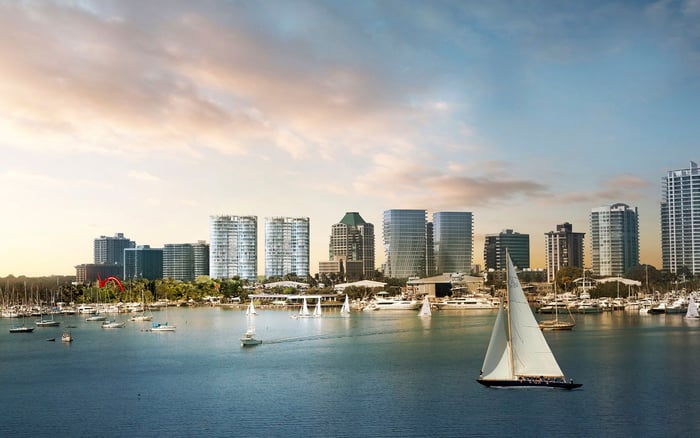
A storm-resilience review of Mr. C Tigertail, focused on parcel-level flood mapping, critical equipment, flood-barrier operations, backup power, and post-storm access.

At Mr. C Tigertail Coconut Grove, the most consequential luxury may be the continuity residents cannot see during a tour. Mechanical rooms, garage thresholds, drainage paths, backup-power loads, access controls, and post-storm inspection procedures can determine how gracefully a condominium moves from warning through recovery.
Located at 2678 Tigertail Avenue in Coconut Grove, the 21-story tower was completed in 2024 and comprises 138 residences. Terra developed it in partnership with Maggio Cipriani’s Mr. C brand. It is part of Mr. C Residences Coconut Grove, alongside a second tower at 2655 South Bayshore Drive.
For a buyer, that profile provides context-not a conclusion about resilience. The available public details do not include a sufficiently specific mechanical-elevation plan, deployable flood-barrier specification, generator coverage schedule, or association re-entry protocol. Those questions belong in document review and technical diligence before contract deadlines expire.
Storm resilience is a chain of systems, decisions, and permissions, not a single amenity.
Coconut Grove contains varying flood designations, making neighborhood reputation an unreliable substitute for an exact-address search. Enter 2678 Tigertail Avenue into the county’s interactive flood tool, then confirm the result through the federal address-search system. The objective is to determine whether the parcel lies within a Special Flood Hazard Area and identify the applicable map designation.
Flood maps distinguish VE coastal high-hazard areas from AE Special Flood Hazard Areas. They also identify areas with a 0.2% annual-chance hazard and locations subject to shallow flooding. A buyer should obtain the current map result and ask whether any map amendment or elevation documentation affects the property’s treatment.
A designation, however, describes mapped external exposure-not the building’s complete response. Request the elevation certificate and drawings showing finished-floor elevations, garage entries, loading or service openings, drainage routes, and low points. Compare those elevations with the locations of electrical switchgear, elevator controls, pumps, domestic-water equipment, communications hardware, fire-safety systems, and emergency power components.
This distinction matters throughout waterfront ownership. A line on a map may frame risk, but the vertical and operational arrangement of a tower determines which systems remain protected and how quickly service can resume.
“Elevated mechanicals” is not sufficiently precise for serious diligence. Buyers should request plans identifying each critical component by floor or elevation and, when needed, have an engineer interpret them. The central issue is not whether some equipment sits above grade, but whether every dependency required for safe occupancy has been considered.
Begin with electrical service, the emergency generator, fuel arrangements, transfer equipment, elevator machinery and controls, sump and stormwater pumps, domestic-water systems, security, access controls, communications, fire equipment, and common-area lighting. Then examine how these components connect. An elevated control panel offers limited comfort if a necessary pump, sensor, conduit route, or transfer component remains exposed.
Backup power warrants its own schedule. Confirm which residential elevators, pumps, doors, communications systems, life-safety functions, and shared spaces receive generator power. Determine whether coverage is automatic, how loads are sequenced, and whether resident elevator service is included or restored only after other priorities are met. The relevant evidence is the generator load schedule and emergency plan-not a broad assurance of generator availability.
Within MILLION’s Buyer’s Guides, this systems-based approach applies equally to Branded Residences and conventional condominiums. Buyers comparing Four Seasons Residences Coconut Grove or Park Grove Coconut Grove can use the same document requests while assessing each property through its own engineering and association records.
A deployable flood barrier can be evaluated only through its complete operating sequence. Ask where the components are stored, which openings they protect, who is authorized to install them, and which forecast or warning triggers deployment. Establish whether staff can complete installation without outside contractors and whether the procedure remains workable if roads, elevators, or loading areas are constrained.
Inspection and testing records are equally important. Buyers should seek a written deployment plan, diagrams matching each component to an opening, maintenance logs, drill frequency, staffing assumptions, and a process for replacing damaged or missing parts. Timing should be explicit. Even a technically capable system carries execution risk if activation begins too late or depends on personnel who may be unavailable.
Garage access warrants particular scrutiny because it combines a large opening with vehicles, ramps, drainage, and resident movement. Ask how the garage is secured, when vehicle access stops, where water is directed, and how pumps perform under emergency power. Apply the same questions to service doors, loading access, utility penetrations, and other low-level openings.
After a storm, residents should not return until local officials declare the area safe. Association approval cannot override government restrictions. Even after public clearance, however, entry may still depend on the building’s own inspections and operating conditions.
Request the association’s written sequence for structural or façade review, water-intrusion assessment, electrical and fire-system checks, utility confirmation, elevator inspection, management authorization, and resident notification. Ask who makes each decision, how owners receive updates, whether staff can communicate during a network outage, and which conditions permit restricted access rather than full occupancy.
Re-entry and habitability are not the same. A resident may be allowed to retrieve belongings before elevators, air conditioning, domestic water, or normal security operations have returned. Buyers should clarify how mobility needs, pets, deliveries, household staff, and parking access are managed during phased restoration.
The same questions can sharpen comparisons with newer or Move-In Ready choices such as Vita at Grove Isle. The objective is not to infer that one building performs like another, but to establish a consistent standard for evaluating documentation, staffing, redundancy, and recovery procedures.
A disciplined review begins with the declaration and amendments, offering documents, elevation certificate, relevant engineering drawings, emergency plan, generator load schedule, flood-barrier deployment plan, insurance history, and recent board minutes. Minutes can reveal testing, repairs, vendor changes, incidents, or unresolved discussions absent from polished summaries.
Request written answers rather than relying on tour commentary. Useful questions include which critical systems are elevated, which loads receive backup power, who installs barriers, how often deployment is tested, which outside vendors are essential, and what precise sequence governs post-storm access. Review insurance materials with qualified insurance and legal advisers; technical plans may warrant an engineer’s interpretation.
Neighborhood infrastructure is another layer, though never a substitute for tower-level protection. Miami-Dade is relocating Pump Station 64 from a flood zone to higher ground as part of a Coconut Grove sewer upgrade near Bayshore Drive and Halissee Street. The work is intended to improve sewer service and infrastructure resilience, but buyers should still evaluate the condominium’s internal drainage, power, access, and emergency operations independently.
For MILLION, the decisive question is not whether a residence can be labeled resilient. It is whether the buyer can trace a credible chain from mapped exposure through physical protection, powered systems, trained personnel, official clearance, and orderly re-entry.
For a discreet review of Coconut Grove opportunities and property-specific diligence priorities, connect with MILLION.
If branded residences are on your mind — as a home or as an allocation — we would be glad to share what we are seeing, privately.
Begin a quiet conversationIt is located at 2678 Tigertail Avenue, Miami, Florida 33133, in Coconut Grove.
Terra completed the luxury branded condominium in 2024.
Project data identifies the tower as a 21-story building with 138 residences.
Search the exact street address in the county’s interactive flood tool, then confirm the result through the federal address-search system.
No. It describes mapped external exposure but does not replace review of elevations, openings, drainage, equipment locations, and operating procedures.
Review the locations of electrical, elevator, pump, water, security, communications, fire-safety, and emergency-power components.
It should identify which elevators, pumps, access controls, communications, life-safety systems, and common areas receive backup power.
A credible plan documents protected openings, component storage, deployment triggers, responsible personnel, testing, maintenance, and contractor dependencies.
No. Public officials must first declare the area safe, after which building-specific inspections and management authorization may still be required.
Request governing and offering documents, engineering drawings, the elevation certificate, emergency plans, generator and barrier records, insurance history, and recent board minutes.