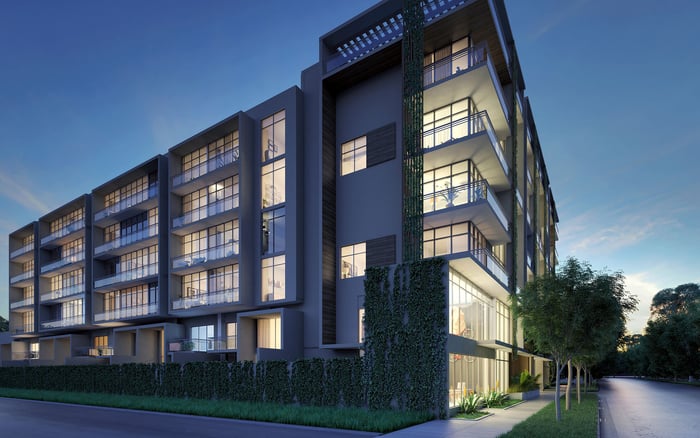
A practical due-diligence framework for Ziggurat Coconut Grove buyers, separating advertised pet services and private elevators from the written rules, route plans, and emergency procedures that determine everyday ownership.

At Ziggurat Coconut Grove, a buyer’s practical questions begin where the architectural presentation ends: taking a dog outside before sunrise, authorizing a walker to reach the residence, or leaving safely when normal circulation is unavailable. These routines deserve the same scrutiny as a floor plan.
The address is 3101 Grand Avenue, Coconut Grove, FL 33133. The approximately 1.7-acre project sits at the crossroads of Grand Avenue, Matilda Street, and Florida Avenue. Private elevators for each home are advertised, while dog walking and pet care appear among planned services. Those details establish an advertised proposition, not a complete operating framework.
For a buyer, the distinction matters. A service offering does not establish pet permission, and a private elevator does not establish emergency availability. Request written evidence connecting each advertised convenience to the specific residence and household that will use it.
Begin with the recorded declaration, current condominium rules, and written approval applicable to your animals. Request species, size, and number restrictions, visiting-pet rules, and service-animal provisions. If documents remain in draft form, confirm their status and ask when final versions will be available.
Advertised dog walking and pet care should not be treated as definitive permission. Any uncertainty calls for a written answer tied to governing documents, not verbal reassurance.
Ask your adviser to assemble three distinct pieces of evidence:
The governing provision addressing whether your household’s animals are permitted.
Any approval required for those animals, with conditions clearly stated.
The operating rules governing movement through common areas and elevators.
Keeping these questions separate prevents a broad statement about pet services from substituting for approval of a specific animal.
A designated pet-relief station or dog run remains unverified. That is not proof that none will exist. Request a marked site plan rather than assuming landscaping or an outdoor area will be available for relief.
The plan should trace the route from the residence to an approved elevator, through the permitted exit, and onward to the authorized relief location. Ask for waste-bin locations, disposal procedures, and leash or carry requirements. Confirm whether the same route remains available at night and what alternative applies during maintenance or closures.
A useful walkthrough tests the ordinary journey, not just the most attractive one. Ask how doors are opened while handling a leash or carrier, where access credentials are required, and how a walker enters and leaves without receiving broader residential access than intended.
Buyers also considering Arbor Coconut Grove can apply the same route-based checklist there. Compare documented permissions and actual circulation without assuming the two properties share amenities or rules.
Dog walking and pet care are planned services. That does not establish that either is already operational or define the arrangement an owner would purchase.
Request a written scope covering hours, booking procedures, fees, provider insurance, and liability terms. Confirm whether service will be operational at the relevant occupancy date and who will communicate changes or interruptions.
For owners who travel, add questions about key custody, access authorization, cancellations, and pets left alone. Ask whether the provider’s responsibilities end with a scheduled visit or include additional welfare checks. Do not assume concierge involvement includes animal assistance during an emergency.
The promise of private elevators for each home does not establish the precise access configuration. Ask for a unit-specific circulation diagram showing the elevator’s relationship to the residence, common areas, and designated exit stairs. Clarify which aspects of access are exclusive and which depend on credentials or operating rules.
The written protocol should identify resident, guest, staff, and dog-walker permissions. It should also address service-elevator availability, if applicable, pet transport, cleaning responsibilities, and the response to an animal-related incident. None of these procedures follows from the term “private elevator” alone.
Request separate answers for ordinary maintenance, power interruption, and fire-related shutdown. Ask which equipment has generator coverage and what restrictions apply in each condition. Backup power should never be interpreted as permission to use an elevator during a fire.
For a household comparing Four Seasons Residences Coconut Grove, carry over the same unit-specific questions. Privacy and convenience are best compared through access plans and written procedures, not terminology alone.
General fire-evacuation precautions include following designated exit routes, keeping fire doors closed, and avoiding crowding. Do not use elevators during a fire unless directed by responding firefighters; private access and backup power are not assurances of safe evacuation.
These general precautions do not establish Ziggurat’s adopted emergency plan. Request building-specific evacuation diagrams, stair locations, emergency communications procedures, and re-entry rules. Do not assume rooftop access provides an approved escape route.
Accessibility deserves a dedicated conversation. Obtain the arrangements for occupants who cannot independently use stairs, including how assistance is requested and how occupant accountability is handled. Have the relevant building personnel explain the procedures before occupancy, rather than leaving interpretation to an emergency.
For pets, ask about carriers, service animals, animals left alone, and animal accountability. Seek an explicit statement of whether staff provide any animal assistance. A planned pet-care service is not a promise of rescue.
Complete the file with the certificate of occupancy, applicable life-safety approvals, and current inspection records for elevators, fire alarms, sprinklers, and generators. Request final policies for hurricanes, flooding, and utility interruptions, including communications and re-entry arrangements.
For each pending item, record its status, the responsible contact, and the expected delivery point. Review unresolved issues with your legal adviser before relying on them in a purchase decision. The aim is not certainty about every future event, but a clear distinction between an established procedure and an unanswered question.
The strongest ownership proposition connects daily ease with clear responsibilities: permission for the pet, a usable relief route, defined elevator access, and an emergency plan understood by the household.
For a discreet perspective on Coconut Grove ownership, explore MILLION.
If branded residences are on your mind — as a home or as an allocation — we would be glad to share what we are seeing, privately.
Begin a quiet conversationIts address is 3101 Grand Avenue, Coconut Grove, FL 33133. The approximately 1.7-acre project is at the crossroads of Grand Avenue, Matilda Street, and Florida Avenue.
The information provided does not establish a definitive condominium pet policy. Buyers should obtain governing documents, current rules, and any required written approval for their animals.
A designated pet-relief station or dog run remains unverified. This does not mean that none will exist.
They are advertised as planned services, not confirmed operating services. Request written confirmation of availability, scope, hours, fees, insurance, and liability terms.
It should identify permitted elevators and exits, authorized relief locations, and waste bins. Buyers should also request leash or carry rules and dog-walker access procedures.
The residences are described as having private elevators for each home. That description does not establish unit-specific access configuration, pet permissions, staff access, or outage procedures.
Do not use elevators during a fire unless directed by responding firefighters. Buyers should obtain and understand the building-specific emergency plan before occupancy.
An approved rooftop escape route is not established here. Obtain the building’s designated evacuation routes rather than assuming rooftop access provides an exit.
No animal rescue commitment is established by the planned pet-care services. Ask explicitly about pets left alone, carriers, service animals, accountability, and any staff assistance.
Request the certificate of occupancy, applicable life-safety approvals, and current elevator, fire-alarm, sprinkler, and generator inspection records. Also obtain final policies for hurricanes, flooding, utility interruptions, and re-entry.