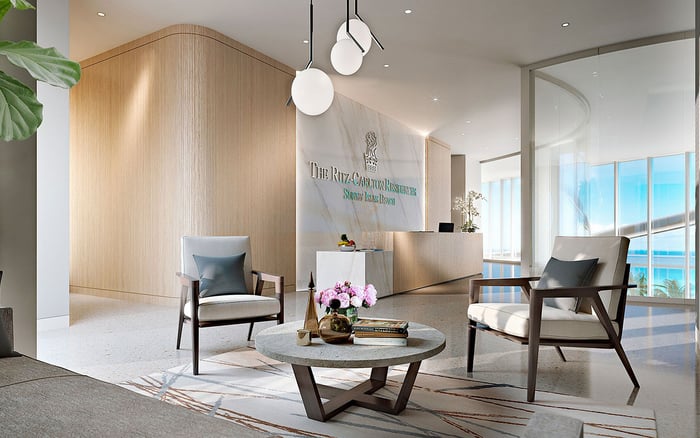
Winter ownership at The Estates at Acqualina should be evaluated as an operational experience. Buyers need written clarity on service capacity, dining reservations, guest privileges, privacy, and response standards when demand is highest.

At The Estates at Acqualina Sunny Isles, the ownership proposition extends beyond an ocean-view residence. The development pairs private residential living with Acqualina-branded resort hospitality, making service infrastructure an essential part of the asset rather than a peripheral convenience.
That distinction matters when evaluating winter use. Peak demand should be treated as an operational stress test-not as evidence that crowding, delays, or restrictions will occur. The relevant question is whether the experience promised throughout the year remains consistent when more owners, resort guests, family members, and visitors may seek hospitality services at the same time.
For an ultra-premium buyer, finishes and views remain important. Yet winter satisfaction may depend just as much on reservation protocols, staffing capacity, privacy controls, and the practical separation between residential and resort experiences.
Service is central to the development's positioning. Buyers should therefore examine how residential requests are received, prioritized, and fulfilled during periods of elevated demand. The objective is not simply to count personnel, but to understand the operating structure behind the visible service.
Ask who handles owner requests, whether residential teams are distinct from resort teams, and how requests move between departments. Written response standards carry more weight than broad assurances. Holiday staffing plans, escalation procedures, valet operations, package handling, housekeeping availability, and in-residence service all warrant specific questions.
This is especially relevant for second-home owners, who may arrive expecting the residence to function immediately after an absence. Pre-arrival preparation, provisioning, maintenance checks, and transportation coordination can shape the first hours of a stay. Buyers should establish which services are included, which require advance notice, and which carry separate charges.
Dining is a practical measure of a resort-residential model. Ownership may provide proximity to hospitality venues, but proximity alone does not establish reservation priority, guaranteed tables, preferred seating, or access for unaccompanied guests.
A buyer should request the current dining policy in writing. Relevant details include reservation windows, cancellation terms, holiday procedures, private-event limitations, room-service eligibility, and whether owner privileges differ by venue. If family members or household staff will make arrangements, confirm who may place or modify reservations on the owner's behalf.
The right inquiry is not whether a restaurant is popular, but whether its reservation system aligns with the owner's expected pattern of use. A household that plans dinners weeks in advance has different needs from one that values spontaneity. That distinction can materially affect the lifestyle experience.
Guest access sits at the intersection of hospitality and privacy. The Estates at Acqualina emphasizes exclusivity, while its association with the neighboring resort creates potential overlap between residential and resort experiences. Owners should understand precisely where those experiences connect and where they remain separate.
Request rules governing guest registration, vehicle arrival, valet use, residential entry, dining, beach and pool access, and any limits on visitor numbers. Confirm whether the owner must be present, whether overnight guests are treated differently from day visitors, and whether advance-registration requirements change during holidays or other high-demand periods.
Families should also ask how access applies to adult children, caregivers, security personnel, assistants, and recurring guests. These are not minor administrative details. They determine whether a household can entertain naturally while preserving the controlled environment expected of an ultra-luxury oceanfront residence.
Sunny Isles Beach offers several high-end residential choices, but a useful comparison should consider operating philosophy as closely as architecture. Buyers evaluating St. Regis® Residences Sunny Isles, The Ritz-Carlton Residences® Sunny Isles, or Turnberry Ocean Club Sunny Isles can apply the same framework: identify who delivers services, which spaces are residential, and how owner and guest privileges are documented.
Within the broader branded-residences category, a recognizable hospitality identity does not replace due diligence. Each property's governance, access rules, staffing structure, and amenity protocols may shape daily ownership differently. Comparisons are most meaningful when measured against how a buyer actually intends to live.
Before purchasing, request current governing documents and written operating policies relevant to the home's intended use. Focus on restaurant reservations, guest registration, amenity access, holiday staffing, valet procedures, beach and pool seating, and service-response expectations.
Then test those policies against realistic scenarios. Can visiting family dine without the owner? Who coordinates a late arrival? How are multiple vehicles handled? What happens when preferred seating is unavailable? Is there a clear escalation point for an urgent residence request?
Policies can change, so buyers should also understand how updates are communicated and who has authority over them. The goal is not to eliminate every variable, but to determine whether the service culture, access framework, and privacy standards support the household's expectations when the residence matters most.
Does ownership guarantee priority at every dining venue? No such guarantee should be assumed. Buyers should request current written reservation and priority policies for each relevant venue.
Are residential services separate from resort services? The development combines private residential living with resort hospitality, but buyers should confirm which teams and services are dedicated to residents.
Should buyers expect slower service during winter? Slower service should not be treated as an established fact. Instead, ask for peak-period staffing plans and written response standards.
Can guests use the beach and pool without an owner present? Access should be verified under the current guest policy, including owner-presence requirements and any registration procedures.
What dining questions matter most? Confirm booking windows, holiday rules, cancellation terms, owner priority, private-event closures, and guest eligibility.
How should a buyer evaluate valet operations? Ask about guest vehicles, multiple-car households, advance notice, high-demand procedures, and escalation contacts.
Why is guest registration important? It affects both convenience and privacy by defining who may enter residential and hospitality spaces-and under what conditions.
What should seasonal owners arrange before arrival? Confirm availability, notice periods, and fees for residence preparation, provisioning, maintenance checks, and transportation coordination.
Can amenity policies change after purchase? Operating policies may change. Buyers should review governance documents and ask how revisions are approved and communicated.
What is the central winter due-diligence question? Determine whether the service infrastructure, dining framework, and guest rules align with the household's actual pattern of use.
For a tailored shortlist and next-step guidance, connect with MILLION.
If branded residences are on your mind — as a home or as an allocation — we would be glad to share what we are seeing, privately.
Begin a quiet conversation