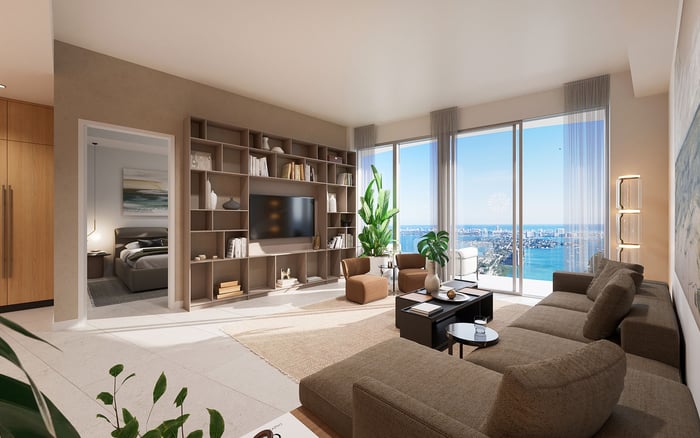
An Edgewater residence’s resale appeal depends on more than its asking price. Transaction depth by bedroom count, the precise water-view corridor, floor positioning and recurring ownership costs offer a more disciplined way to evaluate the next buyer’s choices.

In Edgewater, an attractive asking price is a starting point, not a complete investment thesis. The more revealing questions are who will want the residence when it returns to market, which alternatives they will consider, and what ownership costs they will accept. A discount alone cannot establish that depth of demand.
Buyer-pool depth is the breadth of plausible purchasers for a particular residence at a realistic price and ownership budget. Bedroom count provides an initial filter; the exact layout, view line, floor and recurring expenses refine it. For a luxury buyer, the objective is not necessarily to purchase the most commonly traded configuration. It is to understand whether the residence’s distinguishing qualities have a credible resale audience.
These factors can matter more than a headline asking price when assessing value. They do not make price irrelevant, and this framework does not establish a statistical ranking of their influence.
Begin by reviewing completed Edgewater sales by bedroom count over a clearly defined period. Then compare that activity with the competing inventory in each category. This separates the question of what has traded from the question of what a future buyer can choose.
Sales share measures completed transactions, not the number of qualified buyers waiting. A configuration’s larger share does not establish that every residence in that category sells faster. It must be considered alongside competing listings, marketing time and pricing.
Historical neighborhood median prices can provide context, but they are not present-day valuations for a particular tower or stack. For sellers, the practical lesson is to compete with available alternatives rather than anchor to the original purchase cost.
An expansive residence should be evaluated against alternatives with comparable privacy, views and spatial utility. Neighborhood totals cannot tell a buyer whether a particular large home is scarce relative to demand or simply expensive relative to its substitutes.
When considering Villa Miami, for example, define the proposed residence’s comparison set before applying neighborhood statistics. Establish which layouts and ownership budgets genuinely overlap. The project name alone does not demonstrate resale liquidity, and smaller-unit transaction activity cannot answer the question for a larger residence.
A water-view description is too broad to serve as a valuation category. Edgewater resale analysis should distinguish the exact unit line or stack, the outlook from the principal rooms and the protection of that view. Two residences with the same bedroom count need not offer equivalent experiences.
A residence’s appeal may depend on a particular combination of privacy and outlook rather than size alone. Treat those qualities as comparison criteria, not as proof of a premium.
When considering Aria Reserve Miami, request evidence specific to the line under consideration rather than treating the entire address as one comparable. Examine the actual view corridor and investigate whether its apparent openness is protected. An unobstructed view today does not establish permanence.
Apply the same discipline at The Cove Residences Edgewater: compare the exact residence with alternatives offering a similar outlook, rather than relying on a general waterfront label. These are due-diligence questions, not claims of a measured project premium.
Higher floors deserve analysis alongside the view corridor. Ask whether additional elevation meaningfully changes the outlook from the principal rooms, rather than treating height as an independent guarantee of value.
That distinction prevents a common valuation error: turning a floor number into a universal premium. A higher asking price needs support from closely matched comparisons, not simply a higher elevator stop.
When evaluating EDITION Edgewater, isolate the floor and view under consideration before drawing conclusions about value. Ask what the additional elevation actually changes and whether comparable transactions support the price difference. Neither a recognizable name nor height alone guarantees a resale advantage.
Recurring costs are part of the next buyer’s decision. Use the residence’s actual association charges rather than a neighborhood estimate when evaluating the ownership budget.
Property taxes and insurance require separate attention. A meaningful comparison should include a buyer-specific tax estimate, applicable insurance coverage and assessment obligations. The seller’s existing expense profile is not a complete forecast for the purchaser.
Before evaluating a price concession, request the association budget, reserve information, assessment details and relevant inspection findings. Review insurance and maintenance expenses, and ask whether reserve funding or recertification findings could affect future costs. These are document-review questions, not grounds for blanket assumptions about every older property.
A lower acquisition price and a sustainable ownership budget are different propositions. Consider both, including the possibility of higher recurring expenses over the intended holding period.
A neighborhood-wide inventory headline cannot resolve a unit-level purchase. Check the period and coverage of any supply estimate before applying it to a specific residence.
Instead, assemble a comparison set by bedroom count, usable layout, view corridor, floor positioning and ownership budget. Separate completed sales from asking prices. Then examine competing inventory and marketing time within that set before making a claim about resale speed.
The strongest purchase need not have the lowest asking price or the broadest possible audience. It should have a defensible price, a clearly understood ownership burden and distinguishing qualities a future buyer can recognize. In Edgewater, that is a more durable definition of value than a discount viewed in isolation.
For a considered approach to Edgewater residences and ownership decisions, explore MILLION.
If branded residences are on your mind — as a home or as an allocation — we would be glad to share what we are seeing, privately.
Begin a quiet conversationIt means the breadth of plausible purchasers for a particular residence at a realistic price and ownership budget. Transaction activity helps frame the question but does not directly count qualified buyers.
Review completed sales over the same period and compare them with competing inventory in each category. Neighborhood transaction totals alone cannot establish demand for a specific residence.
No. Resale speed also requires analysis of comparable inventory, marketing time and pricing.
No. They provide context, but a specific residence needs comparisons matched to its building, layout, view, floor and ownership costs.
Size alone does not establish that conclusion. Larger residences require a targeted comparison of demand and competing alternatives.
The line helps define the specific outlook being purchased. Equal bedroom counts do not make residences with different view corridors interchangeable.
No. Evaluate what additional elevation changes about the outlook and whether closely matched transactions support the price difference.
Verify the actual charges for the individual residence and review the association budget, reserves and assessment details. Do not substitute a neighborhood estimate for unit-specific information.
Include actual association charges, a buyer-specific property tax estimate, applicable insurance and assessment obligations. Reserve funding and inspection findings also deserve review.
For evaluating value, the view, configuration and ownership burden can be more revealing than the headline ask. This framework does not establish that these factors statistically outweigh price.