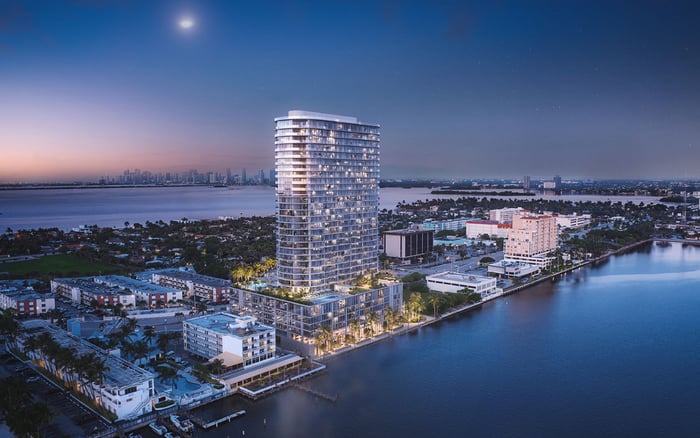
For Montreal buyers considering a South Florida residence, North Bay Village can support a focused comparison of privacy, building services, waterfront lifestyle, governance, and ease of remote ownership. The right choice depends on project-level diligence rather than broad assumptions about the neighborhood.

For Montreal buyers, the appeal of a North Bay Village residence may depend as much on ownership logistics as on design. A second home should be straightforward to secure, maintain, prepare for arrival, and monitor during extended absences.
No-frictions ownership does not mean ownership without obligations. It means selecting a residence where responsibilities, costs, permissions, and service expectations can be identified before closing. Buyers should examine the building and governing documents rather than assume that every residence offers the same operating model.
Privacy is shaped by more than a residence's floor plan. Entry procedures, guest access, package handling, parking controls, staffing, maintenance protocols, and rules governing resident conduct all influence the daily experience.
A buyer planning to occupy a home seasonally should ask how the building handles visitors, vendors, deliveries, emergencies, and access during an owner's absence. These questions can reveal whether a project's service structure supports discretion or creates avoidable coordination.
Rental policies also require careful review. Municipal requirements and condominium restrictions are separate layers of diligence, and buyers should confirm both before relying on any rental strategy. The intended use of the residence should be compatible with the building's governing documents and management practices.
Service has practical value when it limits the number of tasks an owner must manage from another city. Buyers can evaluate how a property handles residence checks, housekeeping access, repairs, storm preparation, deliveries, vehicle readiness, and after-hours issues.
The scope of service should be confirmed in writing. Marketing language alone does not establish which services are included, separately charged, available on demand, or subject to change. Staffing, response procedures, reservation systems, and owner responsibilities deserve the same attention as amenities.
North Bay Village buyers can use Continuum Club & Residences North Bay Village, Shoma Bay North Bay Village, and Tula Residences North Bay Village as starting points for a project-by-project comparison.
The comparison should move beyond architecture and branding. Relevant considerations include governance, access, staffing, maintenance responsibilities, rental restrictions, insurance, reserves, recurring fees, and the process for managing the residence while it is unoccupied.
Waterfront positioning can strengthen the lifestyle appeal, but it does not replace diligence. Buyers should verify the rights, services, amenities, and costs attached to the specific residence under consideration.
A practical ownership plan begins with the buyer's intended use. The residence may serve primarily as a seasonal retreat, a family base, or a longer-term South Florida home. Each purpose creates different priorities for storage, privacy, guest access, maintenance, and rental flexibility.
Before purchasing, buyers should identify who will hold keys, authorize vendors, inspect the residence, respond to building notices, and coordinate urgent work. They should also review the condominium declaration, current financial materials, insurance information, management procedures, and applicable use restrictions with qualified advisers.
For a Montreal buyer, the strongest North Bay Village choice is therefore not necessarily the property with the longest amenity list. It is the residence whose governance, service model, privacy standards, and ongoing obligations align most closely with the owner's plans.
Why might a Montreal buyer consider North Bay Village? It can be evaluated as a South Florida option for buyers who prioritize waterfront living, privacy, service, and manageable seasonal ownership.
What does no-frictions ownership mean? It describes an ownership structure in which responsibilities, services, permissions, and costs are clear enough to manage with fewer avoidable complications.
Does no-frictions ownership eliminate owner responsibilities? No. Owners still need to understand building rules, financial obligations, insurance, maintenance, and applicable use restrictions.
How should buyers evaluate privacy? They should review access controls, visitor procedures, staffing, package handling, parking practices, and rules governing resident conduct.
Why do rental rules require separate diligence? Municipal requirements and condominium restrictions can apply independently, so buyers should confirm both before adopting a rental plan.
What building services matter for a seasonal owner? Residence checks, vendor access, housekeeping coordination, repair oversight, delivery handling, storm preparation, and emergency response may all be relevant.
Should buyers rely on amenity descriptions? No. They should verify availability, access rights, fees, staffing, reservation procedures, and any limitations in the applicable documents.
How should the featured North Bay Village projects be compared? Compare governance, service standards, privacy, maintenance responsibilities, rental restrictions, insurance, reserves, and recurring costs.
Why are governing documents important? They help define permitted uses, owner obligations, building authority, and the rules affecting day-to-day ownership.
What is the final test for a suitable residence? The property's operations, costs, governance, and services should fit the buyer's intended use and tolerance for remote coordination.
If you'd like a private walkthrough and a curated shortlist, connect with MILLION.
If branded residences are on your mind — as a home or as an allocation — we would be glad to share what we are seeing, privately.
Begin a quiet conversation