Miami Beach can work for young families who want coastal routines, cultural depth, healthcare access, and an international urban rhythm, provided they approach neighborhood fit and climate diligence with precision.
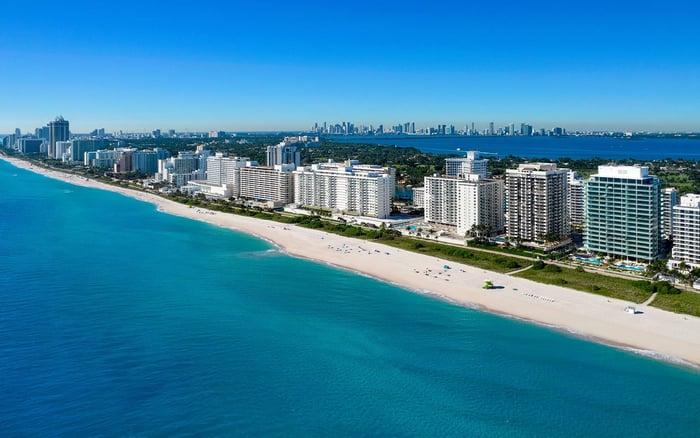
Miami Beach is often read from the outside as a place of hotels, restaurants, nightlife, and winter escape. For young families evaluating South Florida with a more permanent lens, that shorthand is incomplete. The city is a barrier-island municipality set between the Atlantic Ocean and Biscayne Bay, with daily beach access on one side and causeway connections to mainland Miami on the other. That geography creates a rare residential proposition: resort-level outdoor life without giving up urban connectivity.
The city is not merely seasonal. With roughly 80,000 residents, Miami Beach functions as a year-round municipality with neighborhoods, schools, parks, healthcare, civic institutions, and routines that extend well beyond hospitality. For families who want a refined base rather than a quiet suburban model, the appeal is in that balance. Morning beach time, an after-school museum visit, a nearby hospital, a free local trolley, and a direct route to Miami International Airport can all be part of one family operating system.
The strongest case for Miami Beach is not that it imitates the suburbs. It does not. Its strength is that it offers a cultural childhood in a coastal city. The Miami Beach Architectural District gives families a walkable historic environment, where design and streetscape become part of daily awareness. Art Basel Miami Beach adds an annual international art moment, while The Bass, the New World Symphony, and the Miami Beach Botanical Garden create recurring opportunities for education, performance, and low-friction cultural outings.
For parents, this matters because culture is not an occasional excursion requiring a full-day drive. It can be folded into the week. A child can grow up with orchestral programming, contemporary art, subtropical gardens, beach ecology, and architectural history as background rather than novelty. That is a different proposition from a school-district-first suburb, and it will not suit every household. But for internationally mobile families, founders, collectors, designers, and executives who want children raised with urban fluency, Miami Beach has a persuasive rhythm.
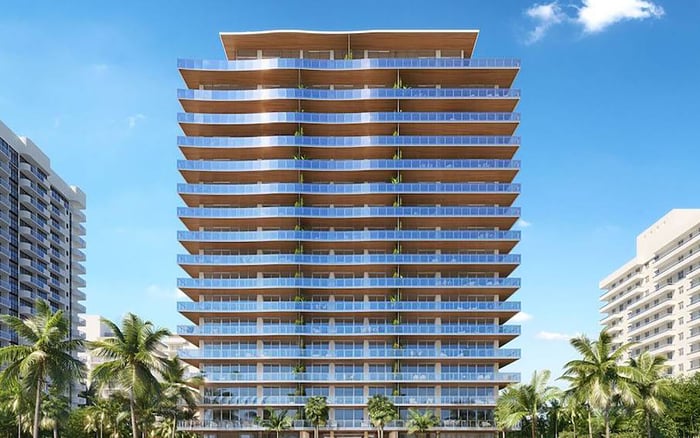
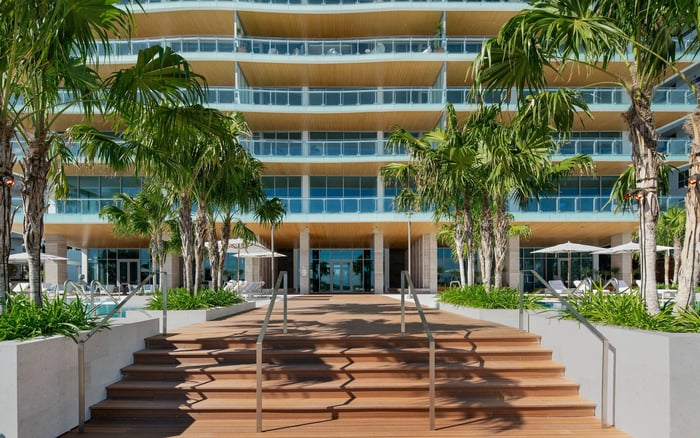
The residential layer increasingly reflects that preference for composed coastal living. Along the oceanfront, 57 Ocean Miami Beach is one of the names buyers may consider when they want the beach to be part of the daily routine, not simply a weekend amenity. In a different register, The Perigon Miami Beach speaks to demand for a quieter, highly designed form of Miami Beach living, where privacy and proximity can be weighed together.
The city’s everyday family infrastructure is more substantial than its reputation suggests. Miami Beach Parks & Recreation operates parks, facilities, camps, athletics, and youth programs, which can be crucial for families with toddlers, school-age children, and visiting grandparents. The free Miami Beach trolley system adds a no-fare local mobility option across multiple routes, reducing the need to drive for every short trip.
Healthcare access is another significant point. Mount Sinai Medical Center is located in Miami Beach, giving island residents access to a major local hospital and medical network without leaving the city. For families with young children, proximity to emergency care, specialists, and routine medical appointments can matter as much as views or amenities.
Education requires a nuanced view. Miami Beach families are served by Miami-Dade County Public Schools, one of the largest public school systems in the United States. Many luxury buyers will also assess private, magnet, charter, and specialized options across the broader county, depending on a child’s age, commute tolerance, and educational goals. The correct approach is not to assume Miami Beach is either ideal or unsuitable for schools. It is to map the actual family schedule, from drop-off logistics to after-school programming and airport travel.
For families dividing time between Miami, New York, London, Latin America, or the Caribbean, Miami International Airport is central to the value proposition. Miami Beach is not isolated coastal living. It is an island base connected to a major global air gateway, a point that matters for households with multiple homes, extended family abroad, or parents who travel frequently.
Neighborhood selection is the defining decision. South Beach, Mid-Beach, North Beach, and private-island enclaves can feel like different cities. Density, nightlife exposure, walkability, privacy, school routes, beach access, and bridge proximity all shift meaningfully from one pocket to another.
South Beach offers walkability, architecture, restaurants, cultural access, and civic energy. It can be rewarding for families who like movement and do not want car dependency to define the day. Yet buyers must be selective about micro-location, building positioning, and noise patterns. A residence near the Convention Center District, for example, may benefit from civic and events infrastructure, but families should understand how major exhibitions and public programming affect traffic and the weekly rhythm.
Mid-Beach often appeals to families seeking a calmer coastal experience while staying close to the cultural core. North Beach can offer a more residential cadence, depending on the specific block and building. Private-island settings may prioritize discretion, bay views, and controlled access, though they often trade some walkability for privacy.
This is where building choice becomes part of family strategy. Five Park Miami Beach may enter the conversation for buyers who want a contemporary condominium option within the broader Miami Beach lifestyle. The Ritz-Carlton Residences® Miami Beach may appeal to households considering a more serviced residential environment on the water. The point is not to choose by brand or brochure, but by how the building supports school mornings, stroller life, guests, wellness, privacy, and storm planning.
For family buyers, Miami Beach’s beauty comes with obligations. Long-term ownership should include careful review of elevation, flood zone exposure, insurance, association reserves, building systems, hurricane protocols, garage location, backup power, and access routes after heavy rain. The city’s resilience work focuses on flooding, sea-level rise, stormwater infrastructure, and long-term adaptation, making these issues central rather than peripheral.
This is especially important for buyers moving from markets where floodplain management is not a daily ownership concern. A refined Miami Beach purchase is not only about finishes, views, and amenities. It is also about how a building performs, how its association plans, and how comfortably a family can remain there through South Florida’s weather cycles.
That diligence should not be viewed as a deterrent. It is simply the mature version of buying well on a barrier island. The best family decisions combine the emotional appeal of oceanfront life with a disciplined review of risk, cost, and resilience.
Miami Beach works best for young families who value culture, walkability, design, water, and international access. It is less ideal for those seeking maximum quiet, large yards, and a conventional suburban school corridor as the primary organizing principle. Its family appeal is sophisticated rather than obvious.
For the right household, however, the city can provide a remarkable childhood setting: beaches for daily outdoor play, museums and music close to home, parks and camps in the municipal fabric, healthcare on the island, and quick access to mainland Miami. It is a South Florida base for families who want their children to grow up near the water, but also near ideas, architecture, performance, and global movement.
Is Miami Beach practical for young families? Yes, for families who want urban coastal living with parks, culture, healthcare, transit, and airport access. It is not a conventional quiet suburb, so neighborhood fit matters.
Does Miami Beach have year-round residents? Yes, it is a permanent municipality with roughly 80,000 residents. That gives it a civic and residential structure beyond seasonal tourism.
What makes the location useful for families? Miami Beach sits between the Atlantic Ocean and Biscayne Bay, offering beach life and causeway access to mainland Miami. That combination supports both recreation and mobility.
Are there cultural activities for children? Yes, families can incorporate institutions such as The Bass, the New World Symphony, and the Miami Beach Botanical Garden into regular routines. Art Basel Miami Beach also reinforces the city’s cultural stature.
How should buyers compare South Beach and Mid-Beach? South Beach is generally more energetic and walkable, while Mid-Beach can feel calmer and more residential. The exact block and building position are critical.
Is healthcare access available on the island? Yes, Mount Sinai Medical Center is located in Miami Beach. For young families, nearby medical access can be a meaningful quality-of-life factor.
Do families need a car in Miami Beach? Many households still use cars, but the free trolley system and walkable pockets can reduce short local drives. Daily needs depend heavily on school, work, and neighborhood choice.
What school factors should families evaluate? Families should review public school assignments, private options, commute times, and after-school logistics. Miami Beach is served by Miami-Dade County Public Schools.
What climate issues matter most for buyers? Flood insurance, elevation, stormwater exposure, hurricane planning, and building systems should be reviewed early. These are core ownership questions on a barrier island.
Who is Miami Beach best suited for? It suits families who value culture, ocean access, design, and global connectivity. Buyers seeking large lots and a quieter suburban routine may prefer other South Florida markets.
For a tailored shortlist and next-step guidance, connect with MILLION.
If branded residences are on your mind — as a home or as an allocation — we would be glad to share what we are seeing, privately.
Begin a quiet conversation