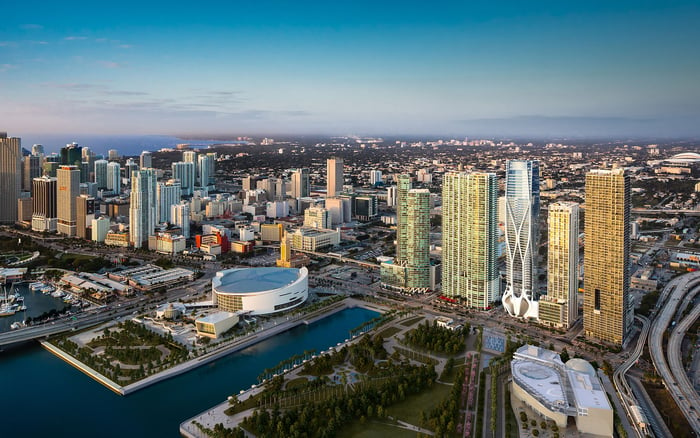
For frequent travelers and second-home owners, Downtown Miami airport access is only one part of the decision. The more revealing measure is the complete journey from terminal curb to residence door, including traffic, driver staging, valet release, security clearance, luggage handling, and elevator access.

For buyers who divide their time among cities, airport access can influence how a Downtown Miami residence feels in daily use. Mileage and an estimated drive time offer only a partial picture. The practical journey continues through the final approach, curb access, luggage handoff, resident verification, elevator call, and arrival at the unit.
For a buyer comparing Aston Martin Residences Downtown Miami with other central addresses, the relevant clock should not stop when the vehicle reaches the neighborhood. The complete sequence determines whether a seemingly convenient location delivers a calm and repeatable arrival.
In luxury real estate, the shortest route is not always the easiest arrival.
Travel conditions can change with the hour, route, weather, roadway activity, and exact destination. The building’s entrance may introduce another variable. A route that feels straightforward during a quiet period may perform differently when resident traffic, deliveries, guests, and car services converge.
A purchaser should test representative travel windows rather than rely on a single demonstration. Consider an early departure, an evening return, and an arrival during a busy Downtown period. The purpose is not to predict every trip but to identify the conditions that make the journey less dependable.
Alternative transportation also requires a door-to-door review. A transit option may avoid some road congestion while introducing luggage handling, transfers, walking, or another local connection. Buyers should assess the complete movement from terminal to lobby instead of comparing only the central portion of each route.
A smooth airport transfer can still end in confusion if the driver cannot approach the entrance efficiently. Chauffeured service makes curb design and operating procedures especially important. The quality of the experience depends on where vehicles wait, how pickups are coordinated, and whether arriving and departing cars can move without blocking one another.
Driver staging is more than the appearance of a porte-cochère. Buyers should ask where a chauffeur waits before collection, whether rideshare vehicles share the resident lane, how luggage is handled, and whether service vehicles follow a separate path. They should also determine who communicates with the driver and what happens when the resident is delayed.
When considering Waldorf Astoria Residences Downtown Miami or Casa Bella by B&B Italia Downtown Miami, purchasers should investigate the applicable procedures directly. Branding, architecture, and asking price cannot replace property-specific answers about pickup coordination, garage entry, vehicle retrieval, and after-hours assistance.
Busy periods can reveal constraints that remain hidden during an ordinary showing. Increased demand for vehicles, guest arrivals, deliveries, and service activity may place competing demands on the same entrance. Rather than assume a fixed traffic penalty, buyers can use event-week conditions as a practical stress test.
Observe the arrival area when demand is elevated. Note whether incoming cars impede departures, whether staff follow a clear release sequence, and whether drivers can wait without repeatedly contacting the resident. Ask how guest authorization is managed when the lobby and curb are busy and whether residents receive operational guidance when access patterns change.
A polished entrance does not answer these questions. The important issue is how the property functions when several needs overlap. Staffing, communication, lane design, garage controls, and elevator access should work as a coordinated system.
The same examination applies to nearby Brickell. A buyer assessing The Residences at 1428 Brickell should distinguish neighborhood travel from property processing. Garage gates, shared loading activity, valet procedures, or elevator transfers can add friction after the regional journey is complete.
For a second-home owner, lock-and-leave performance is an operating system rather than a marketing phrase. The chain may include airport transfer, curb access, vehicle handling, guest authorization, elevator control, vendor access, and after-hours staffing. Security, storm procedures, unit monitoring, and access protocols should be confirmed through current property documentation.
A useful review begins with realistic scenarios. Can an authorized household member arriving late be cleared efficiently? How is a guest admitted when the owner is away? Where can luggage wait if immediate unit access is unavailable? What happens when a vehicle is requested during a busy shift? How are vendors authorized, directed, and supervised?
These questions matter because absence can magnify small operational failures. An owner who is frequently away depends on the property’s staff and systems to manage access without creating unnecessary exposure or delay. Buyers should identify which services are formal obligations, which are customary practices, and which require advance coordination.
Asking price remains important, but operational inconvenience repeats. Instead of assigning a universal financial value to time, buyers can build a personal time ledger based on their own travel patterns. Include airport arrivals, departures, chauffeur pickups, guest visits, luggage movements, and vehicle requests.
Record observed delays rather than relying solely on sales assurances. Note whether the difficulty is occasional or built into the physical design and operating model. A temporary traffic issue may be manageable, while a narrow approach, unclear staging plan, or complicated elevator transfer may affect many journeys.
The comparison should reflect personal priorities. A household that travels frequently may place a higher value on predictable release times and direct staff communication. Another buyer may care more about guest processing or secure vendor access during extended absences. The objective is to identify the recurring friction that matters to the intended pattern of ownership.
Visit under different conditions, including a busier arrival period when possible. Time the movement from curb to unit and observe a vehicle request from initiation through release. Confirm whether residents, guests, rideshare drivers, chauffeurs, deliveries, and service providers follow distinct procedures or share the same limited space.
Review guest authorization, staffing coverage, garage access, luggage handling, elevator transfers, and contingency protocols. Request current written rules where available and verify which procedures apply to owners, household members, guests, and vendors.
Frame questions around specific situations: a delayed flight, an owner traveling abroad, a vehicle carrying several passengers and suitcases, an early departure, or simultaneous guest arrivals. Scenario-based questions tend to reveal handoffs and exceptions that broad promises of convenience may overlook.
Finally, separate observable conditions from assumptions. Building procedures can change, and practices described during a sales presentation may not reflect every operating period. Current documentation and direct confirmation from the appropriate property representatives are essential.
The strongest Downtown Miami choice is not necessarily the residence with the most persuasive headline price. For a frequent traveler or second-home owner, the better fit may be the property that protects time, privacy, and composure across repeated arrivals and departures.
For discreet guidance comparing Downtown Miami residences through financial and operational criteria, consult MILLION.
If branded residences are on your mind — as a home or as an allocation — we would be glad to share what we are seeing, privately.
Begin a quiet conversationIt accounts for the full journey, including the building approach, curb access, luggage handling, security clearance, and elevator movement.
Buyers should test representative travel windows that match their household’s likely departures and returns, including busier periods when practical.
Driver staging is the process or designated place where chauffeurs and car services wait before collecting a resident.
They should watch how arriving, departing, rideshare, delivery, and service vehicles share the curb or porte-cochère.
They can reveal how the property manages competing demands on the entrance, valet operation, lobby, and elevators.
It can be, but buyers should assess transfers, luggage handling, walking, weather exposure, and the final connection to the residence.
The review should cover guest and vendor authorization, staffing, garage access, luggage handling, elevator controls, security, and contingency procedures.
Unclear pickup procedures, shared lanes, or slow vehicle release can add friction after the main journey is complete.
A purchase price is negotiated at a point in time, while operational friction may recur throughout ownership.
They should request current written rules where available and confirm building-specific practices with the appropriate property representatives.