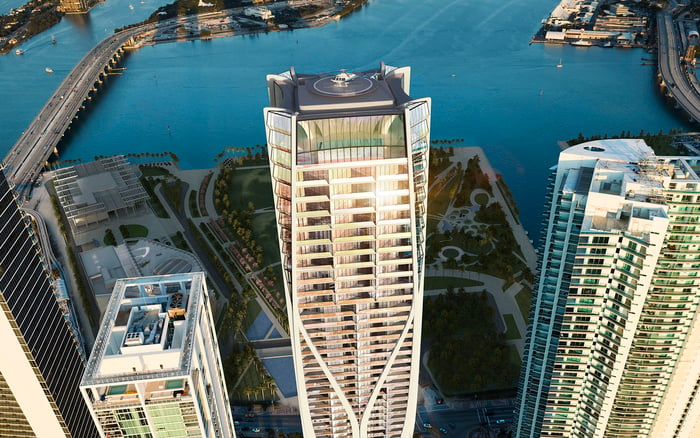
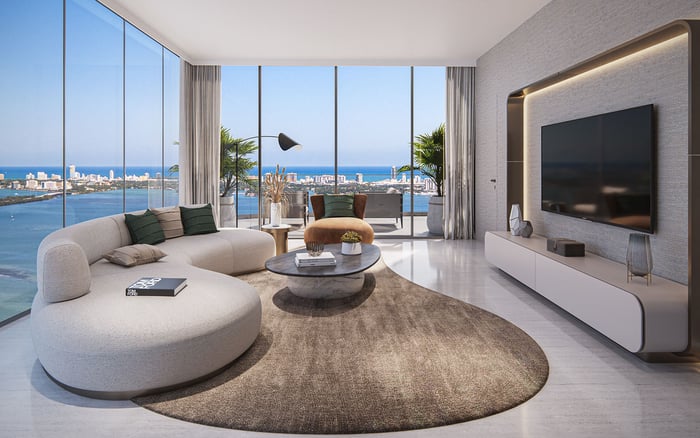
For Edgewater buyers with significant art collections, ownership costs extend beyond monthly dues. Freight access, delivery protection, contractor documentation, environmental requirements, and installation approvals deserve a written plan before closing.

An Edgewater residence may offer the right proportions for a collection, but the ownership budget must account for more than the wall on which a painting will hang. Between the delivery truck and the final installation lie loading arrangements, elevator reservations, protective materials, contractor paperwork, and potentially several layers of approval.
These are not necessarily extraordinary expenses. They are operational details that can become costly when left unresolved until delivery day. A prudent buyer treats art access as part of property due diligence, alongside monthly assessments and alteration rules.
For buyers considering Aria Reserve Miami, the question is not simply whether a residence accommodates the collection visually. It is whether management can confirm a workable route, schedule, and installation process for the actual pieces. Make that inquiry independently at every property; no project-specific policy is implied here.
Do not assume that monthly association dues cover an individual art delivery. Obtain the applicable association budget and fee schedule for the residence rather than relying on a neighborhood estimate.
Request a current written schedule distinguishing fees, deposits, cancellation charges, overtime, and damage charges. Ask whether loading supervision, elevator protection, and post-installation repairs are included or billed separately. Do not assume a neighborhood-wide freight or installation tariff applies.
The distinction matters: a refundable deposit, a nonrefundable charge, and a mover’s waiting-time invoice affect the ownership budget differently.
A large elevator is only one part of a successful delivery. The route review should begin at the loading area and continue through elevator doors, the cab, corridors, fire doors, turns, and the residence entrance to the intended installation location.
A crate can fit inside an elevator yet fail to negotiate a corridor corner or door swing. Use actual packed dimensions-not the artwork’s display dimensions-when asking the mover and building team to assess access. Elevator capacity also belongs in that review.
When evaluating EDITION Edgewater, make this a residence-specific exercise rather than an assumption based on a floor plan. Request confirmation of the available elevator, permitted staging locations, and required common-area protection. Floor coverings, wall padding, corner guards, and elevator protection can all create charges for the owner or contractor.
A pre-purchase mock delivery review offers an opportunity to resolve these questions before ownership begins.
Buildings may require advance service-elevator reservations and restrict deliveries to designated windows. Confirm the required notice, permitted hours, reservation procedure, and cancellation terms before booking the art handler.
Coordination with management, security, concierge staff, and elevator personnel can increase labor or waiting-time charges. A delivery quote should therefore specify what happens if access is delayed, the reserved window is missed, or the crew must return.
After-hours delivery is not a universal solution. Depending on the building, it may require special approval, premium labor, or additional security staffing. Obtain written confirmation before making it part of the plan.
For a buyer considering Villa Miami, the same discipline applies: align the mover’s booking with the building’s confirmed arrangements, not merely a preferred arrival date. The objective is a coordinated appointment, with responsibility for delays agreed in advance.
Climate control deserves its own inquiry, not an assumed allowance within the moving budget. Residential comfort and the requirements of a particular collection should be evaluated separately.
Ask the collection’s adviser or conservator to define the environmental requirements for the works involved. Then ask the appropriate building and mechanical professionals what can be documented for the proposed residence and any permitted staging location. Clarify who controls those spaces and whether the delivery plan accommodates the collection’s requirements.
Do not assign a generic climate-upgrade budget or assume a particular tower provides collection-specific conditions. Any proposed equipment or mechanical changes should receive a scope-specific review and quotation, together with confirmation of applicable building approvals.
The financial goal is to distinguish existing conditions from optional improvements and necessary work before committing funds. Resolve climate questions through documentation, not inferences drawn from a residence’s luxury positioning.
Hanging a work and altering a residence are not always the same task. Drilling, anchoring, lighting, electrical work, and millwork may trigger building review, particularly near structural or mechanical systems.
Condominium approval and any required public building permit are separate matters. Management may require review even when a public permit is unnecessary. Confirm permitting requirements for the actual scope with the relevant local authority rather than treating management consent as a substitute.
Likewise, routine service-elevator reservations should not be confused with elevator construction, alterations, or repairs. If a delivery proposal involves such work, verify the applicable approvals separately.
When evaluating a purchase at The Cove Residences Edgewater, ask for the alteration and contractor-access rules before finalizing an installation design. Buildings may require certificates of insurance, contractor registration, delivery details, and workers’ compensation documentation before admitting the crew. Align those requirements with the installer’s proposal.
Before closing, request the current delivery, move-in, renovation, insurance, contractor-access, and alteration rules rather than relying solely on the sales package. Then assemble a concise plan around the actual collection.
That plan should record the route, crate dimensions, elevator arrangements, staging permission, protection requirements, contractor documentation, installation approvals, and responsibility for access delays. Keep the building’s charges separate from the mover’s and installer’s quotations so omissions remain visible.
A residence is better suited to a collection when arrival and installation are as carefully considered as the display. Written answers make that suitability easier to judge and the ownership budget easier to understand.
For a considered approach to Edgewater ownership, explore residences with MILLION.
If branded residences are on your mind — as a home or as an allocation — we would be glad to share what we are seeing, privately.
Begin a quiet conversationNot necessarily. Elevator scheduling, loading access, protection, staging, documentation, and waiting time can add costs beyond transportation.
No. Request each building’s current written fees, deposits, cancellation terms, and overtime charges.
No. Corridor turns, fire doors, door swings, and the residence entrance can prevent access even when the crate fits inside the cab.
Buildings may require certificates of insurance, contractor registration, delivery details, and workers’ compensation documentation before admitting installers.
Do not assume they are. Ask whether elevator protection, floor coverings, loading supervision, and any repairs are included or separately billed.
That depends on the building. Special approval, premium labor, or additional security staffing may be required.
Define the collection’s environmental requirements and request documentation of relevant conditions and controls. Obtain scope-specific advice and quotations rather than assuming a standard upgrade cost.
No. Confirm any public permitting requirements separately with the relevant local authority; management review may also apply when a public permit is unnecessary.
Obtain the residence’s current association budget and applicable fee schedule. Separate recurring dues from delivery charges, deposits, and mover or installer quotations.
Use actual artwork or crate dimensions to review the full route, elevator arrangements, staging, protection, insurance, and installation approvals. Confirm responsibility for access delays in writing.