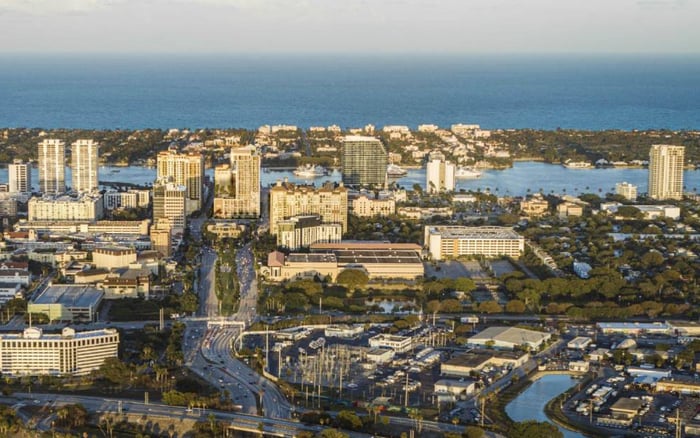
For a Seoul buyer, acquiring in West Palm Beach is only the beginning of a Florida domicile narrative. The strongest file aligns genuine residential use, formal declarations, legal documents, personal relationships and separate day-count analyses.

For a Seoul buyer, acquiring a residence in West Palm Beach can be both a refined residential choice and a consequential legal step. Ownership alone, however, does not establish Florida domicile. The central test is more personal: physical presence in Florida combined with the intention to make the state one’s permanent home.
Florida has no statutory requirement to spend “six months and a day” in the state before domicile can exist. More time in Florida may strengthen the factual record, but it cannot replace consistent conduct. The claimed domicile date should align with the actual move and the formation of an intent to remain. Later registrations and filings corroborate that event; they do not manufacture it retroactively.
This distinction matters for an international principal whose business, family or financial life may still span Seoul and other jurisdictions. Florida domicile, federal tax residency and residency under Korean or any former-state law are separate inquiries. A disciplined plan gives each its own analysis.
The residence is persuasive when the home, the documents and the calendar tell one story.
The most convincing property is not merely described as an investment or second home. It functions as the principal and permanent residence. Deed records, occupancy patterns, personal belongings, household operations and legal documents should all support that position.
Property selection can therefore have an evidentiary dimension. A buyer considering Alba West Palm Beach might evaluate not only its architecture and waterfront orientation, but also whether the residence can support year-round routines, secure document storage, household administration and meaningful personal occupancy.
The same principle applies to Forté on Flagler West Palm Beach. The relevant question is not whether a building appears suitable for domicile in the abstract. It is whether the owner actually uses the home as the center of an established Florida lifestyle.
The evidence grows stronger when recurring relationships move with the household. Florida physicians, professional advisers, clubs, religious organizations and other regular connections can demonstrate that life is centered locally. Core accounts should use the Florida address. When legally appropriate, a Florida driver’s license, Florida vehicle registration and voter registration can add further consistency. Voting evidence is relevant only for a buyer eligible to register.
Florida law allows a resident to record a sworn Declaration of Domicile with the circuit-court clerk in the county of residence. It provides formal, date-stamped evidence of intent, but it is not conclusive when the owner’s behavior points elsewhere.
A Florida homestead application can also reinforce the position by identifying the qualifying residence as the owner’s permanent home. Eligibility generally requires ownership and occupancy on January 1, and the regular application deadline is March 1. Cross-border buyers should coordinate advice before claiming homestead, particularly when title is held through a trust or entity.
Titling should be resolved before closing, not treated as an administrative afterthought. Individual, trust and entity ownership can interact differently with homestead, creditor-protection and estate-planning objectives. A residence such as Mr. C Residences West Palm Beach should be placed into a structure selected through coordinated Florida, international-tax and estate-planning review.
Wills, trusts, powers of attorney and health-care directives should identify Florida residence or domicile consistently. Contradictory documents can weaken an otherwise coherent file. So can retaining a permanent home and extensive personal ties in a former state without carefully addressing their continuing significance.
“183 Days” is not a universal rule. A Seoul-based buyer who is neither a U.S. citizen nor a green-card holder may become a U.S. federal tax resident under the substantial presence test, independently of Florida domicile. That test generally requires at least 31 U.S. days in the current year and 183 weighted days over three years. It counts all current-year days, one-third of prior-year days and one-sixth of second-prior-year days.
Certain days may be excluded, and a closer-connection exception may be available when every statutory requirement and filing obligation is met. These are technical determinations, not assumptions to draw from a travel calendar alone.
A former U.S. state may apply its own statutory-residency test even after Florida domicile has been established. New York, for example, focuses on whether a person maintains a permanent place of abode and spends more than 183 days there. Korean residence and tax questions likewise require separate Korean advice.
The practical response is to maintain distinct schedules for federal U.S. presence, the factual Florida domicile record and every relevant former-state rule. Days in Palm Beach cannot simply be entered into a single master total and treated as dispositive for every purpose.
A strong file has three connected layers. The first comprises formal Florida records, including the Declaration of Domicile and any appropriate licenses, registrations, homestead materials and estate documents. The second documents genuine residential use. The third provides contemporaneous support for each applicable day count.
The day log should be updated as travel occurs. Calendars and flight records provide the framework. Payment-card activity, mobile-location data and toll records can reconcile uncertain dates. Passports, itineraries and tax filings should be reviewed against the same chronology. The objective is not volume for its own sake, but a record in which independent items agree.
For a buyer evaluating The Ritz-Carlton Residences® West Palm Beach, household records may include evidence of recurring occupancy and ordinary administration. The point is not to stage a dossier around a luxury address. It is to preserve the routine records naturally created by a residence genuinely used as home.
The cleanest sequence begins before title transfers. Florida counsel, U.S. international-tax counsel, Korean advisers and estate-planning professionals can align ownership, relocation timing, filings and record retention. This coordination is especially important when the buyer has several residences, travels internationally with frequency, has family members following different calendars or maintains ties to a former state.
Florida’s lack of an individual state income tax and its homestead protections can make domicile economically meaningful. Neither feature eliminates federal tax exposure or a former jurisdiction’s claim. The more valuable the consequences, the more disciplined the supporting facts should be.
For discreet guidance on selecting a residence that fits a coordinated South Florida plan, connect with MILLION.
If branded residences are on your mind — as a home or as an allocation — we would be glad to share what we are seeing, privately.
Begin a quiet conversationNo. Domicile generally requires physical presence plus an intention to make Florida the permanent home.
No fixed Florida domicile rule requires six months and a day. More time in Florida can still strengthen the overall factual record.
It creates formal, date-stamped evidence of intent. It does not establish domicile by itself when the owner’s conduct points elsewhere.
Yes. A qualifying application identifies the property as the permanent home, subject to applicable ownership, occupancy and filing requirements.
The regular deadline is generally March 1, with ownership and occupancy ordinarily required on January 1.
No. Federal presence rules, Florida domicile and former-state residency tests are separate analyses with different standards.
It generally requires 31 U.S. days in the current year and 183 weighted days across three years, subject to exclusions and possible exceptions.
Calendars, flight records, payment-card activity, mobile-location data, toll records, passports and itineraries can help reconcile travel dates.
Yes. Wills, trusts, powers of attorney and health-care directives should align with the claimed Florida residence or domicile.
Yes. Individual, trust or entity ownership should be coordinated with homestead, creditor-protection, tax and estate-planning considerations.