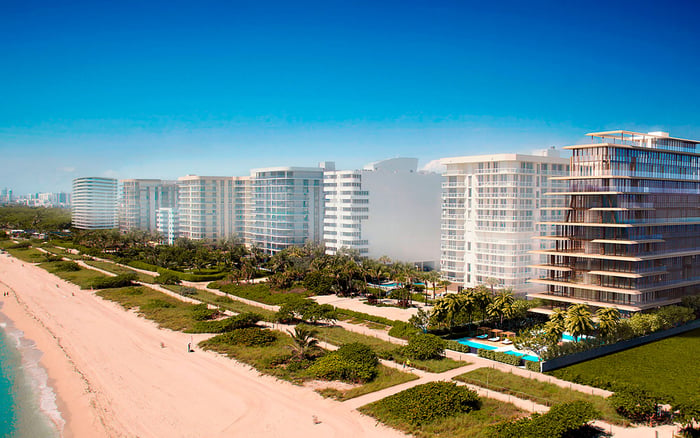
A disciplined Bal Harbour purchase begins well before closing. San Francisco buyers should separate offer-stage proof of funds from collected closing funds, map any currency conversion to contractual deadlines, and coordinate Florida escrow, remote signing, condominium records, insurance, and the final walkthrough as one integrated calendar.

For a San Francisco buyer, acquiring a residence in Bal Harbour may appear straightforward, particularly with an all-cash offer. Yet cash removes financing contingencies, not execution risk. The decisive questions are whether liquidity can be documented promptly, whether foreign currency can be converted into usable dollars on schedule, and whether Florida escrow receives cleared funds before the contractual deadline.
That discipline applies across the market, whether the target is Oceana Bal Harbour, Rivage Bal Harbour, or another waterfront residence. The purchase contract and the title company’s written instructions remain the controlling documents.
Proof of funds establishes credibility during the offer and inspection stages; it does not transfer money into escrow. A polished package typically includes an official bank letter, recent bank or brokerage statements, or custodial-account records showing liquid assets sufficient to cover the purchase price. The evidence should generally be dated within 30 days, and a serious cash buyer should be prepared to provide it promptly-often within 24 hours of a request.
Presentation matters in a discreet luxury transaction. A buyer can redact account numbers while keeping the name, financial institution, document date, and available balance visible. A clean PDF is preferable to a casual screenshot. Locked retirement assets generally do not qualify as readily available funds unless redeemed in advance, while a credit line or mortgage preapproval does not substitute for evidence of liquid cash.
The essential distinction is simple: proof of funds supports the offer; collected funds complete the closing.
Foreign-exchange planning becomes relevant only when some or all of the purchase capital is held outside the United States or denominated in another currency. A San Francisco address alone does not create FX exposure. The location and denomination of the funds do.
When staged deposits are required, each conversion and outbound wire should be mapped to its corresponding contractual payment. Foreign cash transactions in Bal Harbour commonly contemplate a 15% hard deposit, a 30- to 45-day diligence window, and an approximately 60-day closing timeline. These are planning references, not substitutes for the executed agreement.
The final tranche demands particular attention. Currency conversion, bank compliance review, outbound-wire processing, and receiving-bank cutoffs can all stand between an investment account and Florida escrow. Buyers should decide early whether to convert in stages or reserve the required dollar amount in advance, then confirm the title company’s wire cutoff before initiating the final transfer.
The same discipline applies when comparing Bal Harbour with nearby coastal options such as The Surf Club Four Seasons Surfside or Eighty Seven Park Surfside. The property may change, but the funding calendar must still follow the specific contract.
Florida title companies cannot treat a personal or cashier’s check as good funds merely because it has been delivered. The deposit must clear the escrow account. Advance funding or a properly timed wire is therefore central to a cash closing.
Before sending money, the buyer should independently verify wire instructions with the title company using a trusted telephone number. Real-estate wire instructions are fraud targets, so email alone should never be considered sufficient confirmation. The buyer should also confirm the amount, reference information, receiving account, cutoff, and procedure for acknowledging receipt.
Remote Online Notarization can allow an out-of-state buyer to complete identity verification and execute eligible documents during a scheduled video session, avoiding a trip to Florida solely for signatures. It should be arranged early enough to accommodate document review and any title-company requirements.
The broader closing file also includes condominium materials. Preparation may require an estoppel package, condominium documents, recent meeting minutes, and reserve information. At certain project milestones, the final payment may coincide with a certificate of occupancy, final walkthrough, and binding an HO-6 policy. The exact sequence varies, so the contract, association requirements, and written closing instructions should be reconciled within a single calendar.
If financing is involved, international buyers should coordinate vesting with legal and tax advisers early so the title and loan documents reflect the intended ownership structure. Even in a cash purchase, ownership decisions should not be deferred until documents are ready for signature.
Any buyer rebate also requires advance review. A closing credit is possible only when permitted by the representation agreement, applicable lender requirements, compensation received, and final closing terms. It should never be assumed to be available cash for the purchase.
First, assemble current evidence of liquid funds and protect privacy through careful redaction. Second, place deposits, diligence deadlines, FX conversions, and outbound wires on a single schedule. Third, verify Florida escrow instructions and cutoffs directly. Finally, coordinate remote notarization with condominium-document review, insurance, the walkthrough, and acknowledgment of final funding.
The result is not simply a faster closing. It is a more controlled one, with fewer dependencies left unresolved in the final days.
Does an all-cash offer eliminate closing risk? No. Escrow still requires cleared funds, and bank processing, compliance review, or missed cutoffs can delay receipt.
When should proof of funds be prepared? It should be ready at the offer stage and available during the inspection period, ideally for delivery within 24 hours of a request.
How recent should proof of funds be? A strong package is generally dated within 30 days and shows sufficient liquid assets for the purchase.
Can account numbers be redacted? Yes. Keep the buyer’s name, institution, date, and available balance visible while obscuring sensitive account numbers.
Does a preapproval count as cash proof? No. A credit line or preapproval is not the same as a dated statement or letter showing available liquid funds.
When does foreign-exchange planning matter? It matters when purchase capital is held in a foreign currency or outside the United States and must be converted or transferred.
Can a cashier’s check fund closing immediately? Not necessarily. Florida escrow cannot treat it as good funds until it clears, making advance delivery or a wire important.
Can documents be signed from San Francisco? Remote Online Notarization may permit identity verification and execution of eligible documents through a scheduled video session.
Which condominium materials should buyers expect? The file may include an estoppel package, condominium documents, recent meeting minutes, and reserve information.
What should control the final closing sequence? The executed contract, association requirements, insurance milestones, and title company’s written instructions should govern.
For a tailored shortlist and next-step guidance, connect with MILLION.
If branded residences are on your mind — as a home or as an allocation — we would be glad to share what we are seeing, privately.
Begin a quiet conversation