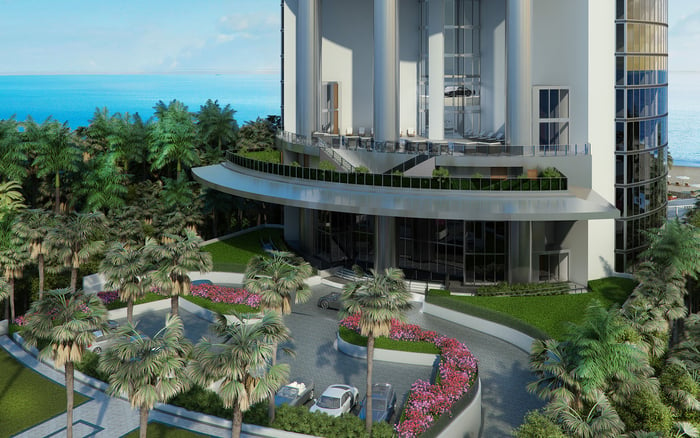
A buyer’s guide to verifying generator endurance, elevator access and refrigerator backup at The Ritz-Carlton Residences® Sunny Isles, with a focus on building-specific documentation rather than assumptions about emergency power.

For a buyer at The Ritz-Carlton Residences® Sunny Isles, resilience deserves the same scrutiny as the residence itself. The question is not simply whether emergency power exists, but what remains available to your household, for how long and under which operating restrictions when utility service is interrupted.
The property’s public-facing information does not establish generator fuel capacity, outage runtime, elevator recall programming or individual refrigerator backup. That is not evidence of a deficiency. It means a purchase decision should rest on building-specific records and written operational answers-not an assumption of uninterrupted service.
Emergency power for specified high-rise systems is not a promise of whole-building backup. Separate the review into three subjects: fuel endurance, elevator behavior and the electrical circuit serving your refrigerator. Each requires its own evidence.
Ask management for the generator equipment schedule, fuel type, usable fuel storage and a complete list of backed-up loads. The list should distinguish required emergency systems from additional resident services. A broad description such as “building generator” does not identify which functions receive power.
The runtime calculation should connect usable fuel to the assumed outage load. Ask the building’s engineer to explain those assumptions and identify any loads disconnected or restricted to preserve capacity. An endurance figure is meaningful only when you know what is running during that period.
The documentation request should include:
Equipment identification and the usable fuel quantity underlying the calculation.
A backed-up load schedule showing the systems supplied during an interruption.
Runtime calculations tied to the stated operating scenario.
Recent maintenance and load-test records, with any unresolved findings explained.
No specific fuel endurance is established here. Do not treat a verbal assurance of several days as verified operating capability. The useful answer is a documented duration under a defined load, with explicit limitations.
Fuel already available and fuel expected from a supplier are distinct parts of the outage plan. Request the actual resupply agreement, not a general assurance that a vendor is retained. Review delivery commitments, exclusions, hurricane priority and the contingency plan if truck access is blocked.
Ask who authorizes a delivery, how the building determines when to request it and how residents are informed if replenishment becomes uncertain. Management’s written procedures should answer these questions; the existence of a contract does not.
A historical 2010 alternate-power provision allowed either an available generator and fuel source on the property or a guaranteed service arrangement providing generator and fuel availability within 24 hours of a request. That historical alternative neither establishes this property’s arrangement nor means every qualifying building must hold a hurricane fuel-delivery contract.
For a Sunny Isles Beach purchase, distinguish documented operating capability without replenishment from service expectations that depend on outside delivery.
Elevator availability requires a separate conversation with management and the elevator contractor. A generator’s presence does not explain how passenger service operates during a power interruption. Standby-power operation and firefighter emergency functions involve distinct requirements and controls.
Request a written explanation of which cars receive backup power, how many may run simultaneously, any transfer delays and the resident-access schedule. Ask where cars are directed during recall, what initiates that sequence and how a fire alarm changes ordinary passenger access. The response should distinguish a utility interruption alone from one accompanied by a fire alarm.
A historical 2010 provision described emergency elevator access for specified hours each day over five days. It was not a promise of continuous, unrestricted elevator service throughout that period. Historical fire-service provisions also distinguish firefighter access and emergency operations from everyday passenger use.
If Jade Signature Sunny Isles Beach is also on your shortlist, request the same written sequence there. This is a comparison framework, not a statement that the buildings share equipment, programming or service levels.
For households whose daily access depends on an elevator, ask management to explain how the documented restrictions would affect their needs. An elevator count alone cannot answer that question.
A lit lobby does not establish that a residence’s refrigerator will remain powered. Neither does backup for fire alarms or other required emergency systems. Refrigerator coverage must be confirmed for the specific unit and circuit.
Request written confirmation identifying the refrigerator circuit and whether it receives power during generator operation. Ask for supporting electrical documentation and clarification of any load-shedding restrictions. If an operating description refers generally to “unit power,” have management define precisely what that includes.
If a residence has additional refrigeration appliances, request a separate answer for each; do not extend confirmation for the main refrigerator to other appliances. Ask whether coverage changes under reduced-load operation and whether management can interrupt that circuit to prioritize other systems.
Second-home buyers should also ask how an absent owner is notified of an interruption and what authorized access arrangements are available. These are services to verify, not presumed features. Until circuit coverage and its restrictions are documented, plan for uncertainty rather than treating refrigeration as assured.
A comparison with Turnberry Ocean Club Sunny Isles should use the same categories: usable fuel, operating loads, replenishment commitments, elevator sequence and unit-level circuit coverage. Do not rank outage capability by brand positioning or common-area presentation.
Keep the legal review separate from the operational review. The relevant background spans provisions from 2010, 2017, 2020 and 2023. Historical language should not be presented as verified current law, nor should the newest edition automatically be assumed to have governed the building’s original permit. Ask qualified counsel and the building’s engineer to identify applicable requirements.
Compliance and household expectations are related but distinct questions. Even when required emergency systems receive power, the buyer still needs to establish which conveniences remain available inside the residence.
Before committing, assemble a single review file containing generator specifications, runtime assumptions, maintenance records, fuel arrangements, elevator procedures and refrigerator-circuit confirmation. Ask your advisers to reconcile any differences between those documents and verbal representations.
Unanswered questions should become specific follow-up requests, not conclusions about the building’s quality. The objective is a clear understanding of how the residence will function under constrained conditions, with expectations proportionate to the evidence.
For a discreet conversation about your South Florida residential search, connect with MILLION.
If branded residences are on your mind — as a home or as an allocation — we would be glad to share what we are seeing, privately.
Begin a quiet conversationNo particular runtime is established by the available public-facing information. Request a building-specific calculation tied to usable fuel and the loads supplied.
No. Requirements for specified emergency and standby systems do not establish whole-building or whole-unit backup.
Request the equipment schedule, fuel type and usable storage, backed-load list, load-dependent runtime calculation, and recent maintenance and load-test records.
Review the actual agreement for delivery commitments, exclusions, hurricane priority and contingencies if truck access is blocked. Distinguish stored-fuel endurance from expectations that depend on replenishment.
No. The historical 2010 provision described emergency elevator access for specified hours each day over five days, not continuous unrestricted passenger service.
Ask about recall destinations, initiating conditions, transfer delays and how fire alarms override ordinary passenger service. Also confirm which cars operate on backup and whether simultaneous operation is restricted.
No. Firefighter emergency operations are distinct from ordinary passenger service, so their presence does not establish unrestricted resident access during an outage.
Obtain written confirmation identifying the specific unit’s refrigerator circuit, supported by electrical documentation. Clarify any load-shedding restrictions rather than inferring coverage from powered common areas.
Yes. Request circuit-specific confirmation for each appliance rather than assuming the main refrigerator’s coverage extends to other refrigeration equipment.
No. Have qualified counsel and the building’s engineer identify applicable requirements, keeping historical provisions distinct from verified current obligations.