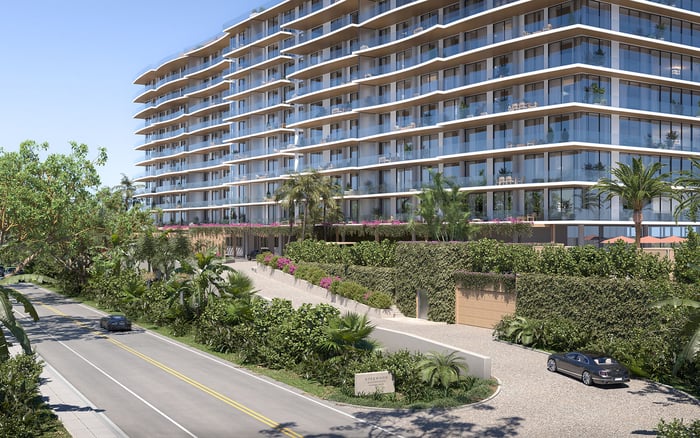
At W Pompano Beach, storage diligence should extend beyond closet count. Seasonal buyers need unit-specific confirmation of ownership, access, rental-program rules, bicycle policies, package handling, and insurance treatment.

For a seasonal owner, storage is not a secondary specification. It determines whether a residence can be closed after one visit and reopened for the next without rebuilding the household each time. Luggage, resort clothing, bicycles, beach equipment, wine, electronics, and personal effects all demand different conditions and levels of control.
At W Pompano Beach Hotel & Residences, that distinction is especially relevant. The 24-story oceanfront project at 20 North Ocean Boulevard is planned as a mixed hospitality and residential environment, with 74 private condominium residences, three penthouses, and 296 furnished condo-hotel suites. Private residences offer two to four bedrooms and approximately 2,400 to 3,400 square feet, while hotel suites span roughly 580 to 1,860 square feet.
Those broad dimensions do not resolve the operational question: what can an owner securely leave behind, and under whose control? A polished arrival depends on rights that are documented, measurable, and compatible with any hotel or rental arrangement.
For seasonal owners, usable storage is a matter of control, not simply capacity.
An “OWNERS CLOSET” appears in at least one floor-plan set beside a terrace measuring 7 feet 6 inches by 20 feet. The label establishes that the concept has appeared in a plan, but it does not establish universal availability or define the closet’s legal and practical character.
The buyer should obtain the latest plan for the selected residence and reconcile it with the condominium declaration, exhibits, storage schedules, rules, and executed contract. Confirm whether the closet lies within the condominium parcel, is assigned separately, or remains only a conceptual design feature. Closet locations, layouts, doors, windows, fixtures, and other elements may differ from completed construction.
Dimensions matter, but so do the lock, permitted contents, ventilation, climate conditions, and access protocol. If guests or renters may use the residence, written rules should identify who controls the key or code, whether the closet may remain locked, and whether management has routine or emergency access. Oral assurances should not substitute for executed documents.
Interior capacity also varies by plan. One residence identifies walk-in closets and a pantry; another identifies closet cabinetry, walk-in closets, a pantry, and a den. For a second-home buyer, that variation can materially affect whether a separate owner closet is essential or merely convenient.
The amenity program does not explicitly identify a dedicated bicycle room. A buyer should therefore avoid treating secured bicycle storage as included until its existence and terms are confirmed in writing.
Ask whether the building will accept conventional bicycles, e-bikes, surfboards, paddleboards, and beach carts. Then establish capacity, assignment method, access controls, operating hours, security provisions, and any limits on equipment size. E-bike owners should obtain the charging policy, including whether batteries may be charged in a storage area or residence. Electrical service should never be inferred from the presence of a room or locker.
This is a useful diligence standard across new oceanfront development in Pompano Beach. Buyers comparing Armani Casa Residences Pompano Beach or The Ritz-Carlton Residences® Pompano Beach should ask the same unit-specific questions rather than assume that similarly positioned properties apply identical storage policies.
Wine storage, package handling, in-unit closets, an owner closet, and a supplemental locker are not interchangeable. Each can carry a different ownership status, access regime, insurance treatment, and permitted use.
The Great Room includes individual wine storage, but specialized wine storage is not evidence of a general-purpose locker for luggage, sports gear, or household supplies. A smart package and mailroom may support owners while they are away, yet it raises separate questions. Confirm hold periods, procedures for perishable deliveries, and whether authorized staff can move packages into the residence or another secured owner area.
For any supplemental locker or cage, determine whether it is deeded, assigned, or leased. Record its dimensions and location, along with climate control, electrical service, access hours, security, insurance treatment, and transferability upon resale. If a storage right is essential to the purchase, it should be identifiable in the controlling documents rather than left to custom or availability.
The same precision belongs in comparisons with other branded residences. A buyer considering Waldorf Astoria Residences Pompano Beach can apply a common matrix covering parcel status, assignment, access, climate, insurance, and transferability. The purpose is not to presume equivalence, but to make unlike offerings legible.
A condo-hotel setting can offer service and convenience, but seasonal-use planning must account for management access. Participation in a hotel or rental program may affect an owner’s ability to lock a closet, retain personal property during guest stays, or restrict housekeeping entry.
Before enrollment, request the rental-management agreement and rules governing personal effects. Confirm whether an owner closet is mandatory, optional, or prohibited for participating residences; whether management retains a master key or override code; and what happens if stored contents violate program standards. Emergency access and routine operational access should be addressed separately.
Insurance deserves its own written review. Valuables, electronics, wine, and e-bikes may face exclusions or limits, particularly when kept outside the main residence or while third parties occupy the home. Buyers should establish whether the condominium association, hotel operator, rental manager, or owner’s policy bears any responsibility for loss or damage. Climate conditions and management liability should also be documented before sensitive property is stored.
The most durable approach is to create a storage file alongside the residence’s financial and legal records. It should include the final unit plan, declaration and exhibits, rules and regulations, storage schedule, applicable rental agreement, and written confirmations for bicycle facilities, package handling, and staff access.
Photograph and measure every assigned area at the appropriate stage, then reconcile what is delivered with the contractual description. For the three penthouses with private rooftop pools, outdoor-space and storage arrangements may differ from standard residences, making plan-specific verification particularly important.
A concise decision matrix can test each feature against six questions: where is it, who owns or assigns it, who can enter it, what may be kept there, how is it insured, and does the right transfer at resale? When those answers are clear, seasonal ownership becomes easier to operate, and personal property is less likely to remain in an ambiguous category.
For confidential guidance on evaluating storage rights and seasonal ownership at South Florida residences, connect with MILLION.
If branded residences are on your mind — as a home or as an allocation — we would be glad to share what we are seeing, privately.
Begin a quiet conversationThat is not established. An owner closet appears in at least one published layout, so availability must be confirmed for the selected residence.
Its legal status must be verified in the unit plan, declaration, exhibits, and executed contract. It could be within the parcel, separately assigned, or only conceptually depicted.
The rental-management agreement and building rules should confirm whether locking is permitted, who controls access, and whether management retains routine or emergency entry rights.
A dedicated bicycle room is not explicitly identified in the promoted amenity program. Buyers should obtain written confirmation before relying on one.
Confirm permitted equipment, capacity, access controls, electrical service, battery and charging rules, security, and insurance treatment.
Not by assumption. Specialized wine storage is distinct from general-purpose storage and may have different use and access restrictions.
It may assist with deliveries while owners are away. Hold periods, perishable policies, and staff authority to move packages should be confirmed.
Verify whether it is deeded, assigned, or leased, plus its size, location, climate control, access, security, insurance, electrical service, and resale transferability.
Published residence descriptions show different combinations of walk-in closets, cabinetry, pantries, and flexible rooms. Usable capacity therefore varies by layout.
Request the latest unit plan, declaration, exhibits, rules and regulations, storage schedule, executed contract, and any rental-management agreement.