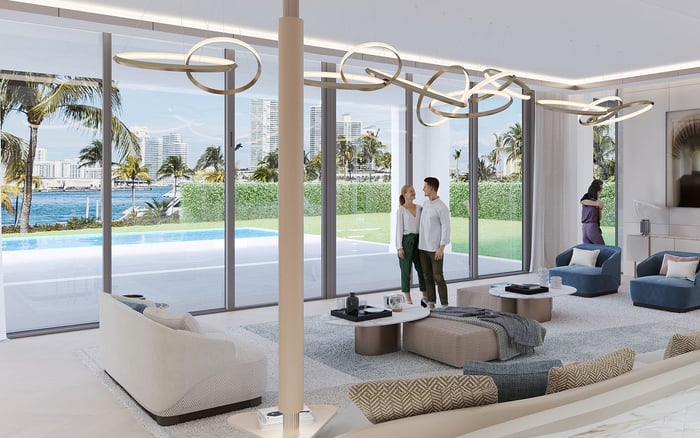
A discreet due-diligence guide to the legal structure, records, engineering review, warranty clocks and insurance pathways that can shape post-turnover defect claims at The Links Estates.

For a buyer evaluating The Links Estates at Fisher Island, the most consequential post-closing questions may lie behind the architecture: who is responsible for a construction condition, which warranty applies, what insurance may respond and who controls the claim after turnover.
The first point to verify is the legal organization. Buyers should not assume every estate and shared component falls under the Florida Condominium Act. The community may be organized as a condominium, homeowners’ association, master association or hybrid-a classification that can alter claim authority, warranty analysis and responsibility for shared property.
Request the declaration, articles, bylaws, purchase agreement, warranty package, turnover provisions and insurance schedule. Counsel should then identify which entity owns or maintains each component, whether an individual owner or the association has standing to pursue a claim and which statutory framework governs.
The strongest post-turnover position begins with matching every component to its owner, warranty and claims authority.
Dates should be treated as assets. The owner-controlled board should document completion, certificate-of-occupancy, original-conveyance, initial-occupancy and turnover dates, along with the date owner control began. Each owner should preserve closing and occupancy records for the same reason.
If condominium law applies, Florida Statute §718.203 provides implied warranties of fitness and merchantability for units and specified building components. The implied warranty for an individual condominium unit generally runs for three years from completion of the building containing it. For roofs, structural components and shared mechanical, electrical and plumbing systems, the period generally runs for three years after completion or one year after turnover, whichever is later, subject to a maximum of five years after completion.
A separate one-year builder warranty under Florida Statute §553.837 covers qualifying material Florida Building Code violations in a newly constructed home caused by equipment, materials or workmanship. That period begins after original conveyance or initial occupancy, whichever occurs first. Counsel should confirm all applicable limitation and repose periods based on the project dates, the claim and the controlling statutory version.
A polished residence is no substitute for an institutional record. The turnover archive should include plans, specifications, permits, approvals, contracts, warranties, insurance policies, financial and maintenance records, engineering materials, inspection reports and developer-board records.
It should also identify every developer, contractor, subcontractor, design professional, manufacturer, warranty provider and insurer potentially connected to the work. Missing documents can complicate proof of causation, responsibility, coverage and timely notice. For an investment of this scale, document custody deserves the same scrutiny as title, financing and physical inspection.
Buyers comparing Fisher Island options, including The Residences at Six Fisher Island, should apply the same discipline: determine who holds the original records, how owners access them and whether the board maintains a formal retention protocol.
A comprehensive engineering investigation at or immediately after turnover can identify latent conditions while warranty, limitation and repose periods remain open. The scope should examine the structure, roof, waterproofing, exterior envelope, foundations, drainage, mechanical-electrical-plumbing systems and life-safety installations.
Common areas of dispute include water intrusion, windows and doors, stucco or façades, concrete or structural work, fire-stopping, roofs, building systems and site infrastructure. Findings should be documented with photographs, precise locations, observed damage and enough technical detail for responsible parties to investigate.
The engineering study and reserve analysis should also distinguish original construction defects from deterioration and future capital work. That distinction matters: a viable defect may be recoverable from a responsible party, while maintenance or later replacement may belong in association reserves. This is particularly important in Estates & Single-Family ownership, where private and shared obligations can differ component by component.
There is generally no universal defect policy. Potential coverage may sit within commercial general liability policies, excess or umbrella layers, or project-specific programs. Developers and contractors ordinarily tender asserted claims to applicable insurers, but coverage depends on policy language, exclusions, notice compliance and the nature of the alleged damage.
The board should create a coverage matrix assigning each reported condition to potential statutory warranties, contractual warranties, manufacturer warranties, liability insurance, association property insurance or owner-funded reserves. The matrix should identify the claimant, responsible party, notice recipient, policy period and relevant deadline-without presuming that a tender guarantees coverage.
This framework applies across New-construction due diligence, not only at one address. A purchaser considering Palazzo del Sol or Palazzo della Luna can ask the same essential questions about claim authority, retained records, applicable warranties and insurance architecture.
Florida Chapter 558 generally requires detailed pre-suit notice and an opportunity for responsible parties to inspect, repair or settle an alleged construction defect before litigation proceeds. An effective protocol should explain how owners report conditions, who retains engineers and counsel, who issues notices and how access for inspection is coordinated.
For common elements or conditions affecting multiple units, a condominium association may be able to proceed collectively rather than leaving each owner to act separately. That authority should be determined by the governing documents and legal structure. Multi-party claims may resolve through repairs, monetary settlements or extended warranties involving developers, contractors, design professionals and insurers rather than through trial.
Any proposed repair should undergo technical review, carry a defined scope and include documentation of completion, with clarity on whether acceptance releases broader claims. Settlement authority, voting requirements and allocation of proceeds should also be confirmed before urgency narrows the available choices.
For MILLION’s Buyer's Guides audience, the practical inquiry is concise. Confirm the ownership regime and maintenance boundaries. Obtain the complete turnover archive and warranty package. Establish every controlling date. Review board minutes for defect notices, inspections, tenders, repairs or settlements. Determine whether an independent engineer has evaluated the property and whether unresolved findings appear in reserve planning.
Finally, determine whether the board maintains a written claims calendar covering completion, occupancy, turnover, discovery, warranty expirations, pre-suit notices, limitation periods and repose. A luxury finish can be assessed in an afternoon; a disciplined post-turnover claims structure demands documentary precision.
For discreet guidance on South Florida luxury real estate, connect with MILLION.
If branded residences are on your mind — as a home or as an allocation — we would be glad to share what we are seeing, privately.
Begin a quiet conversationThe condominium, HOA, master-association or hybrid structure can determine which warranties apply, who maintains each component and who may pursue a claim.
No. Buyers should first confirm the governing legal structure and whether the particular estate or shared component falls under condominium law.
If the condominium statute applies, it generally runs for three years from completion of the building containing the unit.
They should preserve completion, certificate-of-occupancy, original conveyance, initial occupancy, turnover and owner-control dates.
The archive should include plans, permits, approvals, contracts, warranties, insurance policies, maintenance records, engineering materials, inspections and developer-board records.
It should examine the structure, roof, waterproofing, exterior envelope, foundations, drainage, building systems and life-safety installations.
No. Potential coverage may be spread across commercial general liability, excess or umbrella coverage and project-specific insurance programs.
It generally requires detailed pre-suit notice and gives responsible parties an opportunity to inspect, repair or settle alleged defects before litigation.
A Florida condominium association may pursue qualifying claims involving common elements or multiple units collectively, subject to its legal structure and authority.
Possible outcomes include repairs, monetary settlements or extended warranties involving developers, contractors, design professionals and insurers.