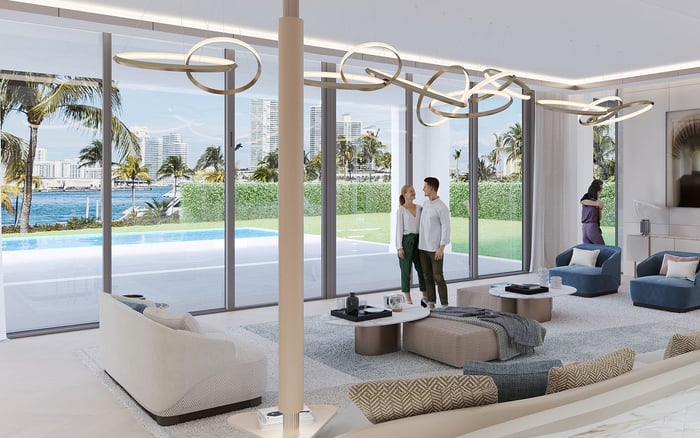
For trust and entity buyers, a Fisher Island purchase deserves a unit-level resale analysis. Request segmented closings, matched view and floor comparisons, verified ownership requirements, and a complete annual carrying-cost budget before committing.

A full-service Fisher Island residence can satisfy a highly personal brief while demanding an equally disciplined exit analysis. For buyers acquiring through a trust or entity, the question is not simply whether a building has achieved exceptional prices. It is whether comparable residences have attracted buyers at a price, pace, and annual ownership cost consistent with the intended holding period.
Buyer-pool depth is not transaction volume. The available figures establish selected closing histories and maintenance benchmarks; they neither count prospective buyers nor establish demand by size, exposure, or floor. Request a decision file organized around the specific residence, keeping ownership-structure review distinct from resale analysis.
Ask for three to five years of building-level closings, grouped initially into 3,000-4,000 SF, 4,000-5,500 SF, and above 5,500 SF. These are useful starting bands, not established liquidity categories. Within each band, request closing date, interior area, stack, exposure, floor, total consideration, and price per square foot.
For Palazzo della Luna Fisher Island, a 2023-2026 qualified-sales sample contains six transactions, a median near $3,637/SF, and a highest sale of $37 million. A separate recent-closing sample contains 10 sales and a median near $3,153/SF. Neither median should be chosen simply because it supports a preferred valuation. Require reconciliation of the dates, included transactions, and definition of a qualified sale.
The same 2023-2026 qualified-sales dataset contains 10 Del Sol transactions at a median near $3,218/SF, four Del Mare transactions near $2,615/SF, and 20 Bayview transactions near $2,128/SF. Bayview's higher transaction count does not establish greater liquidity for every residence type. Nor can building-wide medians establish the value of a particular layout or exposure.
Ask for annual sales counts and a verified residence count before calculating turnover. A percentage based on an uncertain inventory denominator is not a dependable comparison.
Next, narrow the ledger to same-stack or genuinely comparable-stack closings. A useful comparison identifies the view line and floor explicitly rather than grouping every residence with a water outlook into one category.
Request a side-by-side schedule showing interior area, exposure, floor, closing price, and $/SF. Ask the adviser to explain each substitution when an exact match is unavailable. A larger residence with another exposure can provide context, but it should not become evidence of the target residence's resale prospects by default.
Do not accept an assumed high-floor premium, view premium, or large-unit discount. The available evidence does not quantify those adjustments. Where matched transactions are sparse, qualify the valuation range accordingly rather than turning a building median into a precise unit valuation.
If the shortlist also includes The Residences at Six Fisher Island, request a separate evidence file. Do not transfer another tower's closing history or carrying-cost assumptions merely because both addresses are on Fisher Island.
Request marketing timelines for the target segment, not just completed sales. The schedule should distinguish initial listing dates, price changes, relistings, contract dates where available, and closing dates. Keep active asking prices separate from closed consideration.
For example, the listing snapshot for 7055 Fisher Island Drive showed 3,581 SF at approximately $3,602/SF. That is an asking-price observation, not evidence that a buyer paid that amount.
Observation windows matter, too. A Della Luna snapshot showed no closings in the preceding six months alongside broader historical closing data. That does not establish that a comparable residence cannot sell, but it underscores the importance of the measurement period. The available activity and fee snapshots largely reflect August-September 2026, not live conditions.
Request both annual history and a refreshed recent-period view. Together, they provide a more useful basis for planning than either a record sale or a quiet six-month interval alone.
For Palazzo del Sol Fisher Island, a maintenance benchmark is approximately $1.25/SF monthly, with actual charges varying by unit. Other estimates place monthly maintenance at $6,000-$15,000 or more and total annual carrying costs above $200,000 for larger residences when association charges, club costs, taxes, and insurance are included. These are budgeting references, not a quotation for the residence under consideration.
Della Luna's average maintenance benchmark is approximately $2.28/SF monthly. Applied to a hypothetical 4,800-SF residence, that equals $10,944 monthly before separate expenses. A combined Del Sol/Della Luna fee range of $4,087-$24,754 monthly further illustrates why a single building-wide assumption is inadequate.
Request the seller's current association statements and a unit-specific annual schedule separating association charges, club costs, property taxes, and insurance. Have advisers distinguish the seller's historical expenses from the buyer's prospective budget and identify any additional charges requiring confirmation.
Keep club entry costs separate from recurring expenses. Estimates include a $250,000 equity-membership initiation fee and annual dues of $19,260-$25,520. Obtain the current club-issued schedule and confirm applicability before relying on those amounts. No supported carrying-cost threshold establishes when resale demand declines.
One documented transaction demonstrates a trust-managed LLC purchase: Palazzo Del Mare unit 7153, with a stated area of 7,025 SF, sold for $21 million to Fana Fisher Palazzo 7153 LLC, described as managed by a trust in Bellevue, Washington.
That transaction is a precedent, not an approval policy. It does not establish the prevalence of entity ownership, privacy benefits, or the requirements another purchaser will face.
Before committing, ask counsel and the association to confirm in writing what applies to the proposed ownership structure. Request the applicable approval steps, documents, authorized-signatory requirements, and any ownership-change provisions requiring review. These are matters for verification, not assumptions about a particular tower's rules. Keep the legal review alongside the resale and expense files so that an acceptable residence is not mistaken for an approved acquisition structure.
The final purchase memorandum should bring together segmented closings, matched floor and view evidence, marketing timelines, verified turnover inputs, annual carrying costs, and ownership requirements. Ask the adviser to distinguish supported conclusions from judgment calls.
The objective is not a promise of liquidity. It is a clear understanding of the evidence behind the purchase price and the financial capacity to hold the residence if a future sale takes longer than planned.
For a discreet conversation about your Fisher Island acquisition, connect with MILLION.
If branded residences are on your mind — as a home or as an allocation — we would be glad to share what we are seeing, privately.
Begin a quiet conversationRequest three to five years of building-level closings segmented by size, stack, exposure, and floor. Keep the ownership-structure review separate from the resale analysis.
Start with 3,000–4,000 SF, 4,000–5,500 SF, and above 5,500 SF. These are organizational bands, not proven categories of resale demand.
No. Its 20 qualified transactions in the cited period establish greater volume within that dataset, not greater liquidity for every unit size or view line.
The approximately $3,637/SF and $3,153/SF medians come from different transaction samples. Reconcile their observation windows and inclusion criteria before using either for valuation.
The available evidence does not quantify those premiums. Request same-stack or comparable-stack closings that identify floor, exposure, size, and closing price.
It describes activity within that particular observation window, not an inability to sell. Review it alongside annual closing history and segment-specific marketing timelines.
At approximately $2.28/SF monthly, a hypothetical 4,800-SF residence would carry $10,944 in monthly maintenance before separate expenses. Obtain actual unit statements rather than treating that illustration as a quote.
Budget them separately unless the actual documents establish otherwise. The published $250,000 initiation estimate and $19,260–$25,520 annual dues range require confirmation against the current club-issued schedule.
No. The $21 million Del Mare transaction demonstrates one such purchase, but it does not establish another buyer's approval requirements or privacy benefits.
Include segmented closings, matched view and floor comparisons, marketing timelines, verified turnover inputs, unit-specific carrying costs, and confirmed ownership requirements. Distinguish supported conclusions from judgment calls.