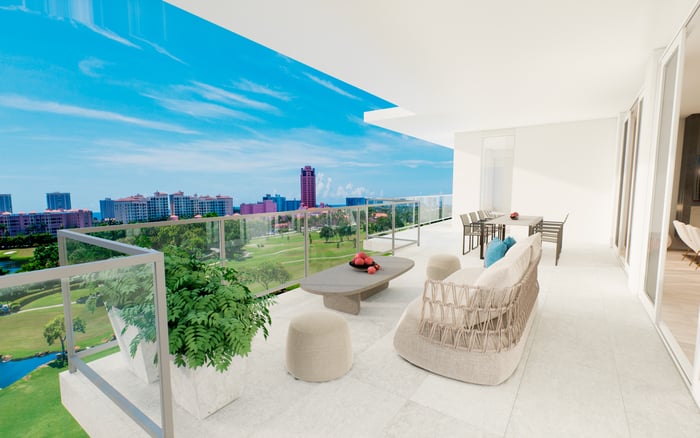
For buyers considering a full-service Boca Raton residence, discreet service should extend to insurance diligence. Review the complete master policy, clarify responsibility for interiors, translate storm deductibles into dollars and test loss-assessment coverage before committing.

In a full-service Boca Raton tower, the most consequential service may be the coordination that takes place before ownership begins. An attentive purchase team should make the insurance position clear without requiring the buyer to become an insurance specialist. Discretion here means coordinated diligence among the buyer’s agent, attorney, association manager and insurance adviser-not a distinct insurance product.
For someone considering Alina Residences Boca Raton, the question is not simply whether the building is insured. It is how the association’s protection, the owner’s HO-6 policy and any potential assessment fit together. These are buyer-side review principles, not representations about any named residence’s insurance arrangements.
A master policy does not eliminate an owner’s financial exposure. The objective is to identify what remains with the buyer and decide, before committing, whether that exposure is insured, fundable or unacceptable.
Ask for the full master insurance policy, including declarations, deductible schedules, endorsements and exclusions. A certificate of insurance cannot substitute for the documents that define coverage and its limitations.
Have the insurance adviser prepare a concise written analysis of covered property, applicable limits, relevant exclusions and deductibles that could affect an owner. Policy wording should guide that analysis-not a sales description or a general assurance that the association carries comprehensive protection.
The request should extend beyond the policy itself. Obtain the association’s storm-claim history, insurance-related assessments and relevant board records. Ask management to explain how the association would fund its storm deductible. The policy identifies an obligation; the funding discussion reveals how it could reach the household balance sheet.
A well-coordinated team can consolidate these requests, keeping the process orderly and unanswered questions visible.
Windstorm, named-storm and hurricane deductibles deserve separate review. Ask whether each is expressed as a dollar amount or a percentage, what value the percentage applies to and how the provision operates for an applicable claim. Do not treat the three labels as interchangeable.
The dollar translation matters. A building insured for $20 million with an applicable deductible of 2%, for example, would face a $400,000 deductible; at 5%, that figure becomes $1 million. This is a hypothetical calculation, not a quote or a verified deductible for any Boca Raton tower. The actual policy controls.
The association’s hurricane deductible is a common expense that may be funded through owner assessments. An insured building can therefore generate a substantial owner payment after a storm.
Do not divide the hypothetical deductible by the number of residences and assume the result is your obligation. Have counsel confirm how the governing documents and Florida condominium law allocate deductible and reconstruction costs. The buyer needs both figures: the association’s applicable deductible and the unit’s potential share under the controlling allocation.
Descriptions such as “bare-walls” and “all-in” are starting points, not a complete allocation of responsibility. Request an itemized written breakdown of which interior finishes and improvements the association insures and which the owner must insure.
When evaluating Glass House Boca Raton, apply the same discipline: assess the particular residence’s insurance responsibilities rather than infer protection from its presentation. A beautifully finished interior makes precision more important, not less.
The HO-6 dwelling limit should reflect the finishes and improvements assigned to the owner. Ask the adviser to reconcile that limit with the itemized responsibility breakdown, establishing a reasoned connection between what must be insured and the amount of coverage purchased.
Separately, obtain written confirmation of wind and hurricane coverage in the proposed HO-6, including applicable deductibles. The master policy and the unit-owner policy require distinct reviews. Neither should be treated as evidence of what the other covers.
Buyers should examine loss-assessment coverage when considering their share of an association insurance expense. It can reimburse an assessed share of the association’s deductible, but only subject to covered causes of loss, limits and policy terms.
Florida requires at least $2,000 of property loss-assessment coverage on residential condominium unit-owner policies, with a deductible no greater than $250. Have the adviser and attorney confirm the requirements applicable to the proposed policy. The minimum is not a measure of adequate protection, particularly when the association’s deductible could be substantial.
Higher limits, including $10,000 to $50,000 or more, may be available by endorsement, depending on the insurer and policy. A larger headline limit alone is not enough. Request the actual endorsement and written confirmation of whether an assessment attributable to the master hurricane deductible is covered, and which limits and exclusions apply.
Depending on its terms, loss-assessment coverage may also address covered building losses exceeding master-policy limits and certain association liability judgments. Those possibilities should be verified, not assumed.
For buyers considering The Residences at Mandarin Oriental Boca Raton, the standard remains the same: evaluate the endorsement against the association’s actual insurance structure. A service proposition cannot answer a coverage question.
The phrase “special assessment” describes a charge, not an automatic insurance benefit. Routine maintenance, reserve contributions, milestone-inspection projects and structural upgrades are generally not covered merely because the association funds them through an assessment.
Ask the adviser to distinguish insurance-related assessments that may qualify for coverage from ownership expenses that ordinarily do not. This avoids treating loss-assessment coverage as a general backstop for every unexpected association bill.
Even an insurance-related assessment can remain payable out of pocket if the owner’s policy does not respond. The relevant questions are what caused the loss, what the endorsement covers and how much protection is available for that particular assessment.
Before committing, request a consolidated written brief with four components: the master-policy analysis, the itemized interior responsibility breakdown, the storm-deductible funding and allocation explanation, and the proposed HO-6 with its loss-assessment endorsement.
Have the attorney review allocation questions and the insurance adviser address coverage questions, with management supplying the association records. Identify any unresolved issue plainly rather than allowing it to disappear into a reassuring summary.
The result is not a promise of risk-free ownership. It is a clearer understanding of which losses are insured and which obligations may still require personal funds. For a buyer seeking discreet service, that clarity is part of the luxury.
Explore Boca Raton residences with a more considered approach to ownership at MILLION.
If branded residences are on your mind — as a home or as an allocation — we would be glad to share what we are seeing, privately.
Begin a quiet conversationRequest the complete master policy, including declarations, deductible schedules, endorsements and exclusions. Also request storm-claim history, insurance-related assessments and relevant board records.
No. The full policy documents are needed to evaluate coverage, deductibles, endorsements and exclusions.
Their terms and application can differ. Confirm whether each is a dollar amount or percentage, the value used in the calculation and how it applies to a claim.
For illustration, an applicable 2% deductible on a building insured for $20 million equals $400,000, while 5% equals $1 million. Those figures do not describe any named tower’s policy.
Do not assume equal allocation. Have the buyer’s attorney confirm how the governing documents and Florida condominium law allocate deductible and reconstruction costs.
Base the limit on the interior finishes and improvements the owner must insure. First obtain an itemized written breakdown of association-versus-owner responsibility.
No. Ask the insurance adviser to confirm wind and hurricane coverage and applicable deductibles in the proposed unit-owner policy separately.
Florida requires at least $2,000 on residential condominium unit-owner policies, with a deductible no greater than $250. Confirm applicable requirements with your advisers and do not treat the minimum as necessarily adequate.
It can, subject to covered causes of loss, limits and policy terms. Review the actual endorsement and obtain written confirmation that the proposed coverage responds to that assessment.
No. Routine maintenance, reserve contributions, milestone-inspection projects and structural upgrades are generally not covered simply because they are funded through a special assessment.