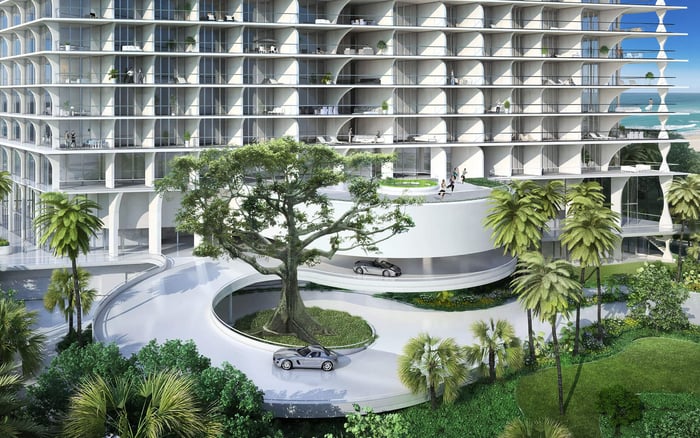
In Sunny Isles Beach, private arrival is no longer a single feature category. Bentley integrates the automobile into the residence, while Turnberry illustrates why buyers must distinguish passenger privacy from a fully engineered car-to-home system.
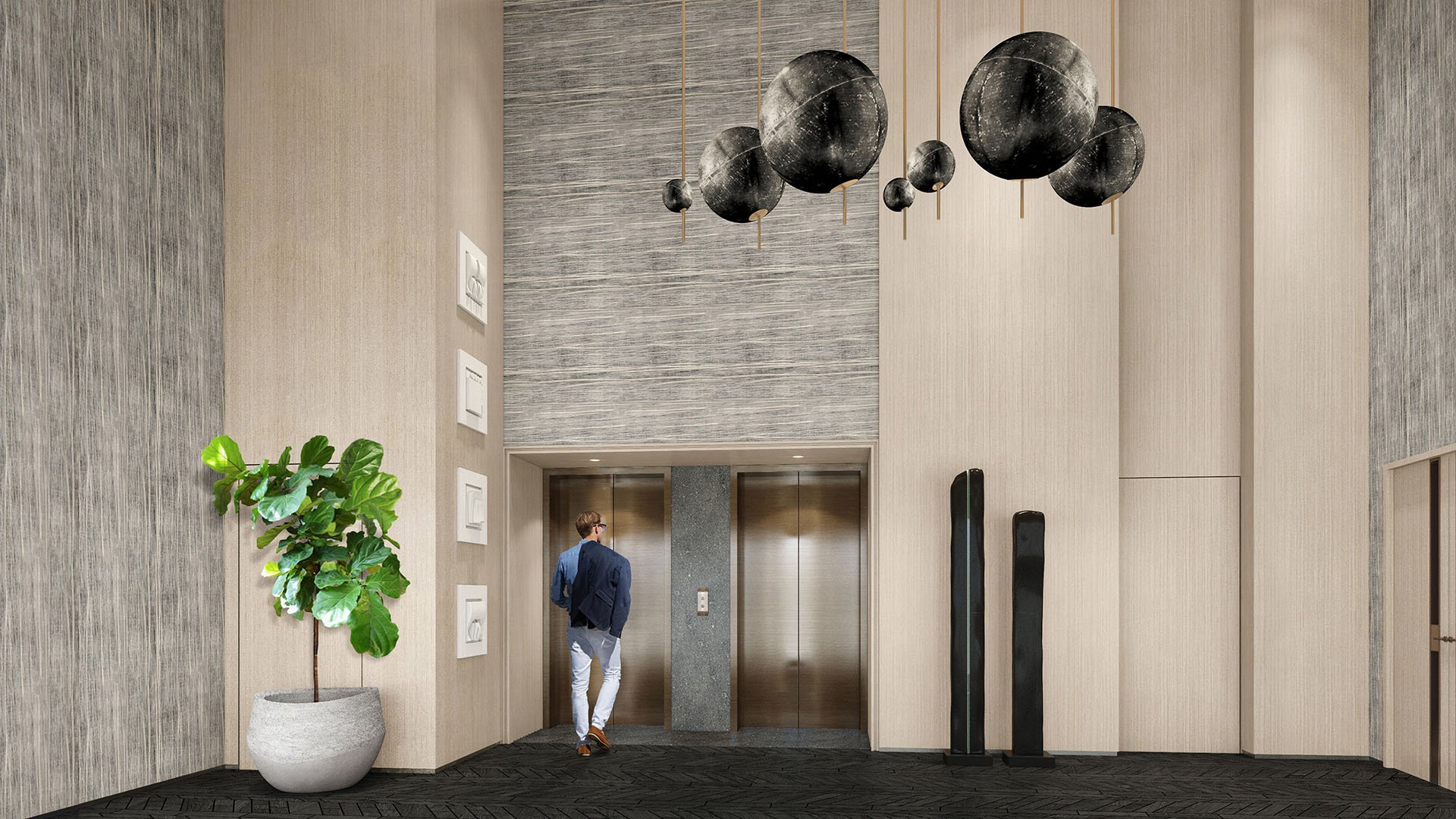
In Sunny Isles Beach, the phrase “private elevator arrival” can describe markedly different ownership experiences. It may refer to passenger access that limits shared circulation, or to a far more ambitious piece of residential infrastructure. For 2026 buyers, that distinction shapes privacy, convenience, automobile storage and the choreography of coming home.
The contrast between Bentley Residences Sunny Isles and Turnberry Ocean Club Sunny Isles is particularly instructive. Bentley is designed around a vehicle-integrated arrival system. Turnberry does not document a comparable vehicle elevator or private in-residence sky garage. The useful comparison, then, is not between identical amenities, but between two expressions of exclusivity: one centered on elevated residential service, the other on physically bringing an owner’s vehicle into the home.
At Bentley, arrival infrastructure is embedded in the tower’s core rather than layered on as a valet convenience. The planned 62-story building comprises 216 condominiums and incorporates the patented Dezervator system. Four robotic, high-speed, passenger-friendly car lifts are designed to carry residents directly to private sky garages while they remain inside their vehicles.
The sequence begins at a porte-cochère with a full-glass car-lift observatory. From there, the automobile becomes part of a controlled transition from roadway to residence, eliminating the conventional sequence of parking, walking through a garage and transferring to a passenger elevator.
Each residence is designed with a private three- or four-car garage. These glass-enclosed spaces present vehicles like artwork within the home, giving collectors a setting that combines storage, security and display. Passenger circulation remains distinct: the plans also include high-speed passenger-elevator access to every residence and a private elevator foyer leading to an eight-foot double-door entrance.
That dual approach matters. Owners are not dependent on the car lift for every arrival, yet the automobile can become part of the domestic environment when desired. Among Branded Residences, this is a substantive architectural proposition-not merely a branded finish package or hospitality ritual.
Turnberry Ocean Club is not defined by a Bentley-style car-to-residence system. That distinction should not be interpreted as a judgment on overall quality. It simply places the project within a more conventional luxury-tower framework, where the arrival experience is not centered on robotic vehicle lifts and private multi-car garages incorporated into each home.
For buyers, this contrast sharpens the question. “Private elevator” should never be treated as a universal specification. Does it mean a passenger elevator opens into a private foyer? Is access shared among a limited number of residences? Does the route begin after a valet handoff? Or can the owner and vehicle travel together to an in-unit garage?
Buyers comparing other Sunny Isles options, including The Ritz-Carlton Residences® Sunny Isles and Muse Residences Sunny Isles Beach, should apply the same rigor rather than assume that similarly elegant marketing language describes equivalent circulation or parking arrangements.
Within Buyer's Guides, elevator privacy is often reduced to a floor-plan note. It warrants broader scrutiny because arrival shapes daily life more frequently than many statement amenities.
First, request a clear account of the complete route from the property entrance to the front door. Identify every handoff, shared threshold and credentialed access point. A private foyer does not necessarily mean a dedicated elevator cab, just as reserved parking does not mean private in-residence storage.
Second, examine choice and redundancy. Bentley’s concept separates the vehicle-elevator system from high-speed passenger access, creating two ways to reach a residence. Buyers should ask how any specialized system functions during maintenance, how guests and service personnel arrive, and what alternative circulation remains available.
Third, consider how the system aligns with actual habits. A collector may regard direct transport and a three- or four-car sky garage as defining ownership features. Another buyer may prefer a traditional valet sequence and prioritize a quiet passenger arrival. Privacy is not merely about avoiding contact; it is also about controlling transitions, timing and access to personal property.
Finally, distinguish architectural infrastructure from service. Concierge and valet teams can refine an arrival, but they cannot replicate a building core engineered to move occupied vehicles directly to individual residences. For Bentley, that difference is central to the proposition.
The next generation of ultra-premium residential design is making circulation more personal. Bentley treats arrival as an extension of the residence, turning automobile storage into visible interior architecture. Turnberry represents the established alternative: a sophisticated luxury-tower experience without a documented car-to-home mechanism.
Neither model should be reduced to shorthand. The informed 2026 buyer will ask what is private, what is shared, what is automated and what depends on service. Those answers reveal far more than the phrase “private elevator” alone.
What does private elevator arrival usually mean? It often means controlled passenger access to a private foyer, although the elevator cab itself may still serve multiple residences.
What makes Bentley’s arrival system different? The Dezervator is designed to transport residents inside their vehicles directly to private sky garages within their homes.
How many vehicle lifts are planned at Bentley? The system comprises four robotic, high-speed, passenger-friendly car lifts.
Does every Bentley residence include automobile storage? Each residence is designed with a private three- or four-car garage accessible through the Dezervator.
Can Bentley residents arrive without using the car lift? Yes. The plans separately include high-speed passenger-elevator access to every residence.
Does Turnberry have a Bentley-style vehicle elevator? Turnberry does not document a comparable vehicle elevator or in-residence sky-garage system.
Is a private foyer the same as a dedicated elevator? Not necessarily. Buyers should confirm whether the cab, landing and access route are private or shared.
Who benefits most from an in-residence sky garage? The concept is especially relevant to owners who collect, secure or display automobiles.
What should buyers ask about specialized elevator systems? Ask about alternative access, maintenance procedures, guest circulation, service routes and operating protocols.
Why does arrival design matter in a luxury residence? It shapes daily privacy and convenience while revealing how deeply the building supports an owner’s routines.
To compare the best-fit options with clarity, connect with MILLION.
If branded residences are on your mind — as a home or as an allocation — we would be glad to share what we are seeing, privately.
Begin a quiet conversation