A buyer-focused comparison of Bentley’s advertised vehicle-to-residence arrival system and Armani/Casa’s private elevator access, with the essential questions that distinguish architectural privacy from enforceable access control.
For a buyer who values discretion, the arrival sequence deserves the same scrutiny as the residence itself. The essential question is not simply whether an elevator or garage is private. It is who may enter, under what authorization, and where residents, visitors and service personnel might cross paths.
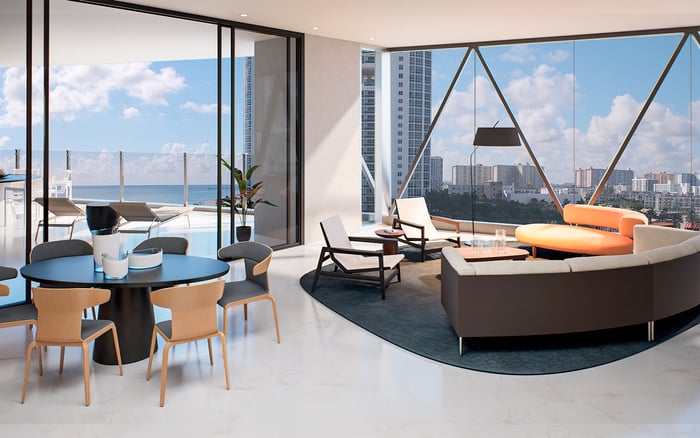
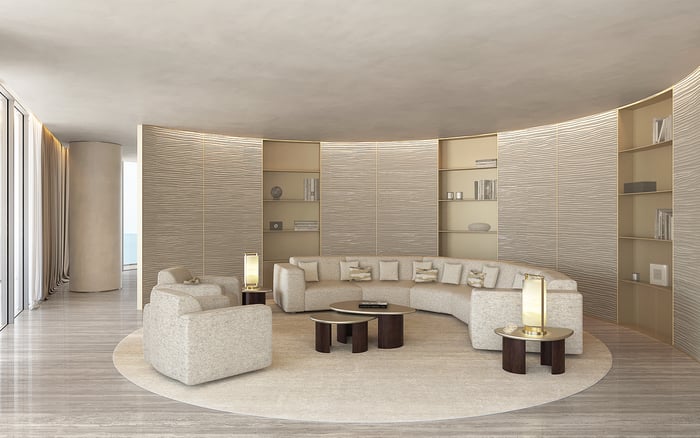
At Armani Casa Residences Pompano Beach and Bentley Residences Sunny Isles, the advertised architecture offers different approaches to arrival. Bentley’s advertised features include a vehicle-to-residence system; Armani/Casa’s include private elevator access, private entry spaces and separate service elevators. Neither description, by itself, establishes resident-only circulation or complete guest separation.
Architectural privacy and access-control policy are distinct. A private foyer can create a discreet threshold without establishing who may reach it. A dedicated garage can provide a personal arrival space without defining visitor permissions. The buyer’s task is to examine both the physical route and the rules governing its use.
Bentley Residences is listed at 18401 Collins Avenue in Sunny Isles Beach. Its advertised Dezervator system allows residents to travel with their vehicle to a private sky garage attached to their residence. The described system comprises four robotic, high-speed, passenger-friendly car lifts with direct access to those garages.
For buyers who prefer to remain with their vehicle during arrival, this is the more explicitly described proposition of the two projects. It connects the vehicle journey to a personal garage rather than simply an elevator foyer. That distinction matters, but it does not replace documented operating procedures.
Private garages are advertised for three or four vehicles per residence, with four parking spaces assigned to east-facing residences and three to west-facing residences. Buyers should confirm the allocation for their specific residence rather than assume the larger capacity applies throughout.
The planned arrival area also includes a porte-cochère with a full-glass car-lift observatory. Residence features include private elevator foyers and eight-foot double-door entrances. These elements describe the setting and threshold-not the authorization process. They do not establish who may accompany an owner or how access is granted.
The decisive questions concern permissions: whether guests may ride in the Dezervator, how a vehicle is authorized, and how that authorization is withdrawn. Buyers should also ask which route applies when a car lift is unavailable. The everyday arrival experience should be evaluated alongside its alternative, not in isolation.
At Armani/Casa in Pompano Beach, the advertised arrival experience centers on private elevator access. Advertised features include two dedicated private elevators in each tower, a private elevator lobby, and private elevator access with entry foyers in all units.
A one-residence-per-floor configuration is also advertised, but buyers should verify that arrangement against final approved plans. Elevator count, floor layout and residence entry must be understood together. None establishes a complete access-control arrangement without the corresponding plans and permissions.
Separate service elevators accessible to all residences are also described. This creates a meaningful architectural distinction between residential and service access. It does not establish that every delivery, contractor or staff movement must follow a separate route, or that those routes remain separate at every point.
Request a plan showing how residential and service paths connect to each residence. Then ask whether household staff, maintenance personnel and deliveries are assigned different permissions. The presence of a service lift answers a design question; its permitted use answers an operational one.
Neither project’s advertised private-arrival features establish a complete, separate guest route from curb to residence. Guest separation remains unresolved at reception, elevators, amenities and residential floors. Buyers should not interpret a private entrance as a broader promise that residents never share circulation with visitors.
A useful review follows an invited guest through an ordinary visit. Where does the guest arrive? Who registers the visit? Can the guest proceed independently, or must the resident authorize each stage? Is permission limited to the destination floor? These are questions to resolve, not features to presume.
The same review should cover a resident arriving with guests, an unaccompanied visitor and a delivery. Each scenario may require different permissions, but the advertised architecture does not establish what those permissions will be. Request written answers that distinguish intended procedures from adopted rules.
Amenity access deserves a separate review. A controlled residential threshold does not explain whether visitors can enter shared facilities or which elevators serve them. Examine the route to a home and the route to amenities separately before drawing conclusions about resident-only circulation.
Begin with approved circulation plans. Ask for resident, guest and service journeys to be traced on those drawings, including any shared spaces. For Bentley, include the vehicle approach, lift entry, sky garage and alternative arrival route. For Armani/Casa, include the private lobby, residential lifts, service lifts and residence thresholds.
Next, request the condominium declaration, adopted rules and available security procedures. Look for provisions addressing visitor registration, floor permissions, staff access, deliveries and amenity access. Where a procedure remains proposed, identify it as such rather than treating it as an established commitment.
Keep three categories separate in the buyer file: advertised features, approved design and operating rules. Most descriptions underlying this comparison concern marketing and property features, not recorded condominium provisions or adopted access policies. Maintaining that distinction prevents an attractive design feature from becoming an assumed guarantee.
Apply the same discipline when considering The Ritz-Carlton Residences® Pompano Beach: ask the same circulation and permission questions rather than transferring assumptions from one branded address to another. This comparison does not establish that project’s access arrangements.
Bentley offers the more explicitly described vehicle-to-residence sequence. Armani/Casa presents private elevator access with an advertised distinction between residential and service lifts. The right fit depends on which arrival experience matters to the buyer, followed by confirmation that the approved configuration and operating rules support it.
Neither should be treated as a verified guarantee of resident-only circulation, fully separate guest journeys or secure arrivals solely because private infrastructure is advertised. The strongest purchase decision pairs an appealing physical experience with clear, documented permissions and a workable alternative when the preferred route is unavailable.
For a discreet perspective on your South Florida residence search, connect with MILLION.
If branded residences are on your mind — as a home or as an allocation — we would be glad to share what we are seeing, privately.
Begin a quiet conversationThe advertised features do not establish that guarantee. Buyers should review approved circulation plans and applicable access rules.
It is an advertised vehicle-elevator system that allows residents to travel with their vehicle to a private sky garage attached to their residence.
The advertised configuration includes four robotic, high-speed, passenger-friendly car lifts with direct access to private sky garages.
Four spaces are advertised for east-facing residences and three for west-facing residences. Buyers should confirm the allocation for their selected home.
Guest permissions are not established by the advertised system description. Buyers should request written clarification of authorization and accompanying-passenger rules.
Descriptions specify two dedicated private elevators in each tower, along with private elevator access and private lobby or foyer spaces. Buyers should verify the configuration against final approved plans.
Yes, that configuration is advertised, but buyers should confirm it against final approved plans rather than assume it applies without qualification.
Yes, separate service elevators accessible to all residences are described. That architectural distinction does not establish mandatory service routes or staff permissions.
Request approved circulation plans, the condominium declaration, adopted rules and available security procedures. Review visitor registration, floor permissions, staff access, deliveries and amenity access.
Ask which alternative arrival route applies when the preferred lift is unavailable and how access permissions work along that route. Bentley buyers should specifically clarify the procedure during a car-lift outage.