For art collectors buying a South Flagler Drive condominium, insurance diligence should connect the association’s master policy, custom interiors, collection coverage and potential deductible assessments before closing.
For an art collector choosing a primary condominium residence on South Flagler Drive, insurance deserves the same scrutiny as the floor plan. A home for a collection is also a financial responsibility: the building, the interiors and the works themselves may fall under different insurance arrangements. The purchase price reveals none of those boundaries.
When considering Forté on Flagler West Palm Beach, include the association’s insurance documents in your purchase review rather than deferring them until move-in. The objective is not simply to obtain an HO-6 policy. It is to understand which losses fall to the association, which fall to you and which could remain uninsured.
This checklist concerns condominium ownership, not detached homes. For a primary residence housing valuable art, those distinctions warrant written answers before closing.
Begin with the master-policy declarations page. It should identify the association’s insured values, hurricane deductible and liability limits. Then request the complete policy and all endorsements. The declarations page is an introduction-not a substitute for the wording that determines coverage.
Ask whether wind coverage is included in the main policy or placed separately. If separate, request that policy’s declarations, terms and endorsements as well. A quoted deductible is not enough to calculate your exposure without its applicable coverage and valuation basis.
Request the condominium declaration and bylaws, too. Read them alongside the insurance documents to establish the responsibilities that apply to the residence you intend to buy. Ask your insurance adviser and condominium counsel to resolve any apparent mismatch rather than relying on a general assurance that “the building is fully insured.”
Finally, ask about ordinance-or-law coverage and code-upgrade limits. Rebuilding requirements can create costs beyond replacing damaged property as it previously existed.
The association’s insurance generally addresses the structure and common elements. The unit owner’s HO-6 policy addresses personal contents and interior property outside the association’s coverage. Establishing the precise boundary requires a document-by-document review.
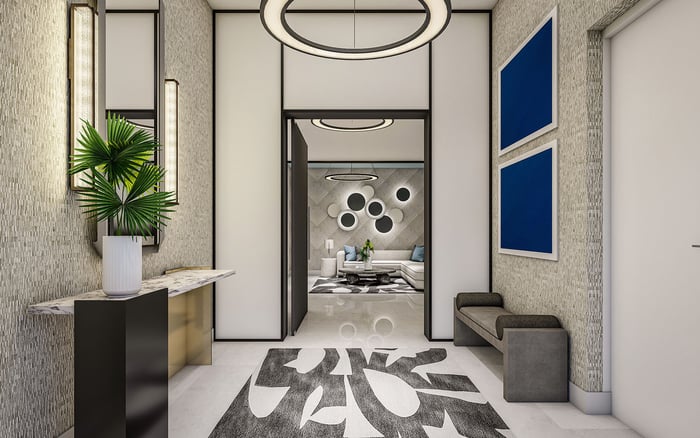
For a collector, this is where design decisions become insurance decisions. Stone finishes, custom millwork and gallery lighting should be valued separately and checked against the HO-6 building-property limit wherever the master policy does not insure their replacement. A substantial contents limit is not the same as adequate interior coverage.
If South Flagler House West Palm Beach is on your shortlist, follow the same process: identify the proposed residence’s interior elements, establish who insures them and match the owner’s limits to that responsibility. Neither the address nor the quality of the finishes establishes coverage.
Request a written summary separating association-insured property, owner-insured interiors and personal contents. Use it as the working brief for your HO-6 quotation.
A percentage deductible can sound modest until its dollar basis is clear. Commercial master-policy windstorm deductibles may be expressed as percentages such as 2% or 5%; the building’s actual policy determines the applicable percentage and how it operates.
If a deductible applies to a $100 million insured building value, 2% equals $2 million and 5% equals $5 million. These are illustrations, not estimates for any named condominium.
Next, establish the allocation. Ask how the association would fund the uninsured deductible and what share could be assessed to your residence. Do not assume equal division: review the governing documents and applicable allocation provisions.
For illustration, a $4 million deductible divided equally among 200 units would produce $20,000 per unit. Change the allocation or the amount funded by the association, and the owner’s exposure changes.
Apply this same dollar-based comparison when extending a West Palm Beach search to Shorecrest Flagler Drive West Palm Beach. Compare the insurance obligations established by the documents, not percentages in isolation.
The association’s deductible and your personal hurricane deductible are distinct obligations. Confirm that the proposed HO-6 policy includes wind coverage, then ask for its hurricane deductible and the coverage amount used to calculate it.
Do not calculate that deductible from the residence’s purchase price unless the policy expressly requires that basis. It may instead use a stated policy coverage limit.
For example, a personal hurricane deductible of 5% on a $500,000 applicable coverage limit is $25,000. That amount is separate from a potential association assessment. One storm could therefore require analysis of both obligations-not a single deductible figure.
Ask your adviser to present the personal deductible and potential assessed share side by side, with any proposed insurance response shown separately. Keeping those figures distinct makes the remaining exposure easier to understand.
Loss-assessment coverage can pay an owner’s assessed share of a common-property loss, but only when the underlying loss and assessment satisfy the policy’s terms.
Florida condominium unit-owner policies must include at least $2,000 in property loss-assessment coverage, with a deductible no greater than $250 for assessments arising from the same direct loss. For that statutory coverage, no additional loss-assessment deductible applies when a deductible has already applied to other property damage from the same direct loss. The minimum does not establish what is adequate for a particular residence.
Request written confirmation that an assessment for the association’s hurricane deductible is covered. Then request the deductible-assessment sublimit: the amount available for that purpose can be lower than the overall loss-assessment limit.
Size protection against the unit’s potential master-deductible exposure, but examine the exclusions and sublimits before treating the proposed limit as usable coverage. Reserve funding, routine capital work and fines generally fall outside coverage for insured property losses.
Neither the master policy nor a large HO-6 contents limit should be assumed sufficient for valuable art. Request a separate comparison of ordinary contents insurance with scheduled-property or personal-articles protection.
Ask the specialist to address humidity, HVAC failure, flood, transit and relocation expressly in the proposed wording. Do not assume any of these exposures is covered or treat ordinary additional living expense coverage as art-relocation insurance.
For a broader city comparison involving Mr. C Residences West Palm Beach, maintain the same collection-specific review rather than treating the building’s insurance as a substitute.
Before closing, bring the master policy, HO-6 proposal, art coverage and assessment analysis together. Review reserves and planned capital projects alongside deductibles to understand how uninsured costs would be funded. The result should be a clear account of what is insured, what is conditional and what you must be prepared to fund yourself.
Explore South Flagler Drive residences with MILLION and make insurance clarity part of your purchase criteria.
If branded residences are on your mind — as a home or as an allocation — we would be glad to share what we are seeing, privately.
Begin a quiet conversationRequest the master-policy declarations, complete policy, endorsements and any separate wind policy. Compare them with the condominium declaration and bylaws to establish coverage responsibilities.
No. Association insurance generally covers the structure and common elements, while owner coverage addresses contents and interior items outside that protection; the applicable documents establish the boundary.
Value stone finishes, millwork and gallery lighting separately. Check those values against the HO-6 building-property limit wherever the master policy does not insure their replacement.
Apply the percentage to the insured value specified by the policy. If the applicable building value is $100 million, a 2% deductible equals $2 million.
Not necessarily. Ask how the governing documents allocate the cost and how the association intends to fund the uninsured deductible.
No, they are separate obligations. Your personal deductible follows your HO-6 terms, while an assessment reflects costs allocated by the association.
Florida condominium unit-owner policies must include at least $2,000, with a deductible no greater than $250 for assessments from the same direct loss. For that statutory coverage, no additional assessment deductible applies if a deductible already applied to other property damage from that loss.
No. Confirm that master-deductible assessments are covered and request any separate deductible-assessment sublimit in writing.
No. Reserve funding, routine capital work and fines generally fall outside coverage for insured property losses.
Do not assume it is. Request a specialist comparison with scheduled-property or personal-articles protection, including explicit review of the collection’s relevant risks.