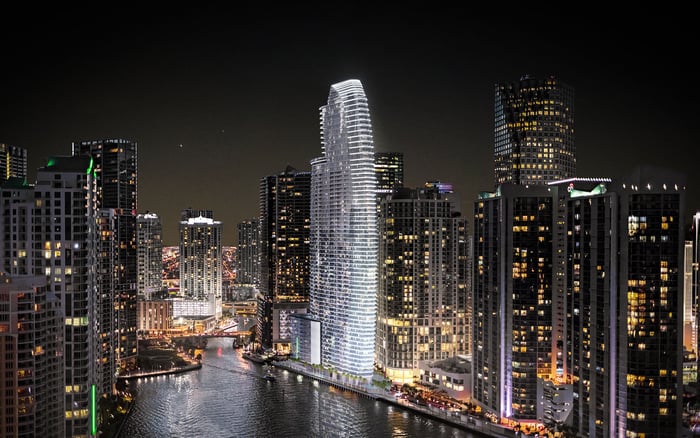
A buyer-focused comparison of two of Miami’s most closely watched luxury residential launches: the singular supertall statement of Waldorf Astoria Residences Downtown Miami and the art-led, riverfront campus vision of Faena Residences Miami Downtown Miami.

In today’s upper tier of Miami residential development, some of the most revealing comparisons are between projects that pursue very different expressions of prestige. That is the case with Waldorf Astoria Residences Downtown Miami and Faena Residences Miami Downtown Miami.
For buyers evaluating luxury residential launches at the highest level, the contrast begins with form. Waldorf Astoria is presented as a singular supertall statement in Downtown Miami. Faena, by contrast, is framed as a two-tower riverfront concept built around art, wellness, social programming, and a more immersive lifestyle narrative.
This is less a question of which project is more luxurious and more a matter of what kind of luxury a buyer wants to inhabit. One prioritizes skyline authority and hotel-style service. The other builds its appeal around atmosphere, community, design culture, and the experience of place.
Waldorf Astoria Residences Downtown Miami is designed to be seen. Its stacked composition of offset glass cubes gives the tower one of the most distinctive silhouettes in the city, reinforcing the idea that the building itself is part of the ownership proposition. Buyers drawn to highly legible skyline architecture may also compare it with projects such as Aston Martin Residences Downtown Miami.
Yet height alone is not the full thesis. The project is positioned as a true hotel-residence hybrid rather than simply a branded tower in name. That matters because the Waldorf Astoria identity is built around service infrastructure: concierge attention, resort-style pool decks, spa and fitness offerings, and hotel-level hospitality. In practical terms, it is aimed at buyers who want their residence to operate with the efficiency and reassurance of a globally recognized luxury hotel.
The design team adds another layer of confidence. For the buyer profile this attracts, the appeal is clear: a globally recognized hospitality name, a commanding Downtown address, and a residence designed for visible ownership.
Faena Residences Miami Downtown Miami takes a more atmospheric approach. Positioned near the Miami River rather than in the traditional central business district core, the project is envisioned as a culturally driven residential environment. Its emphasis is not maximum height but a richer sequence of experiences across two towers and a landscaped riverfront setting.
The development concept leans into the Faena brand’s long association with art-led luxury environments. That matters because the Faena proposition rests heavily on authorship, mood, and curation.
Amenities support that positioning. Publicly described programming emphasizes wellness spaces, social areas, gathering places, marina access, and substantial outdoor environments. In this sense, Faena reads more like a residential campus than a singular statement tower. Buyers who have gravitated toward design-forward projects such as Villa Miami may understand the appeal of a development where the emotional environment is as important as the architecture itself.
The projects also ask buyers to choose between two forms of urban proximity. Waldorf Astoria occupies a more orthodox Downtown position, directly aligned with the district’s business, hospitality, and skyline identity. For owners who want immediate recognition, direct centrality, and the kind of arrival associated with a landmark tower in the urban core, that is a meaningful advantage.
Faena’s location near the Miami River offers a different luxury rhythm. It remains tied to Downtown Miami, but with a looser, more experiential relationship to the city. The riverfront setting opens the door to a lifestyle oriented around outdoor space, marina access, and a more curated enclave feel. For some buyers, that separation from the central business district is not a drawback. It is the point.
That distinction mirrors how affluent buyers already parse Miami’s submarkets. Some want the high-visibility intensity of Downtown and Brickell, where projects like Baccarat Residences Brickell reinforce a service-rich urban luxury model.
At this level of the market, branding is not decorative. It is operational. Waldorf Astoria’s advantage comes from a hospitality system buyers already understand. The brand signals consistency, trained service, and a classic luxury standard translated into residential life. The purchase is not just a home. It is entry into a known service universe.
Faena’s brand language is more editorial than institutional. Its strength lies in immersive placemaking, in the promise that the building will feel culturally authored rather than merely well serviced. For the right buyer, that can be the more compelling form of exclusivity. A residence that belongs to a broader creative narrative may feel rarer than one attached to a famous hotel flag, even if the latter carries greater global name recognition.
This is why the comparison works so well. Waldorf Astoria is status-forward. Faena is sensibility-forward. Both are premium. They simply answer different emotional briefs.
Buyers considering Waldorf Astoria Residences Downtown Miami are likely prioritizing visibility, immediacy, and the assurance of hotel-caliber living in the heart of Downtown. They may be purchasing a primary residence, a city base, or a trophy asset that reads clearly within Miami’s evolving skyline. For that audience, the tower’s height, profile, and branded service platform are not secondary benefits. They are the central reason to buy.
Buyers drawn to Faena Residences Miami Downtown Miami are more likely to place equal weight on design narrative, cultural identity, and the everyday choreography of shared spaces. They may prefer a riverfront environment, a broader campus feel, and a residence embedded in a more expressive lifestyle proposition. For this buyer, the fact that Faena is not defined by supertall scale may actually sharpen its distinction.
If the brief is unmistakable skyline status, Waldorf Astoria is the clearer answer. Its supertall scale, highly recognizable form, and hotel-residence hybrid model give it a level of public identity few Miami projects can match.
If the brief is cultural curation, Faena offers the more differentiated proposition. Its two-tower composition, riverfront setting, and emphasis on art, wellness, and communal programming create a residential vision that feels less like a vertical emblem and more like an authored world.
For many sophisticated buyers, the ultimate choice will come down to whether luxury should feel ceremonial or immersive. Waldorf Astoria excels at the former. Faena is compelling precisely because it pursues the latter.
What is the main difference between Waldorf Astoria Residences Downtown Miami and Faena Residences Miami Downtown Miami? Waldorf Astoria is presented as a singular supertall tower centered on skyline presence and hotel-style service, while Faena is framed as a two-tower riverfront concept centered on culture, wellness, and curated lifestyle.
Which project has the stronger skyline impact? Waldorf Astoria has the clearer skyline advantage because its height and sculptural profile are central to the project’s identity.
Is Faena Residences Miami Downtown Miami in the Downtown core? It is described as being near Downtown in the Miami River area rather than in the traditional central business district core.
Is Waldorf Astoria Residences Downtown Miami better for buyers who want a landmark tower? Yes. Its appeal is closely tied to visible skyline presence, brand recognition, and a trophy-tower identity.
Is Faena Residences Miami Downtown Miami better for buyers focused on lifestyle programming? It may be, especially for buyers who prioritize atmosphere, wellness, gathering spaces, and a more curated residential setting.
How do the two projects differ in layout concept? Waldorf Astoria is positioned as a singular tower, while Faena is described as a two-tower campus-style concept.
Which project is more aligned with hotel-style living? Waldorf Astoria is the more direct fit for buyers seeking a branded hospitality model with service-led daily living.
Which project may appeal more to buyers who value design narrative? Faena may resonate more with buyers who want a residence shaped by mood, curation, and a broader creative identity.
How should buyers think about the location difference? The key distinction is core Downtown centrality versus a riverfront setting with a somewhat more enclave-like feel.
What is the best way to shortlist comparable options for touring? Start with location fit, delivery status, and daily lifestyle priorities, then compare stacks and elevations to validate views and privacy.
For a discreet conversation and a curated building-by-building shortlist, connect with MILLION Luxury.
If branded residences are on your mind — as a home or as an allocation — we would be glad to share what we are seeing, privately.
Begin a quiet conversation