A buyer-focused comparison of the wellness scale and operational disclosures at Faena Residences Miami and W Pompano Beach, with precise questions to ask about capacity, air, water, fees and reservations before purchase.
In South Florida’s upper tier, wellness is no longer defined by the presence of a gym and pool. More useful questions address the range of experiences available to residents, how those spaces manage demand, and which technical standards govern air and water. Reservation priority, guest privileges, and additional charges can be as consequential as the architecture.
That distinction is especially relevant when comparing Faena Residences Miami Downtown Miami with W Pompano Beach Hotel & Residences. One is conceived as a riverfront cultural and residential environment near Brickell; the other combines private residences with an oceanfront W Hotel. Both propose substantial wellness programs, yet several operational and technical details remain to be confirmed.
Wellness value depends on both the spaces offered and the rules governing daily access.
For buyers approaching Branded Residences as a lifestyle purchase, amenity square footage is an important opening measure. It is not, however, a substitute for room-by-room capacity, mechanical specifications, or enforceable access terms.
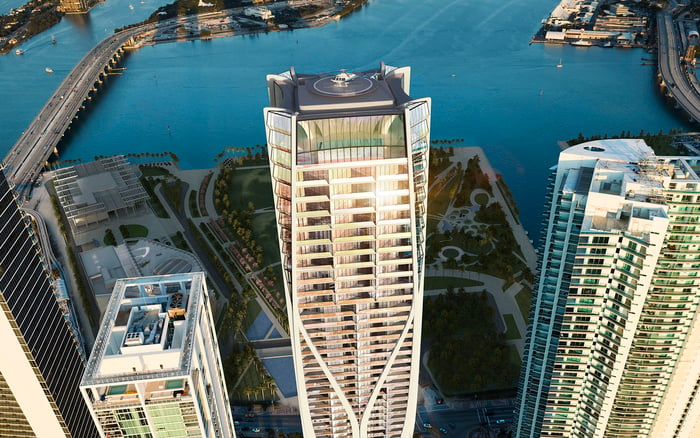
Faena’s Sky Bridge spans three amenity levels and a rooftop, encompassing more than 100,000 square feet of resident amenities. The program includes an infinity-edge pool, restaurant, lounges, creative spaces, and a wellness center, creating multiple settings where leisure, fitness, and recovery can occur simultaneously.
The wellness offering is notably layered. Plans identify a 25-meter smart pool with underwater sound, a red-light infrared sauna, and cold-plunge experiences. A botanical steam room is promoted as operating at 100% humidity with cold-pressed South American botanicals. Inspired by Italian thermal spas, the wider sanctuary combines hot and cold plunges, saunas, steam rooms, treatment suites, and relaxation lounges. Fitness areas add Technogym equipment, boxing, yoga, and Pilates.
This breadth suggests demand can disperse across multiple activities. It does not reveal how many residents may occupy the smart pool, thermal rooms, treatment suites, or movement studios at once. The promoted “Sauna Penthouse” is a distinctive marketing description, not a disclosed capacity standard or third-party designation.
For a Downtown Miami buyer, the practical request is a capacity schedule detailing occupancy by room, operating hours, and any restrictions during private programming. Those evaluating the neighborhood more broadly may also consider The Residences at 1428 Brickell, but wellness comparisons should remain document-led rather than driven by headline amenity totals.
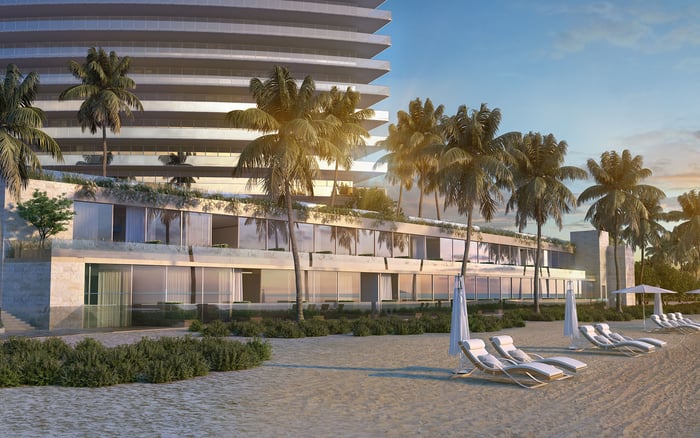
At W, the wellness proposition is distributed across private residential facilities and branded hotel concepts. Residents are slated to have a private lobby and a 12,000-square-foot outdoor pool deck with a dedicated spa, private cabanas, and a chef’s grilling station. The larger hotel-oriented WET® Pool Deck spans approximately 60,000 square feet, with a resort pool, Jacuzzi, cabanas, bar and restaurant, plus pickleball and padel courts.
AWAY® Spa is planned at approximately 6,800 square feet. Its program includes massage suites, a cold plunge, Jacuzzi, sauna, steam rooms, and nail services. FIT® adds a gym and yoga studio, while the broader recreation offering includes pickleball, padel, F1 racing, and multisport or golf simulators.
Separate decks and spa facilities can help distribute activity, yet size should not be interpreted as guaranteed availability. User limits for pools, thermal rooms, and treatment suites are not stated. Some hotel-style services and amenities also require additional payment and are not automatically included with ownership.
That creates a central question for any Pompano Beach purchase: Which amenities are resident entitlements, which are shared with hotel guests, and which require payment or advance booking? Buyers comparing oceanfront options such as The Ritz-Carlton Residences® Pompano Beach should apply the same test to access, cost, and priority-not merely the number of water features.
Neither development currently publishes maximum occupancy for individual wellness zones. Buyers should therefore distinguish among three considerations: physical scale, simultaneous-user capacity, and practical availability. A large pool deck may accommodate many people while a sauna, massage suite, or Pilates studio remains capacity-constrained.
Request a matrix covering every pool, plunge, thermal room, studio, and treatment space. It should identify posted occupancy, resident-only periods, hotel or guest access, class sizes, private-event rights, and seasonal operating hours. Ask whether cabanas, courts, and treatments use separate reservation systems and whether unscheduled access is preserved.
The key point is simple: Multiple zones create flexibility, but only governing documents and operating procedures can establish who receives priority when demand is highest.
Faena does not specify filter ratings for residences or common areas, outside-air delivery rates, dedicated outdoor-air systems, or detailed humidity controls. W likewise does not publish MERV or HEPA specifications, outside-air rates, or detailed ventilation standards for residences, hotel spaces, and spa wet zones.
These omissions do not establish that suitable systems are absent. They mean buyers need technical schedules before assigning value to air-quality claims. Request filter ratings, outside-air quantities, humidity-control design, exhaust provisions, and the party responsible for filter replacement. In wet wellness areas, ask how steam, odors, and moisture are isolated from adjacent relaxation, fitness, and circulation spaces.
Also clarify whether residential HVAC is individually controlled and whether common wellness zones operate on separate systems. The most useful answers will be numerical, space-specific, and supported by clearly assigned maintenance responsibilities rather than general assurances.
Both developments describe extensive hydrotherapy, but neither identifies potable-water filtration grades or treatment methods for its pools, Jacuzzis, and cold plunges. Faena does not specify whether its systems use chlorine, bromine, salt, ultraviolet light, or ozone. W similarly leaves its pool and spa disinfection systems undisclosed.
Buyers should request potable-water specifications, pool and spa mechanical schedules, disinfection methods, and documented testing protocols. Questions should cover testing frequency, recordkeeping, closure procedures following an out-of-range result, and maintenance responsibility. For thermal circuits, confirm whether each feature has an independent system or shares equipment with another body of water.
Water filtration within the residence deserves separate attention. Ask whether filtration is building-wide, point-of-entry, or point-of-use; which contaminants the specified media addresses; who replaces consumables; and whether owners may install supplementary equipment.
Faena does not provide booking windows, cancellation terms, guest limits, or treatment-room procedures. W also does not state booking windows, cancellation penalties, resident-priority rules, or guest limits for spa treatments and shared hotel amenities.
Before making contract decisions, request draft condominium rules, guest policies, fee schedules, and spa reservation procedures. Confirm how far in advance residents can book, whether unused reservations carry penalties, whether guests must be accompanied, and whether hotel patrons compete for the same appointment inventory. At W, obtain a written distinction between included amenities and services requiring additional payment. At Faena, clarify whether classes, treatments, creative programming, or special events alter ordinary resident access.
Ultimately, the stronger wellness purchase is not necessarily the project with the largest amenity figure. It is the residence whose capacity, environmental systems, and access rules best align with the owner’s actual routine, with all material terms confirmed in writing.
For discreet guidance on comparing South Florida wellness residences and their governing documents, connect with MILLION.
If branded residences are on your mind — as a home or as an allocation — we would be glad to share what we are seeing, privately.
Begin a quiet conversationThe Sky Bridge spans three amenity levels plus a rooftop and provides more than 100,000 square feet of resident amenities.
Plans include a 25-meter smart pool, infrared sauna, cold plunges, steam rooms, treatment suites, relaxation lounges and dedicated movement spaces.
No room-by-room maximum occupancies are disclosed for its pools, thermal rooms, studios or treatment spaces.
Residents are slated to receive a 12,000-square-foot outdoor pool deck with a dedicated spa, private cabanas and a chef’s grilling station.
The WET® Pool Deck is approximately 60,000 square feet, while AWAY® Spa is planned at approximately 6,800 square feet.
Not necessarily. Some hotel-style services and amenities require additional payment.
No. MERV or HEPA ratings, outside-air rates and detailed ventilation standards are not specified.
No. The available details do not identify whether the water systems use chlorine, bromine, salt, ultraviolet light, ozone or another treatment method.
Booking windows, cancellation penalties, resident-priority procedures and comprehensive guest limits are not stated.
Request draft condominium rules, guest and fee policies, reservation procedures, HVAC schedules, water specifications and pool or spa testing protocols.