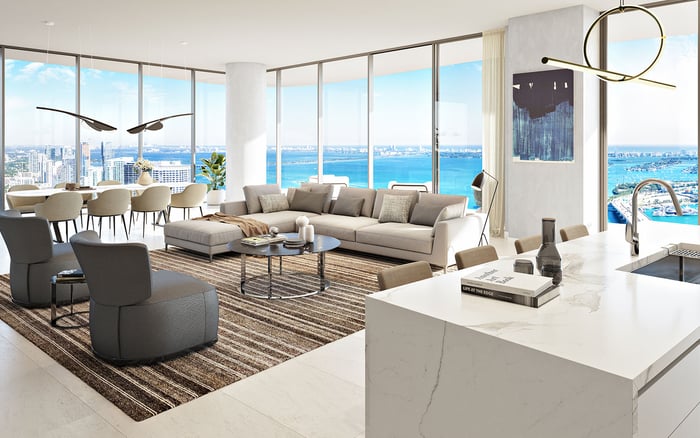
A buyer-focused comparison of the service models, staffing signals, gratuity questions, and ownership-cost considerations shaping two of Miami’s most prominent branded residences.

Miami’s branded-residence market requires buyers to evaluate more than architecture, views, and amenity plans. Service delivery can shape daily life as directly as the residence itself, particularly at EDITION Edgewater and Waldorf Astoria Residences Downtown Miami.
The two properties use the language of luxury hospitality, but buyers should examine how each operating model defines included services, optional services, shared personnel, guest access, and incidental charges. The essential question is not which project presents the longest amenity list, but how consistently its service platform can support an owner’s preferred lifestyle-and at what total annual cost.
An amenity plan does not, by itself, establish a service standard. Buyers should distinguish physical spaces from the personnel, hours, booking procedures, usage rules, and fees required to operate them.
Front-of-house functions may include reception, concierge, security, valet, doorman, porter, bell, or residence-management roles. The practical comparison should focus on which positions are dedicated to residents, which may be shared, how requests are prioritized, and whether coverage changes overnight or during peak periods.
Service descriptions also require careful reading. Assistance with reservations, deliveries, transportation, housekeeping, maintenance, dining, spa appointments, or in-residence requests may represent coordination rather than an included benefit. Buyers should confirm who performs each service and how the charge appears on the owner’s account.
Neither property publicly discloses a staff-to-residence ratio. Buyers should not treat that omission as proof of either limited or abundant staffing. A raw ratio can obscure shift coverage, supervisory roles, shared personnel, outsourced vendors, and the difference between guest-facing and operational employees.
A more useful review considers service breadth, response structure, escalation procedures, and dedicated residential oversight. Buyers comparing nearby Edgewater options such as Aria Reserve Miami should ask the same questions so that staffing comparisons use consistent definitions.
Written diligence should address the number of residences served, positions scheduled by shift, after-hours procedures, vendor reliance, response targets, and service recovery when demand exceeds normal capacity. These details provide more insight than a single headline ratio.
Neither project provides a detailed public gratuity policy. Written clarification is therefore important for valet, housekeeping, spa treatments, dining, bell assistance, and third-party vendors. Buyers should ask whether automatic service charges apply, whether gratuities are pooled, and whether holiday tipping is customary but discretionary.
Optional services deserve separate review. Housekeeping, laundry, pet care, childcare, personal training, in-residence spa treatments, car care, grocery assistance, vacant-home care, and other concierge-arranged services may involve separate fees or outside providers. Coordination by building staff does not necessarily mean the underlying service is included in common charges.
Account-signing privileges can simplify purchases, but convenience should not be confused with inclusion. Buyers should request a sample owner statement showing how service fees, vendor costs, taxes, and gratuities are identified.
Annual carry begins with association dues, but it does not end there. A credible ownership model should consider property taxes, residence insurance, utilities, parking, optional housekeeping, dining, spa use, service fees, and discretionary gratuities. Owners who travel frequently may also need to budget for vacant-home care, pet services, package handling, and recurring in-residence maintenance.
Any dues estimate should be confirmed against current project documents. Buyers should verify the amount, billing period, inclusions, residence type, reserve assumptions, and potential allocation of expenses between residential and hospitality components.
Request the latest available operating budget, reserve schedule, assessment information, service-fee schedule, hotel-service price list, parking charges, insurance assumptions, and gratuity policy. Identify which expenses are fixed, which vary with usage, and which outside vendors may reprice.
The same discipline applies when evaluating Downtown Miami alternatives such as Aston Martin Residences Downtown Miami. The meaningful comparison is not dues alone, but the annual cost of recreating the service routine an owner expects to use.
EDITION Edgewater and Waldorf Astoria Residences Downtown Miami present different branded-residence settings, yet both require a careful distinction between standard operations and optional consumption. Buyers should compare not only what can be requested, but who delivers it, when it is available, how it is charged, and what happens if pricing or service scope changes.
For a luxury buyer, annual carry is best understood as a personalized operating budget rather than a single association-dues figure. Current governing documents, budgets, fee schedules, management disclosures, and written service policies should control the final analysis.
Does EDITION Edgewater publish a staff-to-residence ratio? No public ratio is identified. Buyers should request current staffing and shift-coverage details directly through project documentation.
Does Waldorf Astoria Residences Downtown Miami publish a staff-to-residence ratio? No public ratio is identified. The more useful review considers dedicated roles, shared teams, hours, and response procedures.
Is housekeeping included at EDITION Edgewater? Buyers should confirm whether housekeeping is included, separately purchased, or arranged through an outside provider in the current service schedule.
Is housekeeping available at Waldorf Astoria Residences Downtown Miami? Buyers should review the current service menu, pricing, booking process, and any applicable service charges before relying on availability.
Are gratuities mandatory at either property? Neither project publicly discloses a detailed mandatory gratuity policy. Written confirmation should address automatic charges and discretionary tipping.
What should buyers ask about tipping? Confirm automatic service charges, pooled gratuities, and expectations for valet, spa, dining, housekeeping, bell assistance, and vendors.
What belongs in annual carry? Consider dues, taxes, insurance, utilities, parking, optional services, service fees, maintenance, and discretionary gratuities.
Should buyers rely on an unverified dues estimate? No. Confirm the amount, billing period, inclusions, residence type, and reserve assumptions in current documents.
What documents should a buyer request? Request current budgets, reserve information, assessment details, service pricing, insurance assumptions, management disclosures, and gratuity policies.
Which property has the stronger service model? The answer depends on the buyer’s preferred setting, expected service usage, tolerance for variable costs, and need for dedicated residential support.
When you're ready to tour or underwrite the options, connect with MILLION.
If branded residences are on your mind — as a home or as an allocation — we would be glad to share what we are seeing, privately.
Begin a quiet conversation