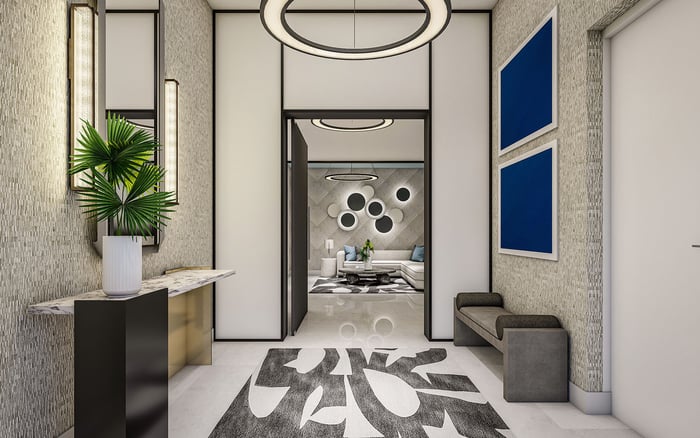
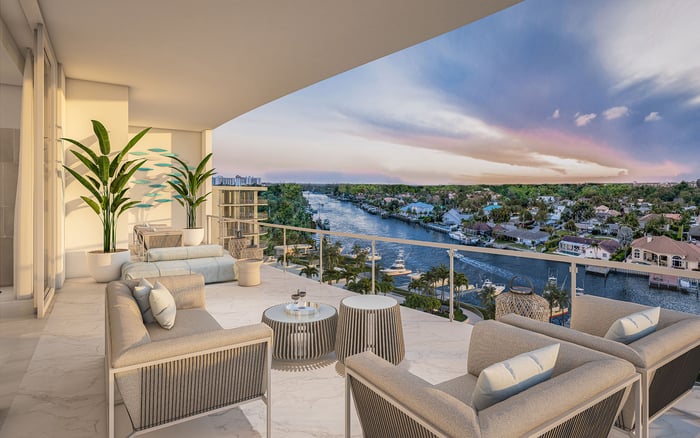
A buyer-focused framework for evaluating arrival control, shared areas, vertical circulation, guest access, and residence-owner privacy at two branded South Florida residences.

At a branded residence, privacy depends on how people move from an arrival point to residential floors, amenities, service areas, and individual homes. Buyers comparing The Ritz-Carlton Residences® Palm Beach Gardens and Viceroy Brickell should therefore examine circulation as an operating system rather than rely on branding or marketing language.
The key distinction is among genuinely public space, resident common areas, controlled guest areas, and private residential space. A clear review should identify where access changes, who grants permission, and whether visitors, staff, deliveries, and residents follow the same routes.
Begin at the property boundary or primary entrance and map every transition to the residence. Ask whether visitors are identified before entry, at a reception point, at an elevator, or through more than one checkpoint. Then determine how vehicle arrivals, pedestrian arrivals, and service access differ.
The same method should be applied to both developments. The available fact table does not establish project-specific arrival, visitor, or service protocols, so buyers should request current written information rather than infer an operating model from the setting or brand.
Shared amenities can allow owners to meet or entertain guests without bringing them into a private home, but that benefit depends on the applicable access rules. Buyers should ask whether guests must remain accompanied, whether access can be limited by time or area, and whether reservations change who may enter.
It is equally important to identify whether routes to amenities intersect with routes to residential floors. A common lobby or elevator does not necessarily eliminate privacy, while a private-sounding feature does not by itself explain how credentials, permissions, or overrides work.
Elevator terminology requires careful review. Terms such as “private,” “controlled,” or “key-activated” can describe different arrangements and should not be treated as interchangeable. Buyers should confirm how many residences use each elevator or vestibule, which floors a credential can reach, and how access is issued to guests, staff, and service providers.
Written clarification should also address emergencies, move-ins, large deliveries, maintenance visits, and credential deactivation. These practical situations often reveal more about residence-owner privacy than a general description of the elevator system.
A hospitality brand may shape service, management, or the resident experience, but branding alone does not prove that hotel guests use residential entrances, elevators, or amenities. The relevant question is whether any nonresident group can enter spaces used by owners and, if so, under what authorization and supervision.
This distinction also matters when comparing other South Florida residences, including Una Residences Brickell and The Ritz-Carlton Residences® West Palm Beach. Each property should be evaluated through its own current documents and operating procedures rather than through assumptions about a neighborhood or brand.
Request the current condominium documents, rules, access policies, and written responses addressing everyday operations. The review should cover visitor registration, amenity permissions, residential elevator credentials, deliveries, household staff, contractors, valet procedures, move-ins, and overnight guests.
Ask for a simple route map for residents, invited guests, deliveries, and staff. Note every shared threshold and identify who controls it. If a privacy feature matters to the purchase decision, seek precise written confirmation of how it works and whether the applicable documents allow the procedure to change.
What is residential circulation? It is the sequence of entrances, checkpoints, corridors, elevators, and other routes used to reach homes and resident areas.
Why distinguish public and shared areas? Public access and resident common-area access are not the same, so buyers should verify who may enter each space and under what conditions.
Does a branded residence automatically share space with hotel guests? No. Branding alone does not establish whether hotel guests use residential entrances, amenities, or elevators.
What should buyers ask about visitors? Ask how visitors are registered, who approves them, where they may go, and whether they must remain accompanied.
What should buyers verify about elevators? Confirm who shares each elevator, which floors credentials reach, and how guest, staff, and service access is managed.
Can amenities support owner privacy? They can provide places to meet guests outside the home, but the privacy benefit depends on access and accompaniment rules.
Why review delivery procedures? Delivery routes can intersect with resident circulation, making screening, handoff, and elevator policies relevant to privacy.
Which documents are most useful? Current condominium documents, rules, access policies, and written management or sales-team responses can clarify operating procedures.
Can marketing terms establish a privacy guarantee? No. Terms such as “private” or “controlled” should be tested against precise written procedures and governing documents.
How should the two projects be compared? Apply the same route-by-route checklist to each and avoid declaring one more private without current, project-specific documentation.
For a discreet conversation and a curated building-by-building shortlist, connect with MILLION.
If branded residences are on your mind — as a home or as an allocation — we would be glad to share what we are seeing, privately.
Begin a quiet conversation