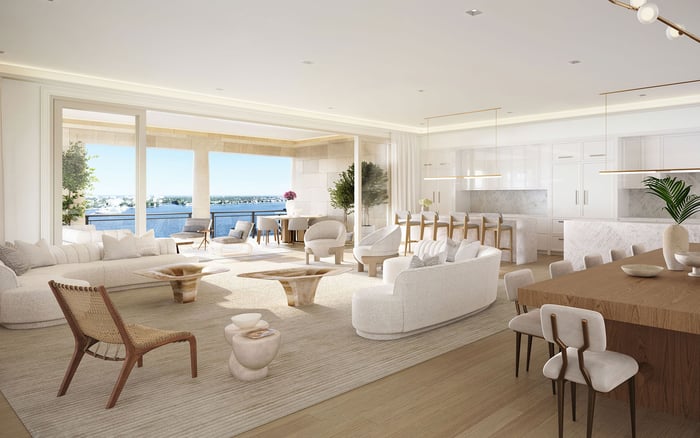
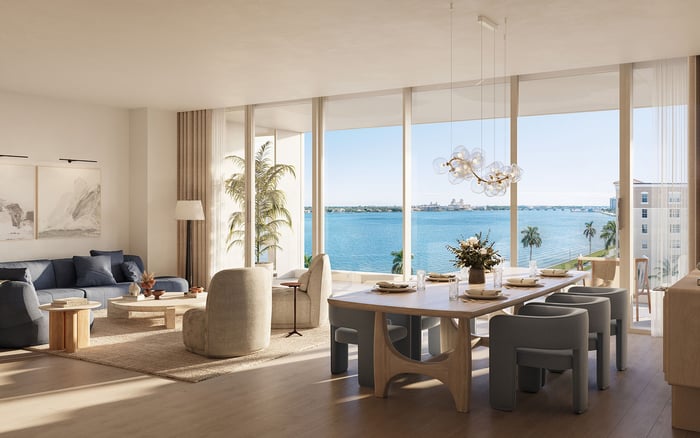
An editorial shortlist of five West Palm Beach new-construction residences, organized around the privacy questions buyers should resolve before comparing amenities.

For privacy-focused buyers, the most important part of a residence may be the sequence between arrival and the front door. Elevator access, shared circulation, neighboring entries, service movement, adjoining spaces, and the separation of private rooms from common areas can matter more than the length of an amenity list.
These qualities cannot be established by a project name, brand, rendering, or broad building description. They require residence-specific plans and current documentation. The following ranking is therefore an editorial screening order for further due diligence, not a claim that one project delivers a verified level of privacy in every home.
Forté on Flagler takes the first position on this screening list. Before treating that placement as a purchase conclusion, buyers should review the selected residence's arrival sequence, elevator relationship, neighboring doors, shared walls, and exposure to common or service areas.
South Flagler House belongs in the comparison, but privacy should be assessed at the individual-residence level. A marked plan can help identify how occupants, guests, staff, and deliveries move between the building entrance and the home.
3. The Ritz-Carlton Residences, West Palm Beach
The Ritz-Carlton Residences, West Palm Beach should be evaluated without assuming that branding determines residential discretion. Buyers can instead focus on access control, the number and position of nearby entries, elevator and corridor exposure, service routes, and the uses adjoining the chosen home.
Alba enters the shortlist as another project requiring plan-level review. The useful comparison is not only between projects but also between residence types and positions, because arrival conditions, shared boundaries, and nearby common functions may vary.
5. Mr. C Residences West Palm Beach
Mr. C Residences West Palm Beach completes the five-project screening order. Its inclusion should prompt the same disciplined review: trace the daily path to the residence, identify adjoining uses, and examine whether service activity intersects with principal living areas.
A floor plan can look generous while revealing little about the experience outside the residence. Buyers should request documentation that shows the elevator landing, foyer, corridor, stairs, service areas, refuse areas, mechanical spaces, amenity access, and neighboring entries where available.
The review should also extend inside the home. Bedrooms positioned against shared or active spaces may produce a different sense of separation than rooms buffered by closets, baths, or other secondary areas. Outdoor areas likewise require attention to sightlines, access, and their relationship to neighboring spaces.
Privacy also has an operational dimension. A household that regularly receives guests, deliveries, or staff may prioritize a different circulation pattern from an owner seeking a quiet lock-and-leave residence. Defining those routines in advance makes comparisons more precise.
Begin by writing a privacy brief. It may address lobby exposure, directness of arrival, acoustic separation, visibility from neighboring homes, outdoor seclusion, guest movement, service access, or separation between entertaining and sleeping areas.
Next, compare each candidate using the same questions:
How does a resident move from arrival to the front door?
Which portions of that route are shared?
What spaces sit beside, above, and below the residence?
How do guests, deliveries, and service personnel reach the home?
Which doors, corridors, elevators, or common functions are close to the residence?
Do the plans and governing documents answer these questions clearly?
Finally, confirm that the reviewed materials apply to the exact residence being considered. If drawings or arrangements may change, buyers should rely on the applicable transaction documents and qualified professional advice rather than an earlier marketing presentation.
Amenities can enrich ownership, but they should not distract from the parts of a property used every day. A privacy-led buyer can first test circulation, separation, access, and adjacencies, then compare lifestyle features among the candidates that satisfy the household's core requirements.
This approach also prevents broad assumptions. A prominent name does not establish privacy, and a limited shared experience cannot be inferred without documentation. The decisive question is whether the specific residence and its daily movement patterns suit the buyer.
Does the first-place ranking prove that Forté on Flagler is the most private option? No. The ranking is an editorial screening order, and the selected residence still requires document-based review.
Can a project brand establish how private a residence will feel? No. Privacy depends on residence-specific access, circulation, adjacencies, and operating patterns rather than branding alone.
Which plans should a privacy-focused buyer request? Buyers should seek current materials showing the residence, elevator landing, corridor, nearby entries, service areas, and adjoining uses where available.
Why does the arrival sequence matter? It reveals how much shared space a resident crosses and where interactions may occur before reaching the home.
How should buyers evaluate shared walls? They should identify what lies on both sides of each boundary and pay particular attention to bedrooms and other quiet spaces.
Why should service routes be reviewed? Service and delivery movement can affect how private areas function and whether household operations cross principal living spaces.
Are outdoor areas automatically private? No. Their sightlines, access points, orientation, and relationship to neighboring spaces should be examined.
Should amenities be ignored entirely? No. They can be compared after the residence meets the buyer's core requirements for access, separation, and circulation.
Can two homes in the same project offer different privacy experiences? Yes. Position, adjacencies, arrival conditions, and nearby shared functions may differ by residence.
What should buyers do if plans or arrangements may change? They should confirm the applicable transaction documents and seek qualified professional advice before relying on earlier materials.
For a discreet conversation and a curated building-by-building shortlist, connect with MILLION.
If branded residences are on your mind — as a home or as an allocation — we would be glad to share what we are seeing, privately.
Begin a quiet conversation