A discreet buyer guide to the South Florida residence types best suited for serious art collectors, with emphasis on wall planning, freight access, privacy, and long-term display control.
.jpg)
For a South Florida buyer with meaningful art, a residence is not simply a beautiful setting. It is a working environment for conservation, installation, privacy, and movement. Even the most elegant acquisition can be compromised if a major canvas cannot turn from the freight elevator, if a sculpture must cross the lobby, or if a primary wall cannot support the intended load.
The phrase “art-ready” should be treated with discipline. It is not a mood, a neutral palette, or a photogenic corridor. It means usable uninterrupted walls, controllable light, predictable humidity, reinforced hanging zones where needed, sufficient ceiling height, and a controlled route from building arrival to final placement. In South Florida, where waterfront views and glass architecture are prized, the strongest art residences balance spectacle with restraint.
For buyers comparing Miami Beach, Brickell, Sunny Isles, Fisher Island, oceanfront, and penthouse options, the essential question is not which home offers the most dramatic backdrop. It is which home gives the collection the quietest, safest, and most flexible life.
1. Full-floor oceanfront condominium - maximum privacy and clean circulation
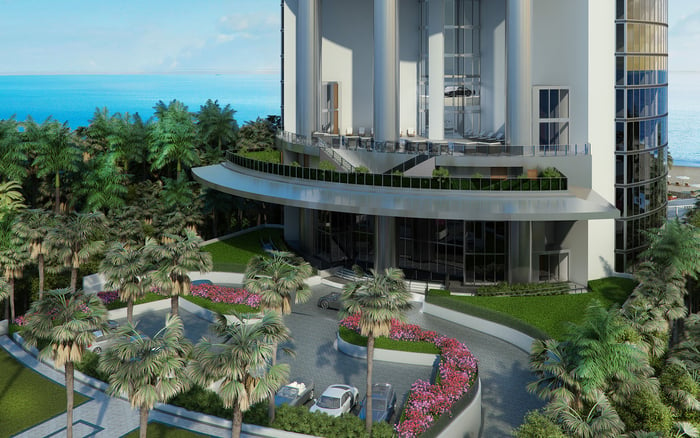
A full-floor oceanfront residence is often the most intuitive choice for collectors because it can reduce shared thresholds and simplify installation planning. Fewer immediate neighbors, more private arrival sequences, and expansive plans can make it easier to choreograph deliveries without turning an artwork move into a public event.
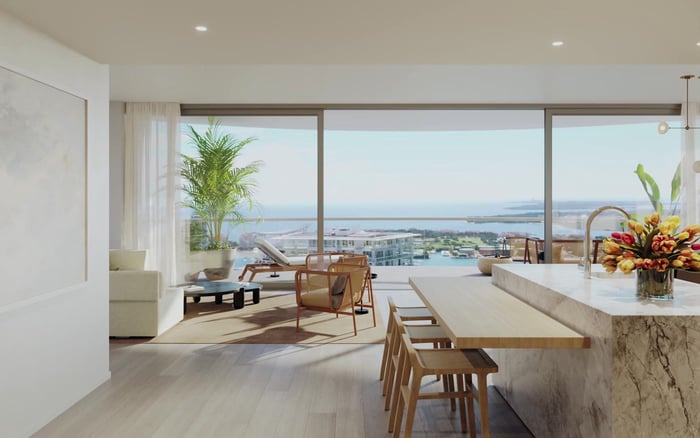
The best examples pair broad wall runs with deep terraces positioned far enough from principal display walls to limit glare. Buyers should look beyond the view line and study the full service path: loading area, freight elevator, corridor width, ceiling clearance, turning radius, and the final approach into the main living volume.
2. Penthouse with service elevator control - scale, height, and discretion
A penthouse can provide the ceiling height and spatial drama that large-format art demands. It can also introduce complications if the final delivery route is narrow, if elevator access is shared at peak hours, or if rooftop mechanical areas affect climate consistency.
The strongest penthouse candidates have a clear service strategy. A collector should confirm whether freight reservations are managed discreetly, whether crating can be staged safely, and whether installers can access the residence without crossing principal guest areas. Scale matters only when the building can support the mechanics of scale.
3. Boutique waterfront residence - fewer units and more manageable moves
Boutique buildings can be especially compelling for collectors who value discretion over spectacle. A smaller resident population may make freight scheduling more predictable, while calmer common areas can reduce congestion during installation.
The tradeoff is that boutique does not automatically mean technically superior. Buyers should verify elevator dimensions, delivery policies, dock or porte-cochère procedures, and whether walls can be modified for blocking, lighting, or specialty hanging systems. A serene building is ideal only when its back-of-house design is equally composed.
4. Brickell high-rise residence - urban access with careful light control
Brickell appeals to buyers who want a metropolitan base near dining, finance, and cultural energy. For art owners, the opportunity is convenience. The challenge is glass. Many high-rise residences favor panoramic glazing, which can reduce serious wall space and increase the importance of controlled lighting and UV strategy.
The right Brickell residence offers more than impressive skyline views. It has rooms with purposeful walls, flexible lighting circuits, reliable climate control, and a freight route that installers can navigate without improvisation. In this category, restraint in the floor plan can be more valuable than visual drama.
5. Private island or gated waterfront residence - estate-level control
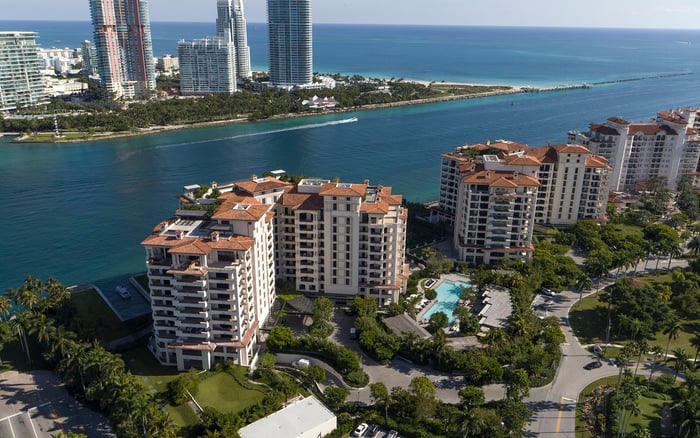
For some collectors, the most compelling South Florida solution is a private island, gated waterfront, or estate-style residence where access can be controlled from the property line. This format may allow greater authority over timing, staging, security, and installation privacy.
The buyer should still be exacting. Long driveways, bridges, gatehouses, steps, narrow entries, or decorative thresholds can all complicate art movement. The ideal private residence offers not only land and discretion, but also a calm, protected route for crates, lifts, installers, and conservators.
A wall becomes art-ready through planning, not paint. Collectors should ask where blocking exists, which walls can accept additional reinforcement, and how lighting will be controlled in each room. Large works often need more than a centered picture light. They may require balanced ambient light, low-glare fixtures, dimming scenes, and careful coordination with shade systems.
Wall value is also a matter of editing. A residence with fewer but stronger display planes may serve a collection better than a larger home interrupted by doors, millwork, glass corners, vents, and media walls. The most successful interiors leave space for art to breathe. They do not force important pieces into leftover zones.
Humidity and temperature deserve equal attention. South Florida’s climate makes high-performance mechanical systems more than a comfort feature. For collectors, consistent interior conditions are part of the residence’s cultural infrastructure.
Controlled freight access is rarely the detail that sells a residence in photographs, but it is one of the details sophisticated buyers remember. A proper art move requires timing, insurance coordination, security awareness, and room to maneuver. The goal is to avoid public exposure, reduce handling, and protect both the artwork and the building.
Before contract, buyers should request the building’s move rules and ask how fine art deliveries are handled. Confirm whether there is a dedicated freight elevator, how reservations are managed, what size crates can be accommodated, and whether after-hours delivery is permitted. In a condominium, the association’s policies can matter as much as the floor plan.
Privacy is part of the equation. A controlled route helps keep the collection discreet, limits unnecessary observation, and reduces friction with other residents. For serious collectors, this is not convenience. It is stewardship.
Start with the art, then evaluate the residence. Measure the largest works, including crates. Study the elevator, corridor, door, and vestibule dimensions as a continuous path rather than isolated numbers. Walk the route with the same discipline an installer would use.
Next, evaluate walls by quality, not quantity. Look for uninterrupted planes, logical viewing distances, controlled sunlight, and mechanical consistency. Ask which walls can be reinforced and which are constrained by structure, plumbing, or mechanical systems.
Finally, consider how the residence will adapt. Collections evolve. A home that can accept new lighting, new hanging systems, and changing curatorial priorities will age more gracefully than one designed around a single decorative moment.
What makes a residence truly art-ready? It should have usable wall planes, controlled light, stable climate, and a safe installation route. Finishes matter, but infrastructure matters more.
Is a penthouse always best for large artworks? Not always. A penthouse may offer height and scale, but elevator size, service access, and delivery policies must support the work.
Why is freight access so important for collectors? Freight access reduces handling risk and protects privacy. It also determines whether large crates and specialized installers can move efficiently.
Are glass-heavy residences bad for art? They can be challenging if sunlight and glare are not controlled. Shade systems, UV strategy, and thoughtful wall placement are essential.
Should buyers review building move rules before purchasing? Yes. Rules on freight reservations, after-hours access, insurance, and staging can affect how comfortably a collection can be installed.
Can an existing residence be upgraded for art? Often, yes. Lighting, wall reinforcement, shades, and climate adjustments may be possible, subject to building and structural constraints.
What is the best South Florida location for collectors? The best location depends on lifestyle and the collection’s needs. Waterfront, urban, boutique, and private settings each offer different strengths.
How should a buyer assess wall space? Look for uninterrupted planes, appropriate viewing distance, limited glare, and room for future rotation. Avoid judging by square footage alone.
Do private homes solve all art logistics issues? No. Gates, steps, tight entries, and landscape features can still complicate movement. The full route must be reviewed carefully.
When should art consultants or installers be involved? Ideally before purchase or during due diligence. Their practical review can reveal constraints that are not obvious during a showing.
For a tailored shortlist and next-step guidance, connect with MILLION.
If branded residences are on your mind — as a home or as an allocation — we would be glad to share what we are seeing, privately.
Begin a quiet conversation