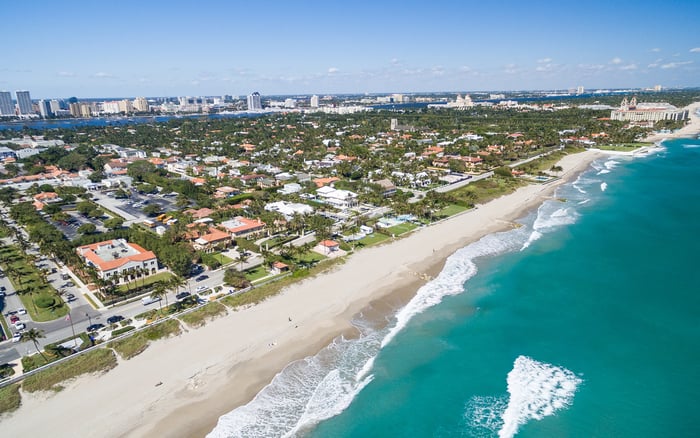
A buyer-focused ranking of five South Florida luxury condo corridors where seasonal ownership can be paired with credible independent home-watch and estate-management support.

A South Florida residence intended for later life must perform in two distinct modes. When occupied, it should support ease, dignity, and a low-friction daily routine. When vacant, it requires a dependable system for inspections, reporting, maintenance access, storm preparation, and emergency coordination. A beautiful condominium is only half of that equation.
This ranking identifies five luxury-condominium corridors where seasonal ownership can be paired with credible absence-care services. It evaluates service-market fit rather than price, as no acquisition costs are included. Nor does it assume that a condominium association provides private home watch. In most cases, owners retain an independent home-watch, concierge, or estate-management firm under a separate agreement.
The strongest seasonal residence is designed for both graceful occupancy and disciplined vacancy.
A serious home-watch arrangement extends beyond an occasional walkthrough. Common services include visual inspections, digital reports, early problem identification, vendor coordination, and seasonal preparation. More comprehensive programs may add photo or video documentation, contractor supervision, maintenance reporting, mail handling, secure keyholding, and emergency response.
The appropriate scope depends on the residence and the owner's travel pattern. A lightly furnished apartment may require scheduled checks and pre-arrival preparation. A larger home with vehicles, a vessel, or extensive household operations may warrant estate management, laundry logistics, grocery provisioning, and special arrival requests. Buyers should define the required service level before comparing contracts.
1. Boca Raton and Highland Beach oceanfront corridor - focused absentee oversight
This Palm Beach County corridor ranks first because the local absence-care market expressly serves seasonal residences, estates, and absentee homes. Available programs emphasize detailed inspections, proactive monitoring, and concierge-level oversight, establishing a strong foundation for owners who may be away for extended periods.
For aging in place, buyers should assess each building rather than rely on location alone. Step-free circulation, elevator resilience, emergency power coverage, staff procedures, and access for authorized caregivers or vendors all warrant direct confirmation.
2. Palm Beach Island luxury condos and co-ops - broad management support
Palm Beach ranks second for access to county-focused luxury home management, turnkey assistance, and concierge service. That breadth is valuable for an owner seeking a residence that can be closed, monitored, maintained, and prepared for return without improvisation.
Co-op and condominium rules can differ, particularly regarding contractor access, keys, deliveries, and representatives entering during an owner's absence. The service agreement and building protocol should therefore be reviewed together.
3. Miami and Miami Beach luxury high-rises - documented urban care
Brickell, Edgewater, and South of Fifth offer a deep urban absence-care proposition. Available services include weekly inspections with photo or video reports, contractor oversight, monthly maintenance reporting, mail handling, emergency coordination, and secure keyholding.
This documented approach can suit owners who want a clear record while away. It remains essential to determine how an outside provider coordinates with management, security, loading areas, parking, and emergency procedures in a high-rise setting.
4. Fort Lauderdale and coastal Broward condos - flexible service depth
Fort Lauderdale beach, the Intracoastal, and coastal Broward County rank fourth. Seasonal residents can access lighter-touch home-watch programs designed for extended travel or vacancy, as well as more comprehensive estate-management options when a property requires active supervision.
That flexibility allows the care plan to evolve as household needs change. Before departure, buyers should clarify visit frequency, reporting format, escalation authority, vendor approval, and storm-related responsibilities.
5. Jupiter, Palm Beach Gardens, and Singer Island - northern county coverage
These northern Palm Beach County markets rank fifth for access to countywide luxury home management and concierge support suited to seasonal residences. The combination can appeal to buyers who value a northern location but still require organized check-ins, property preparation, and vendor coordination.
As elsewhere, the building's capabilities matter. Elevator redundancy, generator coverage, staffing, hurricane procedures, accessibility, and emergency access should be verified property by property.
The corridors provide context, not a substitute for building-level diligence. In Boca Raton, Alina Residences Boca Raton is one candidate for an accessibility and operations review. On Palm Beach Island, Palm Beach Residences offers another starting point for comparing association protocols with an independent care plan.
In Miami, a Brickell search could include The Residences at 1428 Brickell, with particular attention to how private home-watch personnel would enter, document visits, and coordinate vendors. Farther north, Four Seasons Hotel & Private Residences Fort Lauderdale and The Ritz-Carlton Residences® Palm Beach Gardens can be evaluated through the same disciplined lens. Inclusion here identifies relevant geography only; it does not suggest that any project automatically provides the independent services discussed.
For a Jupiter-area search or any second-home purchase, request written answers rather than rely on broad concierge language. Determine which responsibilities belong to the association, which require a private provider, and which remain with the owner.
Inside the residence, examine entry thresholds, hallway and doorway clearances, bathroom maneuverability, shower access, floor transitions, lighting, controls, and the practicality of future modifications. In common areas, trace the entire journey from the vehicle or drop-off point to the front door. An accessible interior is insufficient if parking, elevators, or emergency routes introduce avoidable barriers.
For absence care, request proof of insurance, the precise inspection checklist, reporting cadence, key-control policy, emergency contacts, and terms for authorizing repairs. Confirm whether the provider coordinates contractors, documents completed work, handles mail, prepares the home seasonally, and supports storm readiness. Establish who communicates with building management and how urgent issues are escalated.
Finally, review hurricane procedures, generator coverage, elevator redundancy, staffing, insurance obligations, service frequency, and emergency-response terms. The goal is not merely convenience, but continuity: a residence that remains observable and cared for while vacant, then functions comfortably when its owner returns.
For discreet guidance in comparing South Florida residences for long-term livability and seasonal ownership, connect with MILLION.
If branded residences are on your mind — as a home or as an allocation — we would be glad to share what we are seeing, privately.
Begin a quiet conversationThe Boca Raton and Highland Beach oceanfront corridor ranks first for its focused market of detailed inspections, proactive monitoring, and concierge oversight for seasonal and absentee residences.
Not necessarily. Absence care is generally arranged separately through an independent home-watch, concierge, or estate-management provider.
Core services commonly include visual inspections, digital reports, early issue detection, vendor coordination, and seasonal preparation.
Palm Beach offers access to county-focused luxury home management, turnkey assistance, and concierge support suitable for seasonal owners.
Miami offers documented weekly inspections, photo or video reporting, contractor oversight, mail handling, emergency coordination, and secure keyholding.
The market supports both lighter-touch home watch and fuller estate management, allowing service depth to evolve with the owner's requirements.
Buyers should assess step-free circulation, doorway clearances, bathroom access, floor transitions, elevators, emergency routes, and the feasibility of future modifications.
Elevator redundancy, generator coverage, staffing, hurricane procedures, emergency access, and vendor-entry rules should all be confirmed.
Yes. Buyers should request proof of insurance and review inspection frequency, key control, reporting, repair authorization, and emergency-response terms.
No. The ranking reflects service-market fit for seasonal ownership and absence care rather than acquisition cost.