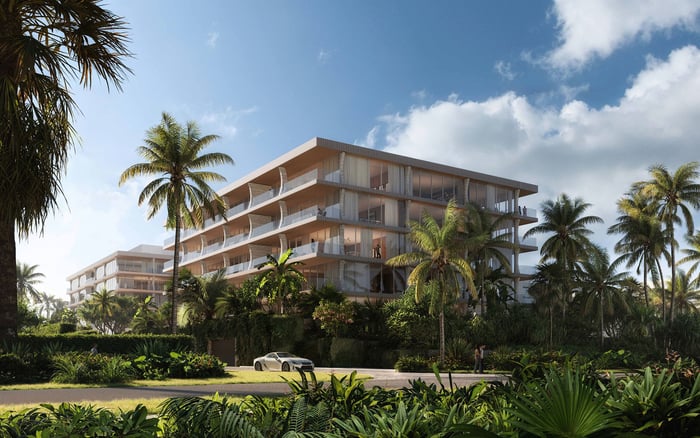
A buyer-focused review of five Palm Beach County residential projects, using service scope, association budgets, reserves and separate charges as the framework for evaluating long-term ownership costs.

For buyers considering branded residences in Palm Beach County, service expectations and recurring costs should be evaluated together. A realistic stabilized HOA assessment is not necessarily the lowest figure; it is one supported by a clearly defined operating plan, appropriate reserves and a transparent explanation of what owners receive.
Preconstruction and newly completed residences require particular care because early estimates may not reflect a mature operating history. Buyers should review the available association documents, identify assumptions that remain subject to change and avoid comparing projects solely by a preliminary monthly figure.
1. The Residences at Mandarin Oriental Boca Raton
This Boca Raton project belongs on a high-service buyer’s shortlist. The financial review should focus on the proposed staffing model, the services included in regular assessments and the assumptions supporting the operating budget.
2. Mr. C Residences West Palm Beach
Buyers considering this West Palm Beach project should determine how the planned ownership experience translates into recurring association obligations. Service hours, staffing, management costs and separately billed items deserve close attention.
3. The Ritz-Carlton Residences® Palm Beach Gardens
The due-diligence process should separate standard common expenses from any charges connected to optional or individually allocated services. Buyers should confirm inclusions directly from the governing and budget documents available for review.
4. South Flagler House West Palm Beach
For this West Palm Beach project, the key questions concern the final operating structure, reserve planning and the scope of services funded through regular assessments. Preliminary estimates should be tested against the latest available documents.
5. Forté on Flagler West Palm Beach
This project completes the shortlist. Buyers should evaluate its recurring costs on an inclusion-adjusted basis, accounting for the services covered by assessments and any obligations billed outside them.
Begin with the proposed or current association budget and determine whether it reflects the intended staffing and service level. Review the reserve schedule, insurance allocation, management arrangements and the treatment of maintenance for shared spaces and systems.
Next, identify every recurring charge beyond the primary assessment. Optional services, separately allocated expenses and layered association obligations can make a simple comparison of headline dues misleading. The most useful analysis places each project on the same basis by separating included services from additional costs.
Buyers should also distinguish association expenses from other carrying costs. Each category should be reviewed independently so that changes in one are not mistakenly attributed to another.
Request the latest available budget, reserve information, governing documents, management terms and schedule of assessments. Ask which figures are estimates, which services are included and which charges may vary according to use.
Compare the planned service model with the services you expect to use. A higher recurring obligation may be reasonable for one buyer and inefficient for another, depending on priorities and the value placed on staffing, convenience and shared facilities.
Professional legal, tax and financial review remains important. The objective is not to predict an exact future assessment, but to understand the assumptions behind the current figures and the circumstances that could change them.
What does a stabilized HOA cost mean? It refers to a recurring association expense considered after the property’s operating model has matured rather than relying only on an early estimate.
Does realistic mean inexpensive? No. A realistic figure is one that can be evaluated against the services, staffing, reserves and obligations it is intended to support.
Why should buyers review more than the monthly assessment? The headline amount may not include every recurring or use-based charge associated with ownership.
Which documents are most useful for comparison? Review the latest available budget, reserve information, governing documents, management terms and assessment schedule.
How should proposed budgets be treated? Treat them as planning documents that require verification and may change as operations develop.
Why do staffing assumptions matter? Staffing levels and service hours can influence the operating costs required to deliver a high-service ownership experience.
What are separate charges? They are costs billed outside the primary association assessment, whether recurring, optional or based on individual use.
How can buyers compare projects fairly? Normalize the analysis by identifying what each assessment includes and adding any separate obligations relevant to the buyer.
Should reserves be part of the review? Yes. Reserve information helps buyers evaluate how the association plans for future repair and replacement obligations.
Who should review the ownership documents? Buyers should consider qualified legal, tax and financial professionals familiar with the proposed transaction.
For a tailored shortlist and next-step guidance, connect with MILLION.
If branded residences are on your mind — as a home or as an allocation — we would be glad to share what we are seeing, privately.
Begin a quiet conversation