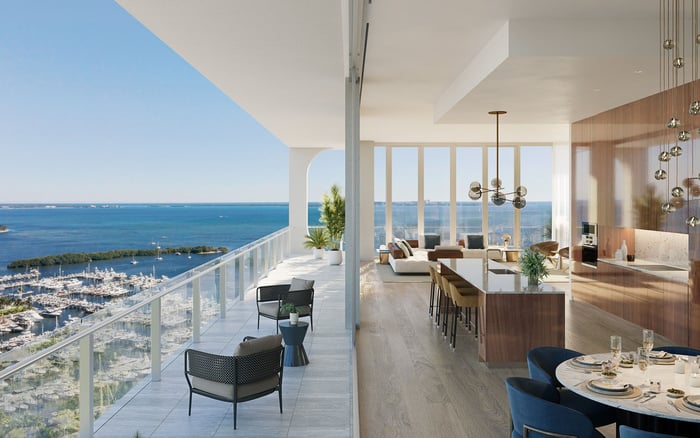
A buyer-focused shortlist of five Coconut Grove residences, with a practical framework for evaluating staffing, access, upkeep and owner-absence protocols.

For buyers who divide their time among several homes, the defining luxury is often continuity. A residence should be ready upon arrival, orderly throughout an absence and supported by a team with clear responsibility for access, deliveries, maintenance coordination and urgent situations. In Coconut Grove, the right choice therefore depends as much on operations as it does on architecture.
This editorial ranking identifies five names that merit priority consideration. It does not assume that every desired service is included. Buyers should verify current staffing, service hours, fees, vendor-access rules and residence-care options in the governing and contractual documents.
The broader field provides useful context. Opus Coconut Grove can help frame questions about boutique scale, while The Lincoln Coconut Grove offers another relevant point of comparison for buyers assembling a focused Grove tour.
1. Four Seasons Residences Coconut Grove - branded-service due diligence
For buyers placing staffed service at the top of the brief, Four Seasons Residences Coconut Grove is the logical first inquiry. Its brand identity makes the project especially relevant to a service-led search, but the decision should rest on the precise residential offering rather than assumptions attached to the name.
Ask which functions are included, which carry separate charges and which depend on third-party vendors. Confirm coverage outside standard hours, procedures for owner-authorized guests and how the team addresses an issue discovered while the residence is vacant.
2. Mr. C Tigertail Coconut Grove - brand-led operating review
Mr. C Tigertail Coconut Grove belongs near the top for an owner seeking a brand-centered residential experience. The essential comparison is operational: who receives requests, how they are documented and whether service remains consistent through routine arrivals, extended absences and high-demand periods.
The strongest due diligence extends beyond a general amenity discussion. Request written clarity on keys, deliveries, contractor access, housekeeping coordination and the limits of staff responsibility within a private residence.
3. Park Grove Coconut Grove - continuity and governance test
Park Grove Coconut Grove is a compelling third stop for buyers evaluating how day-to-day condominium operations support low-friction ownership. Assess it through the practical experience of leaving, returning and authorizing access while the owner is away.
Review management procedures, staffing schedules and the approval process for vendors or household personnel. A polished arrival matters, but dependable escalation protocols matter more when the home is unoccupied.
4. Vita at Grove Isle - access and absence-planning review
Vita at Grove Isle merits consideration for buyers whose lock-and-leave brief emphasizes controlled access and deliberate arrival planning. The key question is not simply whether staff are present, but whether the operating structure matches the owner’s expectations for privacy, responsiveness and delegated residence care.
Before committing, map out a typical absence of several weeks. Determine who may inspect the home, how the owner grants permission, what records are maintained and how quickly the designated contact is notified when attention is required.
5. The Well Coconut Grove - owner-use protocol review
The Well Coconut Grove completes the shortlist for buyers considering a residence organized around a distinctive brand identity. Its ranking reflects its relevance to a contemporary, service-conscious search, subject to close review of the condominium documents and service arrangements.
Ask how owner requests move from initial contact through completion. The best fit is the residence whose rules, staffing structure and communication style feel intuitive before closing, not merely after move-in.
The most revealing tour begins with operations. Buyers can use Four Seasons Residences Coconut Grove as one service-oriented reference and Mr. C Tigertail Coconut Grove as another, then pose the same questions at every appointment. Consistency makes the differences easier to identify.
Request a complete schedule of recurring charges, distinguishing building-wide operations from optional, residence-specific work. Clarify whether staff may admit a housekeeper, designer or repair technician without the owner present. Ask what happens after hours, how packages are stored and whether management documents entry into the residence.
For any second-home purchase, insurance, humidity control, leak response and periodic interior checks warrant close attention. These are not glamorous details, yet they often determine whether ownership feels effortless. A residence can present beautifully while still demanding substantial private management.
A lock-and-leave buyer should first define the intended cadence of use. Short, frequent visits create different demands than a seasonal stay or an extended overseas absence. The ideal service plan should accommodate that pattern without unnecessary complexity.
Buyers considering The Well Coconut Grove can prepare a written arrival-and-absence scenario before touring. Present that same scenario to each sales or management team. The responses will reveal whether the building’s procedures align with the owner’s preferred level of delegation.
Coconut Grove is the essential area tag for this search, but lifestyle, waterfront and new-construction considerations should remain secondary to documented operations. Even a Top Project designation cannot substitute for careful review of rules, costs and staffing boundaries.
Before signing, identify the person or department responsible for owner requests and determine how accountability is tracked. Obtain current written materials addressing access, emergencies, deliveries, pets, renovations and outside vendors. If private household staff will use the residence, confirm registration and entry procedures.
Then examine the economics. Separate mandatory assessments from optional services, gratuities and private contracts. Consider the likely frequency of housekeeping, preventive maintenance and pre-arrival preparation. The objective is not the longest service menu, but a reliable structure that supports how the residence will actually be used.
Finally, test communication. Ask how an urgent matter would be conveyed when the owner is in another time zone and who acts if the owner cannot respond immediately. True lock-and-leave ownership depends on clear authority, disciplined records and realistic expectations on both sides.
What does lock-and-leave ownership mean? It describes a residence that can be secured and left for extended periods with minimal owner intervention.
Does staffed service always include residence care? No. Building staffing and in-residence services may be separate, optional or unavailable.
Which documents should a buyer review? Review the governing documents, current fee schedules, rules, service terms and access procedures.
Should buyers rely on a luxury brand name? A brand can shape expectations, but only written terms define the actual services and obligations.
How should after-hours coverage be evaluated? Ask who responds, which situations qualify and how owners are notified outside regular hours.
Can building staff admit private vendors? Policies vary, so confirm authorization, identification, scheduling and supervision requirements.
Are housekeeping services typically included? Never assume they are included. Verify availability, scope, pricing and scheduling in writing.
What matters during a long absence? Access control, emergency response, interior checks and a clear communication chain are central.
How should buyers compare recurring costs? Separate mandatory charges from optional services and estimate usage based on actual occupancy.
What is the best first step before touring? Write an owner-use scenario covering arrivals, absences, guests, deliveries and emergencies.
If you'd like a private walkthrough and a curated shortlist, connect with MILLION.
If branded residences are on your mind — as a home or as an allocation — we would be glad to share what we are seeing, privately.
Begin a quiet conversation