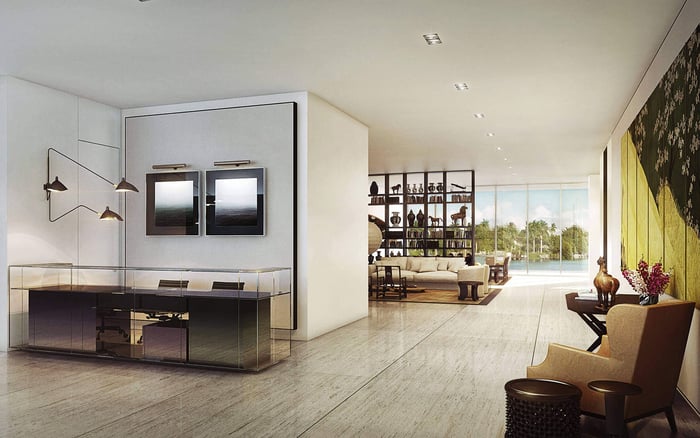
Five hospitality-branded residences merit a closer look for service-focused Miami-Dade buyers. This editorial shortlist separates brand positioning from the written benefits, reservation rights, and management protections that require contractual review.

For a buyer who values discretion and an effortless daily routine, a hospitality-branded residence promises more than a recognizable arrival experience: a home supported by professional service standards. The essential distinction is between what a brand evokes and what the ownership documents provide.
Concierge, housekeeping, in-residence dining, and wellness services may feature in a residential offering, but availability and inclusion require property-specific confirmation. A polished service menu is not a funded, enforceable owner benefit. Staff training, maintenance standards, and consistent delivery deserve as much scrutiny as the name above the entrance.
This five-property ranking is an editorial shortlist, not a measure of verified contractual service commitments. Here, “active” refers to marketing, construction, or sales and preconstruction activity-not necessarily occupancy. Current project status must be confirmed independently. This review does not establish enforceable owner-priority rules or guaranteed operator continuity for any of the five. Buyers considering St. Regis® Residences Brickell should therefore distinguish its hospitality positioning from the specific obligations offered to purchasers.
1. The St. Regis Residences, Miami - South Brickell
St. Regis opens this editorial shortlist for buyers interested in hospitality-led residential service. Its placement is not a finding that its contractual benefits outperform those of the other residences.
For buyers, the central question is how that positioning translates into residential obligations. Guaranteed reservation priority, loyalty benefits, and the operator’s contractual tenure have not been verified in this review. Before assigning a premium to anticipated service, obtain the included-service schedule and identify who must deliver it, for how long, and under which budget. Confirm construction and completion milestones separately from the expected start of residential services.
2. Waldorf Astoria Residences Miami - Downtown Miami
Waldorf Astoria offers another hospitality-branded address to investigate. Development progress, however, should not be treated as evidence of occupancy or the start of residential services.
Second place reflects editorial ordering, not verified preferential access. Buyers should distinguish residential facilities from anticipated hotel offerings and request written terms for each. Included services, hotel-access rights, reservation priority, and long-term management commitments each require confirmation; none should be inferred from the brand.
3. Aman Miami Beach - Mid-Beach
Aman’s privacy-oriented positioning makes it relevant to buyers seeking personalized hospitality rather than a highly visible social setting. The useful comparison is how that philosophy would translate into daily residential service.
Third place reflects the appeal of that positioning, not a verified owner-benefit package. This review does not establish a complete contractual benefit schedule, fee matrix, or dining and spa priority rules. Buyers should ask how privacy and personalization would work in practice, including staffing availability, appointment allocation, and eligibility for household members and guests. Confirm delivery and service-commencement dates directly rather than treating a target as completed work.
4. Four Seasons Private Residences Coconut Grove - Coconut Grove
Four Seasons belongs on this service-focused shortlist as a hospitality-branded option in Coconut Grove. Without verified project-specific delivery and contractual-benefit documents, a firmer conclusion about operating advantages would be premature.
Fourth place reflects that distinction. Buyers should not assume preferred hotel access, a particular staffing structure, or enforceable operator continuity. Instead, request the proposed residential-management arrangement and determine which services are obligations, which are discretionary, and which depend on separate agreements. The brand is a reason to investigate, not a substitute for documentation.
5. Mandarin Oriental Residences, Miami - Brickell Key
For this Brickell Key option, the relationship between residential ownership and anticipated hotel operations deserves particular attention. Evaluate the residential service agreement separately from the appeal of the hospitality name.
Buyers should establish whether anticipated services depend on a hotel opening, which entity is responsible for delivering them, and what happens if the operating arrangement changes. Hotel access and management terms should be evaluated independently of architectural scale. Confirm the delivery schedule and any dependencies before relying on a projected service experience.
At Waldorf Astoria Residences Downtown Miami, compare service capacity and allocation, not simply the breadth of the anticipated offering. Ask whether a reservation is guaranteed, preferential, or merely subject to availability.
For Four Seasons Residences Coconut Grove, focus on the residential operating structure. Establish who controls staffing, who sets service standards, and which documents govern changes. Those answers matter more than the assumption that another property’s experience will transfer unchanged under the same brand.
At The Residences at Mandarin Oriental, Miami, scrutinize any connection between the future residences and hotel operations. For a Miami Beach alternative such as Aman, apply equally specific questions to any proposed dining, spa, and wellness experience. A service connection is not an enforceable entitlement.
First, separate inclusion from availability.
Request the declaration, purchase agreement, residential-management agreement, applicable hotel or services agreements, operating budget, and rules. Ask for a written schedule identifying included services, separately charged services, staffing hours, and limits. Housekeeping, transportation, provisioning, personal training, and dining may be billed separately. Model the services your household would actually use rather than comparing amenity descriptions alone.
Second, define priority precisely.
Seek reservation windows, blackout dates, capacity restrictions, and cancellation terms. Establish whether benefits extend to family, guests, and tenants. Anticipated loyalty privileges should be documented, not assumed. Ask who may change eligibility or fees and how owners would be notified. “Access” without allocation rules leaves an important ownership question unanswered.
Third, test continuity beyond opening.
Have counsel examine management duration, renewal and termination rights, assignment provisions, operator-replacement procedures, and remedies if the brand exits. Determine which standards would survive a management change and which depend on the original operator. A long ownership horizon warrants attention to both the initial service offering and its contractual durability.
The decisive comparison is not which brand sounds most attentive. It is which residence can document the services your household values, the rules governing access, and the protections supporting continuity. Until those terms are established, treat hospitality positioning as an invitation to investigate, not a guaranteed ownership benefit.
Explore your next South Florida residence with MILLION.
If branded residences are on your mind — as a home or as an allocation — we would be glad to share what we are seeing, privately.
Begin a quiet conversationActive refers to marketing, construction, or sales and preconstruction activity, not necessarily occupancy or operating services. Current status must be confirmed independently for each project.
No. It is an editorial shortlist based on hospitality positioning, not a verified contractual-service score.
St. Regis opens the editorial shortlist for buyers interested in hospitality-led residential service. Its placement does not establish superior contractual benefits, guaranteed owner priority, or operator tenure.
Confirm the current schedule and relevant milestones directly. A completion target does not establish occupancy or the start of residential services.
No. Buyers should confirm occupancy and residential-service commencement separately from construction milestones.
Request the contractual benefit schedule, service fees, staffing arrangements, and any dining or spa priority rules. Privacy-oriented positioning alone does not establish these obligations.
No. Housekeeping, dining, transportation, personal training, and provisioning may be separately billed, so buyers should obtain a property-specific service and fee schedule.
Request the residential-management arrangement, service obligations, staffing provisions, and applicable access agreements. Preferred hotel access and enforceable operator continuity should not be assumed.
Buyers should establish whether anticipated residential services depend on hotel operations and which entity must provide them. A hospitality brand alone does not establish enforceable hotel-access rights.
Have counsel review management duration, renewal and termination rights, assignment provisions, replacement procedures, and remedies if the brand exits. This review does not verify guaranteed continuity for any of the five projects.