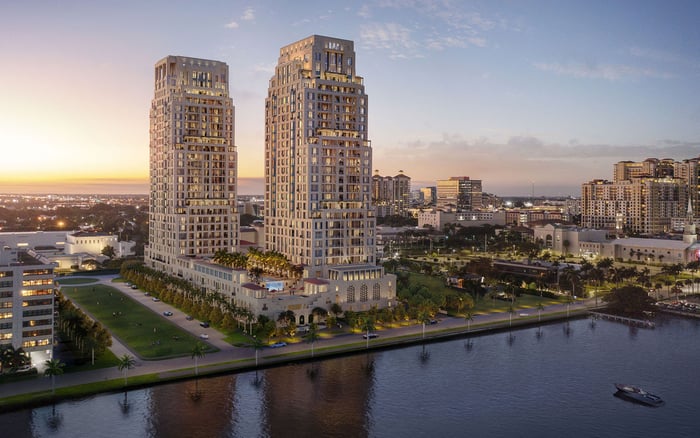
Nora House’s planned amenities invite a closer look at the cost of ownership. A disciplined buyer should test insurance, staffing, reserves and shared expenses before treating a proposed assessment as an established operating cost.

The appeal of Nora House West Palm Beach is clear: a planned 117-residence condominium within a walkable district organized around dining, hospitality and neighborhood life. The more consequential purchase question is less photogenic: what will it cost to sustain the promised experience once the building operates at its intended service level?
A developer’s pro forma is a forward-looking estimate. A stabilized operating cost reflects an established pattern of spending, supported by actual contracts, service delivery and reserve contributions. This distinction does not imply that Nora House’s budget is understated. It means a proposed assessment should be tested before becoming a fixed assumption in a buyer’s ownership plan.
For an ultra-premium purchase, the objective is not necessarily the lowest monthly charge. It is confidence that the charge supports the lifestyle being purchased.
Nora House is planned as an 11-story building at 1105 North Dixie Highway. The Ronto Group is partnering with NDT Development, Place Projects and Wheelock Street Capital, with architecture by Swedroe Architecture and interiors by Lillian Wu Studio.
The marketed two- to three-bedroom residences span approximately 1,700 to more than 6,700 square feet of total living area. That measurement is not interchangeable with interior area. When comparing assessments per square foot, request the relevant area definitions and governing allocation formula rather than assuming marketing dimensions determine each residence’s share.
Timing matters, too. Launch-era targets contemplated groundbreaking in mid-2027 and completion in 2029, while the district’s delivery window extends from 2027 to 2030. These are planning expectations, not guaranteed dates. Ask which operating year the budget models and whether its assumptions reflect today’s costs or anticipated opening-year costs.
Request the complete operating budget, reserve schedule and unit-specific assessment calculation together. A monthly figure without its underlying assumptions cannot explain the ownership obligation.
Approximately 65,000 square feet of planned amenities underpin Nora House’s lifestyle offering. Two pools, spa facilities, a fitness center and landscaped outdoor space sit alongside a two-lane bowling alley, golf simulator, pickleball courts and a sports/game lounge. Six guest suites and a hosting room with catering capacity add another operational dimension.
The buyer’s task is to connect those spaces to funded services, not simply count them.
Staffing: Request positions, coverage hours, compensation assumptions, benefits, overtime and relief coverage. Distinguish dedicated personnel from contracted services.
Maintenance: Identify pool servicing, landscaping, cleaning, spa upkeep and specialized recreation-equipment contracts. Ask which estimates have vendor support.
Guest suites: Clarify booking rules, housekeeping, linen replacement, utilities and any assumed usage revenue. If revenue is budgeted, establish who bears a shortfall.
Replacement: Separate routine repairs from eventual renewal of furniture, fitness equipment, bowling systems and simulator technology.
These are diligence questions, not assertions about Nora House’s arrangements. An impressive amenity inventory deserves an equally explicit operating plan, including expected service hours and any separately charged activities.
Insurance deserves more than a single annual premium line. Request the estimate’s basis, coverage limits, deductibles, exclusions and assumed renewal timing. Establish which expenses belong to the association and which require separate owner coverage. A premium estimate and a bound policy represent different levels of evidence.
Reserves require their own review. Ask for the schedule, component assumptions, anticipated useful lives and proposed contribution levels. Clarify how structural reserve obligations are distinguished from other replacement needs, including amenity equipment and furnishings.
Florida condominium law addresses structural reserve funding and restrictions on waiving qualifying contributions. Counsel should confirm Nora House’s applicable study deadlines, new-construction requirements, funding options and exceptions under current law. Neither blanket assurances of grandfathering nor a generalized claim that every reserve must immediately be fully funded can substitute for project-specific advice.
If Alba West Palm Beach is also on your shortlist, apply the same document requests there. Compare what each assessment includes before comparing the figures; this is a diligence framework, not a claim about either project’s costs.
Nora House includes planned ground-floor commercial space. That makes expense allocation central to document review. Commercial space alone, however, does not establish that residents subsidize retail operations or depend on retail income.
Request the declaration and any cost-sharing agreements identifying responsibility for shared building systems, access areas, utilities, insurance, security, maintenance and replacement. Have counsel distinguish the obligations of residential owners, commercial owners and any district entities. Ask how allocations can change and who controls those decisions.
Keep district infrastructure separate from condominium expenses. An April 2026 request sought to increase public infrastructure funding to $26.1 million. That does not establish a condominium assessment or an additional $26.1 million obligation. Any connection to an owner’s costs must be demonstrated through the applicable documents, not inferred from neighborhood development activity.
Ask whether the proposed assessment reflects any developer subsidy, expense payment or assessment guarantee. If support exists, request its scope, duration, termination conditions and the budget without it. Establish how unsold residences are treated and how financial responsibilities change during the transition to owner control.
Build a baseline from the documented assumptions, then test higher insurance, staffing, utility and reserve contributions separately and together. These are sensitivity exercises, not predictions. Apply each change to the relevant expense category rather than increasing the entire assessment indiscriminately.
Translate the resulting annual difference into the contemplated residence’s share using the governing allocation method. Dividing every expense equally among 117 residences would be inappropriate unless the documents support that treatment. Keep association assessments distinct from personal taxes, financing, owner insurance and other individual costs.
A buyer considering Forté on Flagler West Palm Beach alongside Nora House should use a consistent comparison sheet: assessment period, included services, reserve contributions, shared obligations and separately billed items. Do not assume budget equivalence between these properties.
Likewise, a single-family community’s HOA fee is not automatically a useful condominium benchmark. The governing structures and reserve requirements differ, so a lower headline fee may describe a different set of responsibilities.
Before committing, seek a unit-specific assessment calculation, a documented operating budget, a reserve schedule, the relevant cost-sharing provisions and a clear explanation of any developer support. Unresolved assumptions should become questions for counsel and the financial adviser, not silent entries in a spreadsheet.
The serious buyer need not reject a pro forma. The disciplined approach is to understand what it estimates, what supports it and what could change before treating it as an established cost of ownership.
For a considered approach to South Florida condominium ownership, explore MILLION.
If branded residences are on your mind — as a home or as an allocation — we would be glad to share what we are seeing, privately.
Begin a quiet conversationA pro forma estimates future expenses. Stabilized costs reflect established spending supported by actual contracts, service delivery and reserve contributions.
No. The distinction calls for testing the assumptions, not concluding that the project’s budget is inadequate.
Request the complete operating budget, reserve schedule and unit-specific assessment calculation. Also seek supporting insurance, staffing and maintenance assumptions.
Nora House is planned as an 11-story, 117-residence condominium at 1105 North Dixie Highway in West Palm Beach.
No. The approximately 1,700 to more than 6,700 square feet describes total living area, so buyers should confirm interior dimensions separately.
The program includes two pools, wellness facilities, specialized recreation equipment and six guest suites. Buyers should examine staffing, maintenance, replacement and any assumed usage revenue.
Request the reserve schedule and have counsel verify applicable study deadlines, funding requirements, options and exceptions under current Florida law.
Not necessarily. Governing documents and cost-sharing agreements must establish the respective obligations of residential owners, commercial owners and any district entities.
The launch-era completion target was 2029, while the district’s delivery window spans 2027 to 2030. These planning expectations should not be treated as guaranteed dates.
Model higher insurance, staffing, utilities and reserve contributions as hypothetical scenarios. Apply the resulting difference using the residence’s documented allocation method, not an assumed equal division.