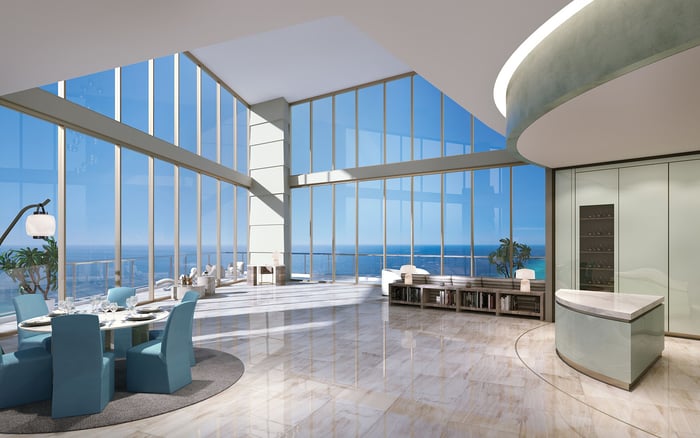
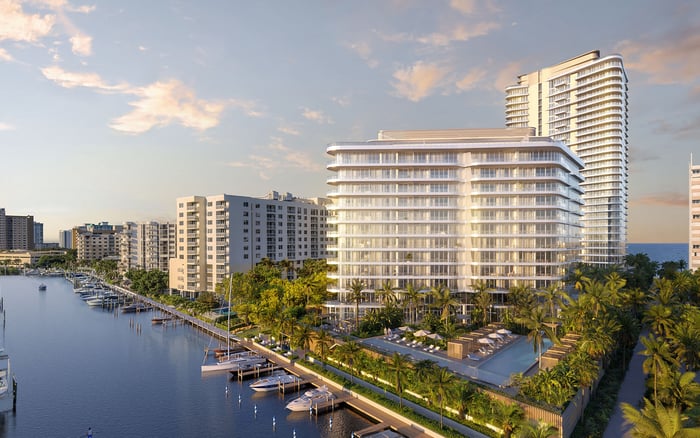
At Armani/Casa Residences Pompano Beach, the operating budget deserves the same scrutiny as the residence itself. A buyer’s checklist for separating preliminary assumptions from documented costs, testing assessment sensitivity, and comparing branded properties without mistaking a reference fee for a forecast.

The appeal of Armani Casa Residences Pompano Beach is clear: a planned collection of 28 full-floor residences across two 19-story towers, with interiors by Armani/Casa Interior Design Studio. For a serious buyer, however, the assessment supporting that environment deserves as much scrutiny as the floor plan.
A developer’s pro forma is a planning document, not proof of stabilized operating costs. That distinction is not an accusation that expenses have been understated. It is a reason to examine what each number represents, when it was prepared, and what evidence supports it. A preliminary assessment and a sustainable operating budget answer different questions.
The objective is not simply to find a low monthly fee. It is to understand the recurring cost of the service environment being purchased-and the assumptions that could change before operations settle into a documented pattern.
Planned at 1550 N Ocean Boulevard, the project’s advertised residences range from approximately 3,200 to 6,800 square feet. Marketing prices start at approximately $5.697 million; they do not establish current availability. Completion is anticipated in 2028, not guaranteed.
With 28 residences, shared fixed expenses are distributed across fewer homes than in a larger condominium. That scale does not establish actual dues, prove higher costs, or mean every owner pays one twenty-eighth of the budget.
Request the assessment allocation for the specific residence under consideration. Ask how expenses are assigned between the two towers and across shared facilities, if applicable. Any comparison in dollars per square foot should identify the area measurement used. A convenient marketing calculation is no substitute for the allocation established in the condominium documents.
Begin with the complete line-item budget, its preparation date, and the operating period it covers. Have the sales team distinguish estimates from executed contracts and identify assumptions awaiting confirmation. Then organize the supporting documents around six questions.
Insurance: Request the basis for the premium allowance, coverage limits, deductibles, exclusions, and whether the amount reflects an estimate or a binding quote. Identify the effective period and what remains the individual owner’s responsibility.
Staffing: Ask for positions, scheduled coverage, compensation, benefits, relief coverage, and any outsourced services. Compare the proposed service schedule with the labor expense supporting it.
Vendor contracts: Request available agreements for maintenance, landscaping, pools, elevators, security, and other applicable services. Distinguish signed pricing from allowances, and examine contract duration and renewal terms.
Utilities: Confirm assumptions for common-area consumption and whether water, sewer, or trash are included in assessments. Separate association-paid services from expenses billed directly to the residence.
Reserves: Ask what contributions are included, what analysis supports them, and how future replacement needs are addressed. Evaluate reserve funding separately from ordinary operating expenses.
Developer support: Ask whether subsidies, guarantees, or other developer contributions affect the initial owner assessment. If they do, request their duration, conditions, and an explanation of costs without that support.
These are verification questions, not statements that any particular expense, contract, or subsidy exists at this property. The purpose is to connect the quoted assessment to a documented service and funding plan.
For buyer underwriting, treat stabilization as an evidentiary standard, not a calendar promise. Look for an adopted budget supported by actual operating experience, current insurance terms, documented staffing costs, utility consumption, and a clear basis for reserve funding.
No single document resolves every uncertainty. A vendor contract may substantiate one expense while another remains an allowance. A formally adopted budget may still contain line items without an established operating history. Ask your advisers to identify which costs are documented and which still require a contingency.
There is no basis here for predicting an inevitable increase within a particular number of years. The disciplined approach is to revisit assumptions as they become contractual or observable-not to declare the opening assessment either artificially low or permanently reliable.
The separate Armani Casa Sunny Isles Beach at 18975 Collins Avenue offers same-brand context, not an interchangeable operating model. That property was developed by Related Group and Dezer Development, a different development operation from the announced Pompano group.
A maintenance reference of approximately $0.80 per square foot for Sunny Isles varies by unit and should not be treated as a currently verified rate. It is neither a minimum fee nor a quote for Pompano. Before using it, compare service scope, insurance, reserve contributions, fee inclusions, and residence sizes.
For illustration only, a monthly assumption of $0.80 per square foot produces $3,600 for 4,500 square feet and $5,440 for 6,800 square feet. Those figures demonstrate arithmetic, not expected Pompano assessments.
A buyer also considering The Ritz-Carlton Residences® Pompano Beach should request the same documentary comparison rather than use branding as a proxy for expenses. Across Broward, comparing fee inclusions is more useful than setting headline monthly charges side by side.
Build a base case from the proposed budget, clearly marking unconfirmed inputs. Then model insurance, staffing, and reserve contributions separately. This isolates the assumptions that matter most to the residence’s allocated assessment without implying that all categories will rise together.
For each scenario, calculate the association-level change first, then apply the residence’s documented allocation. Use square-foot sensitivities as a separate affordability exercise, not as a substitute for that allocation.
Across the advertised 3,200-6,800-square-foot range, a hypothetical additional $0.20-$0.30 per square foot monthly would add approximately $640-$2,040 a month. That range is a sensitivity calculation, not a forecast of increases or a statement about the developer’s budget.
Before committing, ask your attorney and financial adviser to reconcile the proposed assessment, governing allocation, budget assumptions, and any developer support. Keep unresolved items visible rather than letting a single monthly number imply certainty.
The strongest purchase decision is one in which the residence remains compelling after its operating assumptions have been tested. Design establishes the appeal; documented costs establish confidence in carrying it.
For a discreet perspective on South Florida residences and ownership considerations, connect with MILLION.
If branded residences are on your mind — as a home or as an allocation — we would be glad to share what we are seeing, privately.
Begin a quiet conversationA pro forma is a planning document whose figures may include assumptions rather than contracted or observed expenses. Buyers should examine the supporting evidence before treating the assessment as a reliable ongoing cost.
No. The distinction between preliminary and stabilized costs does not establish that this developer has understated expenses or offered artificially low fees.
The development is planned with 28 full-floor residences across two 19-story towers. That scale warrants close attention to shared expenses but does not determine individual assessments.
Armani/Casa Residences Pompano Beach is planned at 1550 N Ocean Boulevard, Pompano Beach, FL 33062.
No. Published marketing information identifies 2028 as the anticipated completion year, not a guaranteed delivery date.
Request the complete line-item budget, insurance terms, staffing schedules and compensation, vendor contracts, utility assumptions, reserve-funding support, and the residence’s assessment allocation. Ask which figures remain estimates.
If present, they may affect the initial owner assessment. Buyers should understand their duration, conditions, and how costs would be funded without that support.
No. The approximately $0.80-per-square-foot published reference is not a currently verified rate or a Pompano quote, and actual Sunny Isles maintenance varies by unit.
It illustrates an additional $0.20–$0.30 per square foot monthly across the advertised 3,200–6,800-square-foot residence range. It is an affordability test, not a forecast of assessment increases.
Not without documentary support. Buyers should obtain the specific residence’s assessment allocation rather than infer equal shares from the unit count.