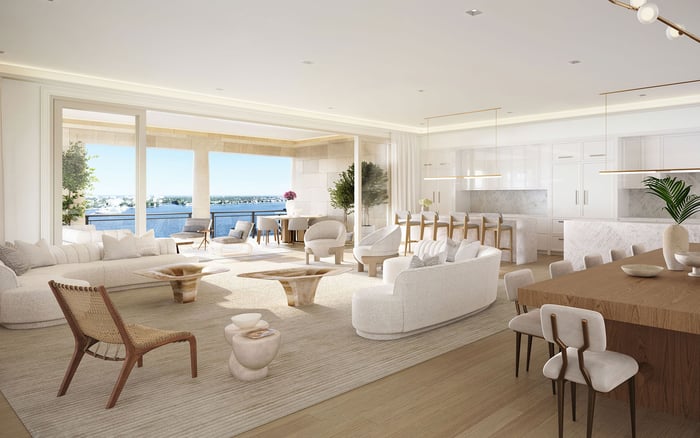
Guest-suite rules at The Ritz-Carlton Residences® West Palm Beach are best understood as part of the building’s quiet-luxury promise, protecting privacy, calm, service discipline, and long-term residential value.

At The Ritz-Carlton Residences® West Palm Beach, the most revealing luxury feature may not be the most visible one. In a branded residential setting, guest-suite rules are not a minor administrative footnote. They are part of the architecture of privacy, the service model, and the building’s daily emotional temperature.
A guest suite in an ultra-luxury residential tower occupies a delicate middle ground. It is hospitality-adjacent, designed to accommodate visitors with polish and ease, yet it remains inside a private owner community. That tension is exactly why the rules matter. Without discipline, a guest suite can become a pressure point: more transient traffic, more unpredictable elevator use, more noise, more ambiguity at the front desk, and more friction in shared spaces.
Quiet luxury is not only about finishes. It is about restraint. It is the confidence that a building knows how to say yes elegantly, and when necessary, how to say no. For the West Palm Beach buyer, the nuance is not whether guests are welcome. It is whether the building has enough structure to keep hospitality from becoming hotelization.
The Ritz-Carlton name creates a specific set of expectations around discretion, service discipline, and controlled residential operations. Buyers drawn to The Ritz-Carlton Residences® West Palm Beach are not simply purchasing a home with amenities. They are buying into an operating culture where privacy should feel intentional and common areas should remain composed.
That is why guest-suite policy belongs in the same conversation as valet protocol, amenity access, security posture, and staff coordination. The more elevated the brand promise, the less room there is for informal usage patterns that create uncertainty. A building can offer beautiful rooms for guests and still preserve a private-residence atmosphere, but only if reservations, access, length of stay, and eligible users are clearly governed.
In a Palm Beach season shaped by visiting family, household staff, business guests, and long weekends, the guest suite becomes a test of operational maturity. If rules are vague, owners may experience the amenity unevenly. If rules are firm but sensible, the suite becomes a quiet convenience rather than a source of tension.
The strongest guest-suite frameworks answer practical questions before they become social problems. Who may reserve the suite? Is it limited to owners, or can family members reserve directly? How long may a guest stay? Can the same owner book repeatedly during peak periods? Must the owner be in residence, or at least present in the building, while the guest suite is in use?
These are not merely procedural questions. They determine whether the building remains residential in spirit. A thoughtful policy distinguishes owner-hosted family or personal guests from commercial, rental, or short-term lodging use. That distinction is central to protecting the atmosphere owners expect in a branded tower.
Reservation controls can also preserve fairness. Blackout periods, length-of-stay limits, advance-booking windows, and repeat-use limits may help prevent one household from monopolizing access during the most desirable weeks. The goal is not to make hosting difficult. The goal is to ensure the guest-suite privilege remains broadly usable and does not become an unofficial extension of one owner’s private residence.
Buyers should be cautious about assuming specific rules before reviewing the actual declaration documents, house rules, amenity policies, and management standards. A sales conversation may describe the amenity, but the governing documents and operating procedures reveal how it will feel over time.
Guest-suite governance is especially relevant for seasonal owners and pied-à-terre households. These buyers often want the flexibility to host adult children, close friends, staff, or business guests without converting their own residence into a perpetual hospitality zone. A well-run guest suite can make a home feel larger in practice, particularly when owners value privacy within their primary living space.
Second-home buyers should think of the guest suite as a pressure valve. It allows a building to accommodate family rhythms without turning hallways, elevators, and amenity areas into a revolving door. But that only works when guest movement is visible to management, coordinated with security, and tied to a known owner host.
The difference between elegant convenience and overuse can be subtle. One visiting couple for a holiday weekend feels residential. A sequence of loosely connected guests using the suite like independent lodging feels different. The rules create that boundary, and staff enforce it in real time.
This is also where the pool, lounges, fitness areas, and arrival sequence matter. Guests do not only sleep in a suite. They move through the building. They ask questions of staff. They may use amenities if permitted. They affect the atmosphere other owners experience. In a quiet-luxury tower, those touchpoints need choreography.
Guest-suite rules also have an investment dimension, even for buyers who are motivated primarily by lifestyle. Buildings that preserve their residential character often age more gracefully in perception. A tower known for calm, privacy, and orderly operations can hold a different kind of appeal than one where shared amenities feel unpredictable.
That does not mean strictness for its own sake. The best policies are clear, consistent, and aligned with the building’s identity. They welcome legitimate personal guests while keeping commercial lodging, unmanaged rental behavior, and party-condo patterns out of the residential ecosystem.
For a buyer evaluating The Ritz-Carlton Residences® West Palm Beach, the guest-suite conversation should sit beside other due-diligence questions. How does the building define guests? What is the booking process? Are there peak-season limits? Who has access to amenities? What happens if rules are violated? How are staff members empowered to manage arrivals, key access, and common-area conduct?
These questions may not carry the glamour of architecture or views, but they shape daily life. In the upper tier of South Florida real estate, the most valuable amenity is often the absence of annoyance. A guest-suite policy that protects calm is not restrictive. It is part of the luxury.
Why do guest-suite rules matter in a luxury residence? They help protect privacy, service flow, security, and the quiet atmosphere owners expect.
Are guest suites the same as hotel rooms? No. They may feel hospitality-adjacent, but they sit within a private owner community and should be governed accordingly.
Should buyers assume specific rules at The Ritz-Carlton Residences® West Palm Beach? No. Buyers should review the actual governing documents, amenity rules, and management standards before relying on any assumption.
What should a strong guest-suite policy define? It should clarify who may reserve, how long guests may stay, and whether the owner must be present or in residence.
Why are length-of-stay limits useful? They can prevent overuse and help preserve fair access for all owners during desirable periods.
Can guest-suite rules support property value? Yes. Disciplined rules can help preserve a building’s residential character and long-term perception.
Why are these rules important for seasonal owners? Seasonal owners may host family, staff, or business guests without wanting their own residence to feel crowded.
What is the risk of weak guest-suite governance? Weak rules can create transient traffic, noise, amenity friction, and a quasi-hotel atmosphere.
Should commercial or short-term lodging use be treated differently? Yes. Personal owner-hosted guests should be distinguished from commercial or short-term lodging activity.
What should buyers ask before purchasing? They should ask how reservations, repeat use, guest access, amenity privileges, and enforcement are handled.
When you're ready to tour or underwrite the options, connect with MILLION.
If branded residences are on your mind — as a home or as an allocation — we would be glad to share what we are seeing, privately.
Begin a quiet conversation