For buyers at Waldorf Astoria Residences Downtown Miami, attentive hospitality and private-residence oversight are distinct considerations. The essential diligence concerns written management responsibilities, documented absence checks, and authority to act when an owner cannot be reached.

For a buyer considering Waldorf Astoria Residences Downtown Miami, the most consequential service question is not who can arrange dinner. It is who takes responsibility for the residence when its owner is elsewhere.
Planned at 300 Biscayne Boulevard in Downtown Miami, the project is described as 360 branded residences above a Waldorf Astoria hotel, with separate residential arrival facilities. Advertised offerings include a private porte cochère, 24-hour valet, 24-hour doormen, lobby desk attendants, and concierge services. Together, they describe an attentive arrival experience-not a private-home care agreement.
The distinction matters: access to service is not the same as delegated authority. Buyers should treat advertised offerings as a starting point for written diligence, not confirmation of current operations or contractual guarantees.
Hilton Management Services is identified as the planned manager. That designation alone does not define the scope of management inside an individual residence. A dedicated on-site Director of Residences is also advertised, but the title does not establish who may inspect, approve spending, or direct repairs within a private unit.
Request a written allocation of three responsibilities: association operations, branded hospitality services, and private-residence care. For each, identify the contracting entity, accountable contact, hours of coverage, and escalation route. Where duties overlap, request a named decision-maker rather than a general assurance that the team will coordinate.
Professional facilities management, including cleaning and maintenance, is advertised. In-residence maintenance is separately described as available upon additional request. Ask which tasks are included, which require a separate agreement, and which incur additional fees.
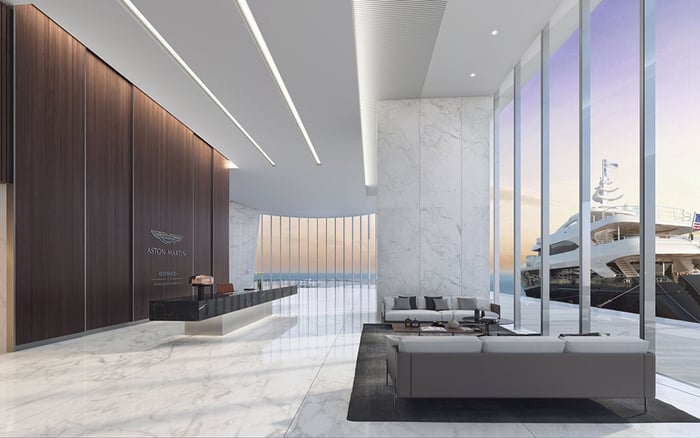
For buyers also considering Aston Martin Residences Downtown Miami, the same responsibility checklist offers a useful basis for comparison without assuming equivalent services or operating arrangements.
The advertised service descriptions establish neither a vacant-residence inspection schedule nor a standard for inspection records. A staffed lobby should not be mistaken for continuous oversight behind a private front door.
Ask whether a formal absence-care arrangement is available and who performs the checks. The agreement should specify inspection frequency, access authorization, the checklist used, and the action required when something is wrong. If an outside provider handles the checks, establish who supervises that relationship and receives the findings.
A proposed checklist should address leaks, HVAC operation, humidity, appliances, windows, signs of storm damage, and unauthorized entry. Ask which observations are visual, which involve measurements, and which require a qualified technician. These are requested safeguards, not confirmed project services.
Documentation deserves equal attention. Request a sample inspection record showing the date, time, inspector identification, photographs, exceptions, and follow-up actions. The record should clearly distinguish an inspection completed without concerns from an issue awaiting authorization.
Before an extended departure, agree on owner and backup-contact details, utility settings, vendor permissions, and the procedure for returning the residence to normal use. The absence plan must remain workable when the owner is on a flight or otherwise unavailable.
Emergency maintenance is advertised, but availability does not answer the central question: what may staff do without first reaching the owner?
Request the emergency-access policy and any owner authorization form. Clarify who may enter, what circumstances trigger entry, how entry is recorded, and who receives notice afterward. Address permission to enter, shut off utilities, and commission repairs separately.
Then establish the financial boundary. Request the applicable spending limit, whether it applies per incident or over another defined period, and which actions require additional approval. The documents should distinguish immediate protective measures from restoration and permanent repairs.
The most revealing exercise is a hypothetical leak discovered while both the owner and backup contact are unreachable. Ask who would enter, isolate the problem, contact a restoration vendor, approve spending, and document the incident. This scenario tests the proposed protocol; it does not imply that any particular authority has already been granted.
Clarify after-hours escalation as well, including who assumes responsibility if the primary contact is unavailable. A named backup is more useful than an undefined promise of assistance.
The advertised phrase “24-Hour Emergency Maintenance Response with 15-Minute Complimentary Service” requires careful interpretation. It should not be read as a verified promise that a technician will arrive within 15 minutes.
Ask what the complimentary period covers, when timing begins, which incidents qualify, and whether the provision applies inside private residences, common areas, or both. Request the rate structure after the complimentary service and any exclusions for specialist work, materials, or outside contractors.
Emergency maintenance, 24-hour security and reception, and parcel receiving and delivery are described as included in HOA services. Confirm their contractual scope and fee treatment rather than extending that description to all private-unit work.
For a parallel search in Brickell, including St. Regis® Residences Brickell, use the same questions about response, authorization, and charges. Compare written commitments, not the breadth of the amenity vocabulary.
A custom residential app is advertised as connecting owners to 24-hour concierge services and building amenities. Its described functions include dining reservations, room service, spa and fitness bookings, house-car reservations, valet access, package delivery, and dog walking.
These conveniences do not establish a continuously monitored property-care system. Savant smart-home systems are marketed as controlling lighting, window treatments, audiovisual equipment, temperature, and security. Ask whether alerts reach staffed personnel, who acknowledges them, and what response those personnel are authorized to initiate.
If an owner prefers an independent property manager or keyholder, confirm whether outside access is permitted and what credentials, insurance, registration, or scheduling requirements apply. The objective is one coordinated access arrangement-not several parties assuming someone else is watching the home.
Request the declaration, bylaws, rules, association-management and residential-services agreements, emergency-access policy, insurance requirements, and any absence-care or keyholding forms. Have counsel distinguish binding obligations from discretionary or request-based offerings.
Organize the review around three outcomes: a defined scope of care, evidence that scheduled checks occurred, and a clear chain of emergency authority. Any separate service agreement should identify fees, exclusions, cancellation terms, and the process for changing owner instructions.
The strongest ownership arrangement is not necessarily the longest service menu. It is the one that makes responsibility clear before departure and action possible when time matters.
For a discreet conversation about matching a South Florida residence to your ownership needs, connect with MILLION.
If branded residences are on your mind — as a home or as an allocation — we would be glad to share what we are seeing, privately.
Begin a quiet conversationThe project is planned at 300 Biscayne Boulevard in Downtown Miami, with 360 branded residences above a Waldorf Astoria hotel.
Hilton Management Services is identified as the planned manager. That designation does not establish the full scope of authority inside individual residences.
Concierge access alone does not establish private-residence management. Buyers should obtain written responsibilities, fees, and any required separate service agreement.
The advertised service descriptions do not establish an inspection schedule. Buyers should request a written absence-care arrangement specifying frequency, scope, and accountability.
Request checks covering leaks, HVAC, humidity, appliances, windows, storm damage, and unauthorized entry. Ask for dated photographs, written findings, and follow-up procedures.
No verified 15-minute arrival guarantee is established by the wording. Ask what the complimentary service period covers and how response is measured.
In-residence maintenance is described separately as available upon additional request. Confirm its fees and contractual scope rather than assuming all private-unit work is included.
The advertised offerings do not establish an owner-unreachable protocol or spending limit. Request written authority covering entry, protective action, vendor dispatch, and repair approvals.
No continuous staff-monitoring arrangement is established by the advertised Savant controls. Ask whether alerts reach staffed personnel and what actions they may initiate.
Request the declaration, bylaws, rules, management and residential-services agreements, emergency-access policy, insurance requirements, and any absence-care or keyholding forms.