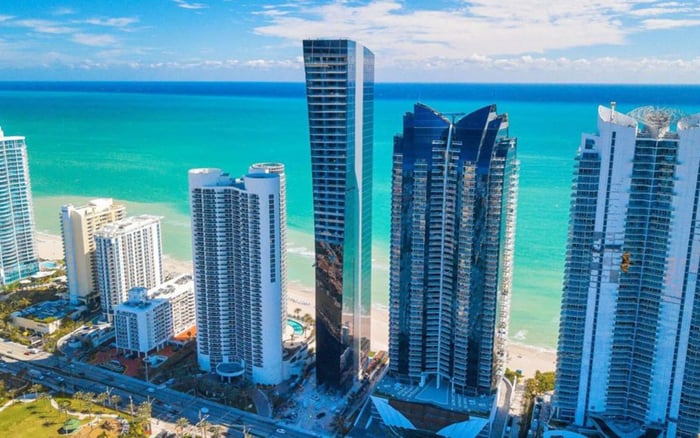
For a primary-residence buyer at Muse, hurricane readiness belongs alongside privacy and service in the purchase review. A practical assessment covers Zone B evacuation obligations, pet arrangements, staff responsibilities, vehicle access, and protection of valuable contents.

For a primary-residence buyer, the appeal of Muse Residences Sunny Isles Beach is inseparable from the practicalities of year-round living. The beachfront condominium at 17141 Collins Avenue comprises 68 residences. Its advertised concierge, valet, security, pet services, and private beach access promise an attentive residential lifestyle. They do not, by themselves, establish emergency-service commitments.
The essential purchase question is not simply how the residence functions on an ordinary day. It is how the household will leave when required, who will accompany its animals, and what happens to vehicles and valuable contents before access is restricted. A primary home deserves a written departure plan-not an assumption that familiar services will continue through a storm.
All of Sunny Isles Beach is in Storm Surge Planning Zone B. Residents must evacuate when Miami-Dade County issues an evacuation order covering that zone, including those living in condominiums. A high floor does not exempt a resident from an applicable mandatory evacuation order.
Zone B is a storm-surge planning designation, not a FEMA flood-zone designation. Keep that distinction clear when discussing evacuation, insurance, and a particular property's exposure. The event-specific order should govern the household's response, not an owner's interpretation of storm category or elevation.
For buyers also considering Jade Signature Sunny Isles Beach, the citywide evacuation obligation provides a common starting point. Building-specific procedures still require separate review; a shared location does not establish identical emergency operations.
Plan an earlier household departure if coordinating several people, animals, or vehicles requires it. The objective is to complete preparations without allowing packing or property protection to delay compliance with an evacuation order.
Take pets with you when evacuating. For a Muse household, begin by identifying an off-site destination that has explicitly agreed to accept every animal. Confirm the arrangements before relying on them, including any restrictions that could separate the household on arrival.
Prepare carriers, identification, medications, veterinary records, food, and water. Plan a seven-day water supply at one gallon per person per day, and include pets in supply planning. Treat the animals' water needs as an additional requirement, not an assumed share of the human allocation.
Residents needing a pet-friendly Hurricane Evacuation Center should pre-register by calling 311. Confirm current registration requirements and the center designated to accept pets for the specific event. A previously used location should not be treated as a standing reservation.
At a county pet-friendly center, animals must be in a crate or carrier, and a family member must remain with the pet at all times. This is not a drop-off boarding arrangement. Muse's advertised complimentary dog walking should likewise not be interpreted as hurricane-period pet care. Confirm ordinary service terms separately and make evacuation arrangements that do not depend on that amenity.
A household plan should distinguish private employees from building personnel. Neither group's continued presence should be assumed during an evacuation. Discuss transport and departure timing in advance, recognizing that employees also need to make their own safety arrangements.
Put responsibilities in writing: who monitors official instructions, who gathers pet supplies, who retrieves the vehicle, and who confirms that everyone has departed. Assign a backup for each essential task. Establish a departure trigger early enough to accommodate the entire household without relying on last-minute assistance.
Owner-absent planning deserves particular attention. Document authorized access, pet-handling permission, emergency contacts, and who may make relocation decisions if the owner cannot be reached. Confirm that these permissions align with association procedures. No employee should be expected to remain behind to protect possessions after evacuation is required.
Muse is advertised with robotic parking and private-elevator access with biometric security. Those features make vehicle retrieval and vertical access important due-diligence questions. They do not establish availability during an evacuation or power outage.
Request the association's current written hurricane plan before purchase. The review should address:
Vehicle-retrieval procedures, deadlines, and parking-system shutdown triggers.
Elevator restrictions, stairwell access, and any arrangements relevant to residents needing assistance.
Generator coverage, including precisely which systems and unit circuits it serves.
Resident communications, emergency contacts, and owner-absent access procedures.
Re-entry authorization and how residents will learn when access is permitted.
Ask management to distinguish routine amenities from documented emergency arrangements. Establish exactly what the household must complete before services are restricted. Do not infer that valet availability guarantees access to a car or that backup power supports every residential function.
Apply the same document-based review when comparing Muse with Regalia Sunny Isles Beach. The useful comparison is the clarity of each property's procedures, not an unsupported judgment about which building is safer.
Treat high-value contents as a separate preparation task, subordinate to personal safety. Create an inventory with photographs, serial numbers, and appraisals, and retain duplicate records off-site. Identify portable, irreplaceable items for early removal and decide in advance who is authorized to transport them.
Temperature-sensitive collections warrant specific questions. Muse residences are marketed with a dual-temperature, 148-bottle wine cooler. That feature does not establish backup electrical coverage or guaranteed temperature control during an outage. Confirm the equipment in the particular residence and ask whether the relevant circuit is supported before relying on it for a valuable collection.
Discuss specialist packing, transport, or off-site storage needs well ahead of an event. Set a clear stopping point: once safe departure requires attention, further property-protection work must not become a reason to stay.
Request association policy documents and review unit-owner contents, flood, windstorm, loss-assessment, relocation, and scheduled-valuables coverage with an insurance specialist. Ask how the proposed protection applies to the household's actual inventory rather than assuming the association's policy covers personal possessions.
For a primary-residence buyer, a satisfactory review should produce three practical outcomes: a confirmed destination for people and pets, a written division of household responsibilities, and a clear understanding of building access and shutdown procedures. It should also distinguish documented commitments from expectations created by everyday service.
Muse can then be evaluated on the terms that matter to a full-time household: not simply the pleasure of arrival, but the ability to depart deliberately and return only when authorized. Preparedness belongs in the ownership decision, alongside the residence itself.
For a considered approach to South Florida primary-residence ownership, explore MILLION.
If branded residences are on your mind — as a home or as an allocation — we would be glad to share what we are seeing, privately.
Begin a quiet conversationMuse is a beachfront condominium at 17141 Collins Avenue, Sunny Isles Beach, FL 33160, with 68 residences.
All of Sunny Isles Beach, including Muse, is in Storm Surge Planning Zone B. This is not a FEMA flood-zone designation.
A high-rise residence does not exempt an owner from an applicable mandatory evacuation order. Residents must leave when Miami-Dade County issues an order covering Zone B.
Yes. Miami-Dade County instructs residents to take pets with them, so transport and a destination accepting every animal should be arranged in advance.
Call 311 to pre-register and confirm current requirements. Verify the designated pet-friendly center for the specific event before traveling.
No. A family member must remain with the pet at all times, and the animal must be contained in a crate or carrier.
No hurricane-period availability is established by that amenity description. Make independent evacuation arrangements for pets rather than relying on ordinary building services.
Request vehicle-retrieval deadlines, shutdown triggers, elevator restrictions, and stairwell-access procedures. Confirm backup-power coverage rather than assuming these systems will remain available.
Agree in writing on departure timing, transport, pet-handling authority, and owner-absent permissions. Do not assume staff will remain to protect the residence or possessions.
Create an inventory with photographs, serial numbers, and appraisals, retaining duplicates off-site. Arrange early removal of portable irreplaceable items and review relevant insurance with a specialist.