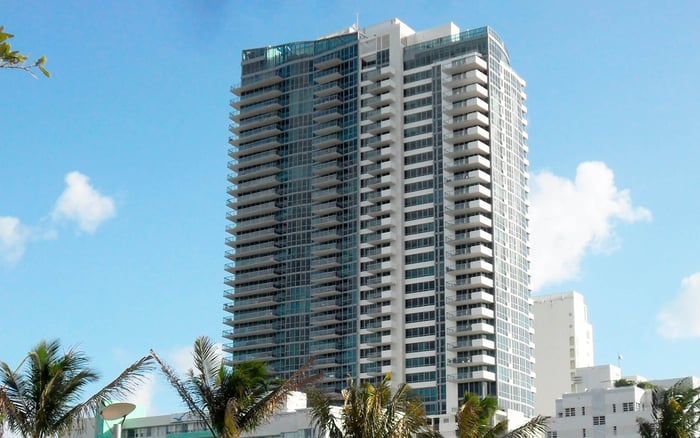
A discreet ownership guide to vacancy care at Shore Club, with proposed humidity targets, remote-monitoring priorities, and a response plan that distinguishes owner recommendations from building requirements.

The most important part of closing a residence for the season is not the final walkthrough. It is deciding who will notice a change in conditions, who can enter, and who has authority to act. For an owner at Shore Club Private Collections Miami Beach, that means treating humidity control as an ongoing responsibility, not a departure-day thermostat adjustment.
The oceanfront development at 1901 Collins Avenue, Miami Beach, FL 33139 combines 49 residences with a 75-key luxury hotel. Those facts establish the setting; they do not promise in-residence monitoring or vacancy care. Owners should confirm any service arrangement separately, including its scope, access permissions, and response responsibilities.
The principle is straightforward: controlling dampness is central to preventing mold. An ownership file should translate that principle into measurable humidity targets, maintained equipment, and a response plan that works while the owner is elsewhere.
Relative humidity, abbreviated RH, deserves its own place in the vacancy plan. For general mold prevention, keep indoor RH below 60%, ideally within 30-50% where possible. Humidity below 50% is preferable for controlling mold and dust mites.
For vacancy planning, consider a 45-50% RH target, subject to review by the residence's HVAC professional and management. This is an owner-side recommendation based on those general humidity parameters. It is not a published Shore Club requirement or a guarantee against mold.
A proposed alert structure separates the operating target from escalation:
45-50% RH: the suggested vacancy target to discuss with the HVAC professional.
55% RH: an advisory threshold prompting review of readings and operating conditions.
60% RH: an urgent threshold prompting escalation to the designated responder.
These thresholds are proposed operating choices, not prescribed public-health alarm settings or a confirmed building protocol. Have the contractor establish how readings are evaluated and when an on-site check is appropriate. An alarm setting should never replace judgment when a leak or equipment failure is evident.
There is no verified numerical vacancy thermostat setting to prescribe here. Confirm permitted settings with management, then ask the HVAC professional to select settings that maintain the agreed humidity target. Temperature alone should not be the ownership file's measure of success.
Measure humidity rather than relying on how a room feels. A humidity meter or hygrometer provides a direct reading; even a simple standalone instrument can serve this purpose. Before an extended absence, consider recording readings across the residence and asking the contractor to review any unexplained differences.
The maintenance discussion should be equally specific. Air-conditioning drip pans should be clean, and condensate drain lines should remain unobstructed and flow properly. Ask the service provider to document their condition during departure preparation. If the system cannot maintain indoor humidity below 60%, it warrants examination rather than acceptance as adequately functioning.
For buyers also considering Setai Residences Miami Beach, the same due-diligence question applies: what care is actually arranged while the owner is absent? The question concerns the ownership agreement and service arrangements. It does not assume that different residences share systems or policies.
A pre-departure record can be simple: current humidity readings, approved settings, the latest service findings, and contact details for the person responsible for follow-up. Its value lies in establishing the residence's expected condition.
Consider zoned temperature and RH sensors alongside water-leak, power-loss, connectivity, and HVAC alerts. These are proposed monitoring options for management and contractor review, not verified Shore Club features. Ask what can be installed, what can be integrated, and which notifications the chosen equipment actually supports.
The monitoring plan should answer four practical questions. Where will conditions be measured? Who receives each alert? Who is the backup recipient? What action follows if a notification is not acknowledged?
A humidity alert and a connectivity alert require different follow-up. The proposed plan should distinguish an elevated reading from an interruption in remote visibility. Arrange an alternative way to check the residence when monitoring is unavailable; silence is not confirmation that conditions are normal.
Before leaving, consider testing notification delivery with the designated responder. Confirm that the recipient recognizes the residence, understands the escalation steps, and can reach someone authorized to enter. A dashboard is useful only when its information reaches a person able to act.
The owner, residence manager, building team, and HVAC contractor should not have to negotiate responsibilities during an incident. Assign a primary responder and a backup before an extended absence. Clarify who can authorize entry, arrange inspections, approve corrective work, and document the outcome.
Confirm management's rules on permitted HVAC settings, water-shutoff procedures, emergency access, inspection arrangements, and any dehumidifier restrictions. A proposed device or procedure is not necessarily permitted simply because it is useful elsewhere.
Owners comparing Shore Club with The Perigon Miami Beach should bring these questions to each ownership discussion. Request a property-specific answer rather than transferring expectations from one address to another.
Keep written permissions and contact information accessible to the people expected to respond. A well-defined service arrangement keeps responsibilities clear even when the owner cannot immediately answer a call.
A leak alert calls for prompt assessment and action, not observation until the next scheduled visit. The response plan should provide for authorized access, assessment of the moisture source, appropriate corrective work, and drying.
As a general prevention measure, clean and dry spills, wet building materials, and carpets within 24 hours. More broadly, drying wet or damp materials within 24-48 hours after a leak or spill generally prevents mold growth in most cases. Neither timeframe is permission to wait, and neither guarantees that mold cannot develop sooner.
Ask the responder to document what was found, what was wet, what action was taken, and how drying was assessed. Follow-up humidity readings can form part of that record, but should not replace assessment of affected materials.
The completed ownership file should contain approved operating settings, proposed alarm thresholds, monitoring details, service records, access permissions, and named responders. Review it before each extended absence, especially when equipment, contractors, or service arrangements change.
The objective is not an elaborate technology package. It is continuity: measured conditions, maintained equipment, and someone accountable for intervention. For a residence used selectively throughout the year, that is a practical expression of considered ownership.
For a considered approach to Miami Beach ownership, explore MILLION.
If branded residences are on your mind — as a home or as an allocation — we would be glad to share what we are seeing, privately.
Begin a quiet conversationThe oceanfront development is at 1901 Collins Avenue, Miami Beach, FL 33139. It combines 49 residences with a 75-key luxury hotel.
A 45–50% relative humidity target is an owner-side recommendation to review with management and the HVAC professional. It is not a published Shore Club requirement.
Keep indoor relative humidity below 60%, ideally within 30–50% where possible. Humidity below 50% is preferable for controlling mold and dust mites.
No. They are proposed advisory and urgent thresholds for an owner-side plan, not prescribed public-health alarm settings or a confirmed Shore Club protocol.
No specific numerical vacancy temperature is established here. Confirm permitted settings with management and have the HVAC professional select settings that support the agreed humidity target.
Use a humidity meter or hygrometer. Zoned temperature and humidity sensors may also be considered for remote monitoring, subject to management and contractor review.
Air-conditioning drip pans should be clean, and condensate drain lines should be unobstructed and flowing properly. Have the system examined if it cannot maintain indoor humidity below 60%.
The proposed monitoring package is not a verified Shore Club feature. Confirm available equipment, services, and response responsibilities directly with management.
Respond immediately and aim to clean and dry spills and wet materials within 24 hours. The broader 24–48-hour drying guidance is neither permission to delay nor a guarantee against mold.
Confirm permitted HVAC settings, water-shutoff procedures, emergency access, inspection arrangements, and dehumidifier restrictions. Assign primary and backup responders with clear authority to arrange corrective action.