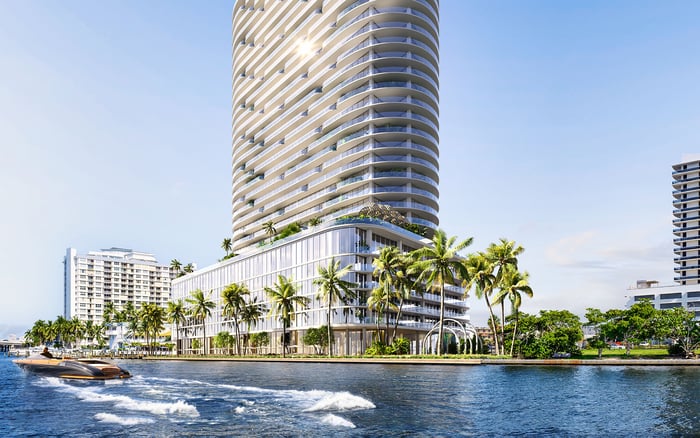
A practical buyer’s guide to evaluating terrace dimensions, shade, wind, furniture placement, storm preparation, and entertaining rules at Continuum Club & Residences North Bay Village.

Buyers considering Continuum Club & Residences North Bay Village should evaluate the terrace with the same care applied to interior rooms. Renderings can communicate design intent, but the purchase review should focus on the exact residence, its plans, and the governing documents.
Begin by defining how the space would be used. Dining, lounging, planting, and hosting can require different layouts, clearances, and building permissions. A terrace that supports one purpose may not comfortably support all of them at once.
Ask for a dimensioned plan showing the terrace’s width, depth, shape, doors, columns, railings, and other fixed elements. Then create a scaled furniture plan that accounts for chairs in use, door operation, walking paths, and access between indoor and outdoor areas.
Do not rely on total area alone. An irregular edge, narrow passage, fixed obstruction, or required clearance can affect where furniture may be placed. Buyers should have the relevant professionals review any dimensions that are important to the purchase decision.
For additional plan comparisons, review Shoma Bay North Bay Village and Tula Residences North Bay Village without assuming that their terrace conditions, specifications, or rules are equivalent.
Request orientation information and plans identifying overhead coverage. Consider when the intended dining and seating zones may receive direct sun, and ask whether nearby building elements could affect exposure.
If umbrellas, screens, awnings, or other shading devices matter to the intended use, verify whether they are permitted. Confirm approval procedures, installation limits, storage requirements, and any restrictions on appearance or attachment before selecting equipment.
Wind can vary by elevation, orientation, and surrounding conditions, so buyers should request any project-specific information available for the exact residence. A visit to a different floor or location should not be treated as a substitute for reviewing the applicable plans and documents.
Ask how railings, partitions, doors, drains, and thresholds are designed. If a wind screen or similar feature is important, determine whether it is included, optional, approvable, or prohibited rather than assuming it can be added later.
A comparison with La Baia North Bay Harbor Islands may help organize questions for another South Florida bayfront residence, but each project must be assessed on its own documents and conditions.
Before purchasing outdoor furniture, request the applicable rules for dimensions, weight, materials, anchoring, covers, planters, and attachments. Also ask whether installers must satisfy insurance, scheduling, elevator, or approval requirements.
Create a storm-preparation plan for every loose outdoor item. Confirm when items must be removed, where they may be stored, and who will act if the residence is vacant. The interior storage plan should be tested against the actual furniture and accessories being considered.
Trace the route between the kitchen, interior seating, doors, and outdoor gathering areas. Check whether furniture placement would interfere with circulation or door operation, and identify where serving pieces and loose items would be kept when conditions change.
Review the governing documents for rules concerning guests, noise, music, catering, cooking equipment, deliveries, and hours of use. Building amenities should not be assumed to establish what is permitted on a private terrace.
Before making a decision, request the plans and documents needed to evaluate dimensions, overhead coverage, drainage, electrical locations, railings, structural limitations, and permitted installations. Any detail material to the purchase should be confirmed in the controlling documents and reviewed with appropriate advisers.
The most useful comparison is residence-specific. Floor, orientation, layout, governing rules, and the buyer’s intended use should all be considered together rather than inferred from marketing imagery or another unit.
What terrace plan should a buyer request? Request a dimensioned plan for the exact residence showing fixed elements, doors, railings, and relevant clearances.
Why is total terrace area not enough? Overall area does not show whether the shape and depth support the buyer’s intended furniture and circulation plan.
How can a buyer evaluate shade? Review orientation and overhead coverage, then ask how permitted shading devices may be installed and stored.
How should wind be assessed? Request available information for the residence’s floor and orientation, and avoid relying solely on conditions observed elsewhere.
What should be checked before ordering furniture? Confirm dimensions, permitted materials, weight limits, anchoring rules, installation procedures, and storage requirements.
What belongs in a storm-preparation plan? Account for every loose item, the required removal timing, available storage, and responsibility when the home is vacant.
Can buyers assume umbrellas or screens are allowed? No. Their use, appearance, attachment, and storage should be verified in the applicable rules.
What entertaining rules deserve review? Check restrictions concerning guests, noise, music, catering, cooking equipment, deliveries, and permitted hours.
How should buyers compare terraces across projects? Compare exact plans, orientation, governing documents, and intended uses without assuming that projects follow identical standards.
Which terrace details should be confirmed before purchasing? Confirm the dimensions, fixed obstructions, shade conditions, drainage, electrical locations, structural limits, and operating rules that matter to the intended use.
When you're ready to tour or underwrite the options, connect with MILLION.
If branded residences are on your mind — as a home or as an allocation — we would be glad to share what we are seeing, privately.
Begin a quiet conversation