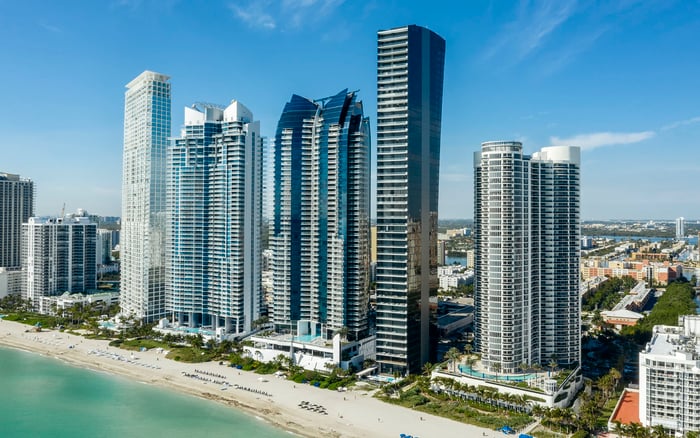
Owning at St. Regis® Residences Sunny Isles can anchor a Florida domicile file, but the purchase is only one element. The strongest position aligns occupancy, intent, government records, daily-life ties, and careful disengagement from a former state.

For an affluent buyer planning a move to Florida, a residence can serve as both a private retreat and the physical center of a carefully documented life. St. Regis® Residences Sunny Isles is a branded luxury condominium development in Sunny Isles Beach, and ownership can provide a meaningful foundation for a Florida domicile position.
Ownership alone, however, is not conclusive. Florida domicile requires physical presence coupled with the intention to make the state one’s true, fixed, permanent home and principal establishment. A person may maintain several residences, but only one domicile. The prior domicile generally continues until a new one is clearly established.
A Sunny Isles home gives the domicile file a tangible center-a place where occupancy, personal records, household routines, correspondence, and community life can converge. The more consistently these elements point to Florida, the more persuasive the narrative becomes.
That distinction matters for owners accustomed to maintaining homes across multiple jurisdictions. A purchase may support permanent intent, yet the same condominium can appear to be a second home if most personal, business, residential, and administrative ties remain elsewhere. The issue is not simply the caliber of the property, but whether the owner’s conduct identifies it as home.
A credible file is cumulative. Filing a Declaration of Domicile, registering to vote, obtaining Florida government identification, transferring vehicle records, and using the Florida residence for important mailing addresses can all reinforce the stated intent. A Florida driver’s license is useful evidence, but it does not determine the matter on its own.
Homestead exemption may provide another important fact when the owner qualifies, although homestead and tax domicile are related rather than identical legal questions. Estate-planning documents, financial correspondence, insurance records, and other daily-life materials should be reviewed for consistency. Conflicting addresses or declarations can weaken an otherwise thoughtful transition.
For buyers surveying branded residences in the same market, alternatives such as Bentley Residences Sunny Isles and The Ritz-Carlton Residences® Sunny Isles may also provide a Florida home base. The legal analysis remains specific to the owner, regardless of building or brand.
Florida imposes no individual state income tax, but establishing Florida domicile is only half of the planning exercise. The former state may independently test whether domicile was truly abandoned or whether statutory residency continues.
Many states consider whether an individual maintains a permanent abode there and spends approximately 183 days within the jurisdiction. Rules vary, including how a day is counted and which exceptions apply. Florida imposes no universal “six months and one day” rule for creating domicile, so relying on that phrase can obscure the more consequential former-state analysis.
Owners should maintain contemporaneous travel calendars and day-count records. They should also evaluate retained homes, offices, business activity, family patterns, memberships, and other connections outside Florida. A declaration filed in Florida cannot, by itself, overcome a conflicting pattern elsewhere.
Florida homestead treatment generally requires the property to be the owner’s permanent residence. Ownership and occupancy as of January 1 are relevant for the applicable tax year, but the permanent-residence analysis does not impose a fixed annual minimum number of occupancy days.
That does not diminish the importance of timing or evidence. Rather, homestead eligibility should be evaluated under its own requirements-not treated as an automatic consequence of a condominium closing or as definitive proof of tax domicile.
The most refined domicile strategy is often the least theatrical. The Florida residence becomes the place used in ordinary, repeated ways: for arrivals and departures, important mail, identification, voting, vehicles, personal administration, and the rhythms of private life.
This principle applies whether an owner chooses St. Regis® Residences Sunny Isles or an established Sunny Isles Beach address such as Jade Signature Sunny Isles Beach. The residence should reflect the owner’s actual pattern, not merely satisfy a paper checklist. Before closing or changing records, buyers should coordinate individualized advice from counsel familiar with both Florida and the jurisdiction being left.
Does buying at St. Regis® Residences Sunny Isles establish Florida domicile? No. Ownership supports the position, but physical presence, permanent intent, administrative records, and real-life conduct must also align.
Can someone own several homes but have more than one domicile? A person may have multiple residences but only one domicile. The existing domicile continues until a new one is clearly established.
Is a Florida driver’s license sufficient proof? No. It can demonstrate intent, but it is only one fact within the broader domicile record.
Should an owner file a Declaration of Domicile? It can serve as evidence of Florida residency, but it should align with conduct and records rather than be treated as conclusive.
Does Florida require six months and one day of presence? Florida has no universal six-month-and-one-day requirement for establishing domicile. Day-count exposure may still arise under another state’s rules.
Why does the former state remain important? That jurisdiction may challenge the abandonment of domicile or apply a separate statutory-residency test based on an abode and days present.
How should travel days be documented? Maintain contemporaneous calendars and supporting travel records. Precise documentation can be important if a former state reviews residency.
Is homestead exemption the same as tax domicile? No. The concepts overlap, but each has distinct legal requirements and should be analyzed separately.
What timing matters for Florida homestead? Ownership and occupancy as of January 1 are generally relevant to that tax year, together with permanent-residence requirements.
What most strengthens a Sunny Isles domicile file? Consistency across occupancy, identification, voting, vehicles, mailing addresses, legal documents, and daily conduct creates the clearest record.
For a tailored shortlist and next-step guidance, connect with MILLION.
If branded residences are on your mind — as a home or as an allocation — we would be glad to share what we are seeing, privately.
Begin a quiet conversation