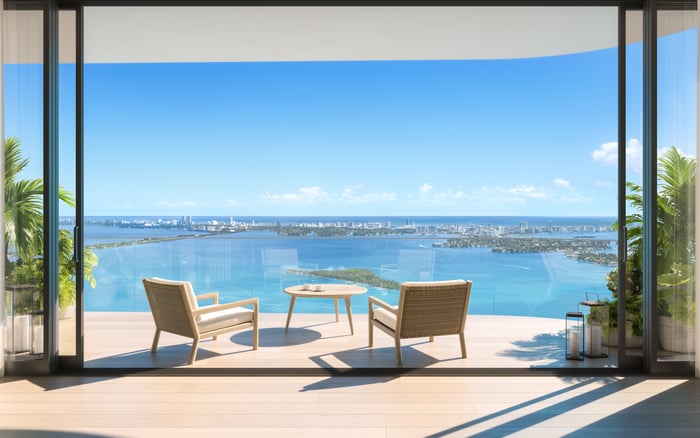
A closing-focused storm-readiness guide for seasonal and international buyers considering Aria Reserve Miami, from design criteria and water exposure to remote unit care and post-event access.

For a lock-and-leave buyer, storm preparation is not simply a question of whether a tower meets applicable code. It also requires examining how the residence, building and management structure are expected to function before, during and after severe weather, particularly when the owner is elsewhere.
Buyers considering Aria Reserve Miami should make storm readiness a documented part of pre-closing diligence. General statements about resilient construction should begin the conversation rather than conclude it.
The appropriate standard is documentary. Buyers should seek written criteria, procedures and authorizations for review with their attorney, insurance adviser and, where appropriate, an independent engineer.
Request the towers’ written design criteria for extreme wind and windborne debris. Useful questions include: What conditions informed the structural design? What standards apply to exterior glazing and openings? Which project documents establish those criteria?
Avoid the phrase “hurricane proof.” Resilient design may reduce risk, but buyers should not interpret that language as a guarantee against damage, water intrusion or service interruption. They should also distinguish structural design criteria from the building’s operational plan for a severe or prolonged event.
The same discipline applies when comparing Miami options such as EDITION Edgewater. Marketing language is not a substitute for project documents. The objective is not to make unsupported comparisons, but to ask each building the same precise questions.
Water-related due diligence should extend beyond glazing. Buyers can ask how project documents address storm surge, wave action, heavy rainfall and potential water intrusion, as applicable to the property. They should also identify which common areas and building systems management evaluates for flooding, moisture or utility disruption.
That inquiry should trace the path from exterior conditions to possible interior consequences. Buyers need to understand how management checks common spaces and residences for water, how moisture concerns are escalated and what procedures apply when an owner cannot return promptly.
This review is also relevant when evaluating Miami residences such as The Cove Residences Edgewater and Villa Miami. Buyers should request the governing documents and response protocols applicable to each property rather than assume that procedures are uniform.
Before closing, request the condominium association’s written hurricane-preparation and emergency-response procedures. The documents should clarify which tasks management performs and which remain the individual owner’s responsibility.
Ask whether management offers any service for inspecting or preparing an unoccupied residence. If it does, determine whether advance enrollment, standing authorization, a separate agreement or fees apply. Confirm the service’s precise scope rather than assuming it covers every item within the residence.
A useful review should identify deadlines, access limitations and any rules governing exterior or terrace-related items. It should also establish who may hold keys or approved access credentials and under what circumstances authorized personnel may enter an absent owner’s home.
Seasonal and international owners should ask how management communicates storm alerts, preparation deadlines, access restrictions and post-storm updates. Confirm the channels used, the people authorized to receive messages and the process for updating contact details. An owner may also wish to designate a property manager or local representative, subject to the applicable documents and authorizations.
A remote-monitoring plan can address indoor temperature changes, moisture, leaks and power loss while the residence is vacant. Buyers should determine who receives an alert, who is permitted to respond and how an issue will be documented. Technology is most useful when paired with a clear human-response protocol.
Owners should also ask how management communicates any interruption affecting elevators, air conditioning, valet operations or other building services. Because the timing and extent of an interruption depend on the event, the focus should be on the response framework rather than a promised restoration schedule.
Buyers should ask about post-storm inspections, water-intrusion checks, owner notifications and procedures for entering residences whose owners are absent. They should not assume that access or normal operations will resume immediately after severe weather passes.
Clarify who conducts initial inspections, how findings are recorded and when an owner may need to engage a private contractor or representative. Determine how management would communicate an all-clear, a partial reopening, an access restriction or a continuing service limitation.
A practical closing plan treats storm readiness as recurring property management rather than a document signed once and forgotten. Contact information, authorizations, monitoring arrangements and local representation should be reviewed before hurricane season and whenever the residence’s occupancy pattern changes.
The closing file should include the applicable wind and debris design criteria, water-exposure information, association emergency procedures, allocation of owner and management duties, remote-service terms, communication protocols and post-event access rules. Buyers should review insurance records, condominium documents and relevant engineering materials with qualified advisers rather than rely on assumptions.
The central operational question is straightforward: If a storm approaches while the residence is empty, who does what, by when, with what authority, and how will the owner receive confirmation? Obtaining a precise written answer can help a lock-and-leave owner build a workable readiness plan.
Is meeting building code enough for a lock-and-leave buyer? Code compliance is only one part of diligence. Buyers should also review written design criteria, emergency procedures, water exposure and operational plans.
Should glazing be described as hurricane proof? No. Resilient glazing should not be treated as a guarantee that damage or water intrusion is impossible.
Which wind information should a buyer request? Request written design criteria addressing extreme wind and windborne debris, then review the supporting documents with qualified advisers.
Why should buyers review water exposure? The review can clarify how project documents and management procedures address storm surge, wave action, heavy rainfall and potential water intrusion, where applicable.
Will management prepare an empty residence? Buyers should verify whether such a service exists and confirm its scope, authorization requirements, enrollment deadlines and fees.
What should remote monitoring cover? A plan can address indoor temperature, moisture, leaks and power loss, along with a defined response when an alert occurs.
How should storm alerts reach an overseas owner? Confirm management’s communication channels and establish which authorized representatives may receive and act on updates.
Can management enter an absent owner’s residence? Entry authority and procedures should be confirmed in the governing documents, emergency plan and any owner authorization.
How should possible service interruptions be evaluated? Ask how management communicates limitations affecting elevators, air conditioning, valet operations or other services and how restoration updates are issued.
When should an owner revisit the storm plan? Review contacts, authorizations, monitoring arrangements and local support before hurricane season and after occupancy arrangements change.
When you're ready to tour or underwrite the options, connect with MILLION.
If branded residences are on your mind — as a home or as an allocation — we would be glad to share what we are seeing, privately.
Begin a quiet conversation