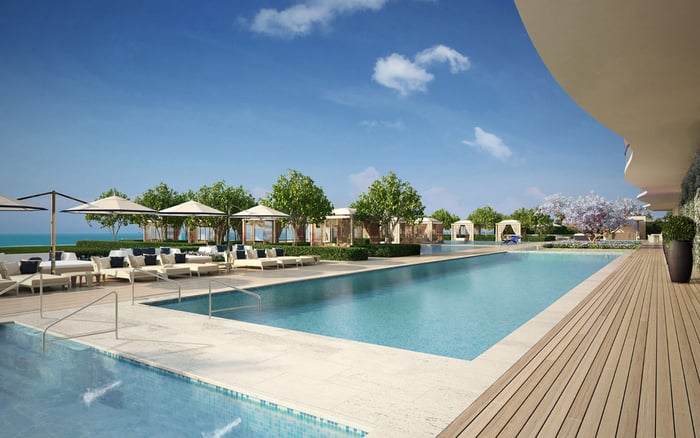
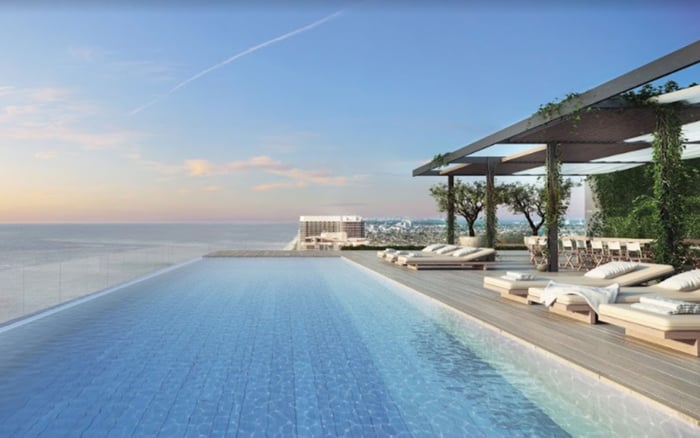
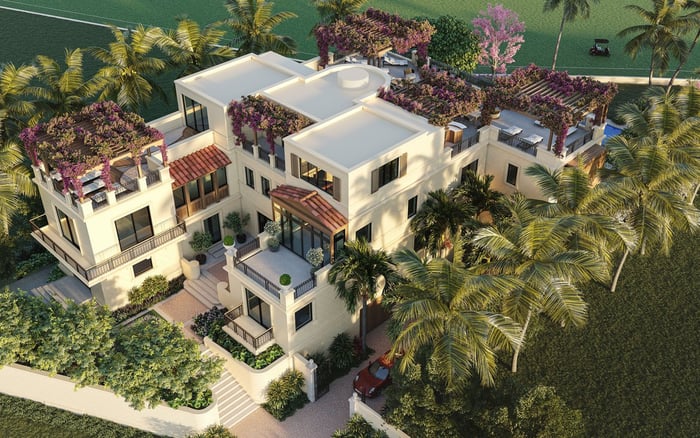
At The Surf Club, view value is not captured by floor alone. Buyers should isolate tower, stack, orientation, terrace usability, privacy and the durability of each ocean-to-bay corridor before pricing a resale.
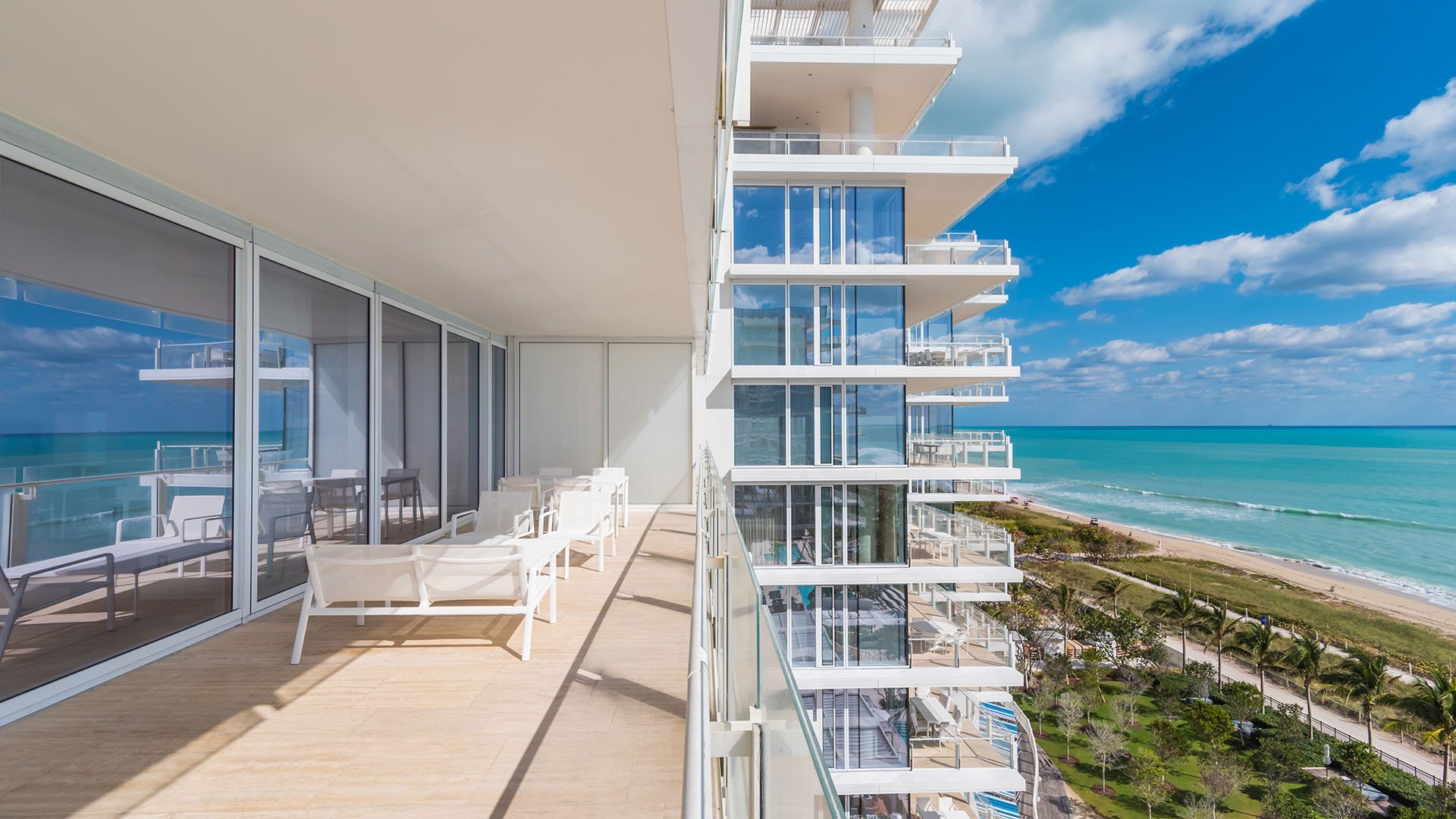
At The Surf Club Four Seasons Surfside, the residential proposition begins with an oceanfront setting, but the value of a particular home depends on far more than proximity to the Atlantic. The branded private residences are sold out, making this principally a resale conversation. Buyers are not selecting from uniform developer inventory. They are evaluating individual opportunities, each defined by its tower position, stack, elevation, orientation, and relationship to surrounding structures.
That distinction is evident throughout the property’s design language. Floor-to-ceiling glazing, expansive private terraces, and privileged vantage points place the outlook at the center of the experience. Panoramic ocean-to-bay views and indoor-outdoor living are defining attributes, not decorative extras. Two residences with similar interior area may therefore warrant materially different treatment if one offers a broad, uninterrupted horizon while the other delivers a narrower or more oblique water view.
The first valuation step is to classify exposure precisely. Direct oceanfront should be distinguished from elevated ocean-facing, partial-ocean, city-facing, and dual-aspect ocean-to-bay configurations. A glimpse of water from one room is not economically equivalent to an Atlantic panorama spanning the principal living areas.
For every candidate, identify the exact tower, stack, floor, and compass orientation. Then test the view from the places where life actually unfolds: seated at the dining table, standing at the kitchen island, reclining in the primary bedroom, and sitting on the terrace. Floor-to-ceiling windows can amplify natural light and horizon drama, but glazing cannot correct a compromised angle. Frameless balcony glass may reduce visual interruption, yet furniture placement, railing height, and terrace depth still shape the seated sightline.
This scrutiny should also guide comparisons with nearby Surfside properties such as Arte Surfside and Fendi Château Residences Surfside. Their presence in a buyer’s search does not make every residence interchangeable. The relevant comparison is between units with genuinely similar exposure, scale, privacy, and indoor-outdoor relationships.
Higher floors often command attention, but elevation is a proxy rather than the asset itself. The true asset is the quality and durability of the visual field. A lower residence with a broad, direct ocean plane may be more compelling than a higher home with an angled or interrupted outlook-or one dependent on standing near the glass.
The oceanfront twin-tower development rises 12 floors, making tower placement and vertical position important. Still, buyers should resist paying for height without confirming what that height delivers. Assess horizon width, the downward beach perspective, sky exposure, sunset reach, privacy from neighboring residences, and nighttime city light.
Dual-aspect homes require their own framework. Ocean-to-bay exposure can add sunrise, sunset, and cross-residence visual depth, but it should not be compared directly with a single-aspect ocean home without adjustments for interior area, privacy, and terrace configuration. A water view is therefore a starting classification, not a finished valuation.
A terrace creates value when it is deep enough to furnish, proportioned for circulation, and naturally connected to the primary rooms. Penthouse plans at the property include oceanfront and bayfront terraces, with some ocean terraces reaching 46 feet in length and up to 26 feet in depth. Selected plans also include rooftop gardens, private pools, private beachfront cabanas, and unlimited ocean-and-bay views.
These features place certain homes in a distinct scarcity tier, but dimensions alone do not determine the premium. Test wind exposure, shade, privacy, access points, and whether the principal view remains available from a seated position. A large terrace that functions gracefully can extend the residence’s daily living pattern; an awkward one may photograph impressively while contributing less in practice.
For broader context, buyers may examine the oceanfront decision set at Eighty Seven Park Surfside or just north at Rivage Bal Harbour. The objective is not to average unrelated asking prices, but to understand what similarly discerning buyers can choose when architecture, service, privacy, and water exposure are considered together.
There is no reliable basis for applying a single property-wide percentage premium to a preferred line. The defensible approach is a matched-unit analysis. Begin with transactions or offerings that align as closely as possible in tower, stack, floor, interior area, condition, terrace utility, and date. Then isolate the remaining differences rather than attributing the entire price gap to the view.
Long-term scarcity is strongest when several conditions converge: direct exposure, broad horizon width, useful outdoor space, privacy, and limited substitution within the building. The residences’ sold-out status restricts access to resales, while the hotel’s inventory of only 77 rooms reinforces the wider property’s limited scale. Neither fact guarantees appreciation, but together they sharpen the importance of waiting for the correct line rather than treating all availability as equivalent.
In buyer’s guides, oceanfront value is sometimes reduced to floor and direction. At this level, the better question is whether the corridor is rare, enjoyable throughout the day, and difficult to replicate. Buyers should reserve conviction for the residence that passes all three tests.
Before placing a premium home under contract, request the exact floor plan and terrace dimensions, then inspect at more than one time of day when feasible. Photograph the view from consistent positions and note any existing or adjacent structural interference. Confirm which rooms receive the principal outlook, how neighboring terraces affect privacy, and whether the bay or city exposure adds meaningful evening value.
Finally, separate permanent attributes from correctable ones. Finishes can be changed. A compromised stack, narrow corridor, or poor terrace relationship generally cannot. At The Surf Club, the most rational premium is paid for enduring spatial advantages rather than presentation alone.
What defines a premium line at The Surf Club? A premium line combines strong orientation, broad view corridors, privacy, useful terraces, and favorable placement within its tower.
Is a higher floor always more valuable? No. Elevation matters only to the extent that it improves horizon width, privacy, light, and the usable outlook.
How should direct ocean views be compared with partial views? Treat them as distinct exposure categories, then adjust for floor, area, condition, terrace quality, and privacy.
Why does tower and stack identification matter? The residences span twin oceanfront towers, so the same floor number can produce different angles, interference, and exposure.
Should ocean-to-bay homes command a premium? They may, particularly when both aspects are usable, but the adjustment must reflect terrace configuration, privacy, and interior area.
How important is terrace depth? Depth shapes furnishing, circulation, and seated sightlines, making it as relevant as total outdoor square footage.
Can one percentage be applied to every superior view? No. A credible adjustment should derive from closely matched unit comparisons rather than a building-wide rule.
Does sold-out status prove future appreciation? No. It limits access to resale inventory, but value still depends on demand, condition, pricing, and the rarity of the specific line.
What should be inspected from inside the residence? Assess the outlook from the living, dining, kitchen, and bedroom positions-not only while standing beside the glass.
Which attributes are hardest to change after purchase? Tower, stack, orientation, elevation, view interference, and terrace geometry are fundamentally fixed.
For a confidential assessment and a building-by-building shortlist, connect with MILLION.
If branded residences are on your mind — as a home or as an allocation — we would be glad to share what we are seeing, privately.
Begin a quiet conversation