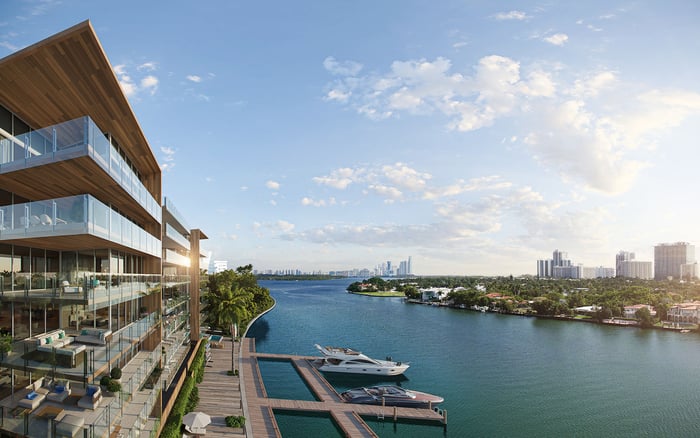
A buyer-focused framework for comparing La Maré and The Well through governing documents, ownership costs, waterfront rights, amenity access, privacy, and practical daily use.

Buyers considering La Maré Bay Harbor Islands or The Well Bay Harbor Islands should distinguish the marketing promise from the rights, costs, and restrictions established by current documents. A useful comparison asks four questions: what is privately owned, what is shared, what requires an additional payment, and what remains available during ordinary daily use.
This approach is especially important when evaluating waterfront ownership. A water-oriented setting, marina reference, amenity image, or service description does not by itself establish an owner’s legal right to use a particular space or service. Those details should be confirmed in the applicable declaration, budget, rules, contracts, plans, and written disclosures.
Begin by identifying exactly what the purchase includes. The review should distinguish the residence from limited common elements, general common elements, parking rights, storage rights, waterfront facilities, and any separately assigned or licensed spaces.
The same discipline applies when a development contains distinct buildings, collections, or ownership components. Buyers should not assume that access, staffing, amenities, expenses, or rules apply uniformly. The relevant documents should explain which association controls each component, how shared costs are allocated, and whether access can change.
A contract-level review is also necessary for finishes, appliances, layouts, views, and other residence-specific details. Promotional materials can introduce a design concept, but the executed agreement and incorporated schedules determine what the buyer is entitled to receive.
A fee figure is meaningful only when its calculation and coverage are clear. Buyers should verify the assessment basis, billing frequency, applicable square footage, included services, reserve treatment, and any expenses charged outside the regular assessment.
The current budget should be read alongside the declaration and rules. Relevant questions include how insurance, staffing, elevators, pools, wellness areas, waterfront infrastructure, utilities, landscaping, security, and management are treated. If facilities are shared, the documents should explain how costs are divided and whether one component can subsidize another.
A useful comparison between La Maré and The Well should therefore model total recurring ownership costs rather than compare a single quoted rate. The analysis should also account for separately billed services, optional programs, parking charges, waterfront expenses, and potential assessments disclosed in the available documents.
Waterfront positioning and marina use are separate questions. A buyer should determine whether any boat slip or dock right is deeded, assigned, licensed, rented, separately purchased, or governed by a priority system. If no written right is attached to the residence, marina access should not be assumed.
The applicable agreement should address vessel limits, insurance requirements, utilities, guest use, waiting lists, transferability, operating rules, and recurring charges. Buyers should also confirm whether waterfront areas are exclusive to residents, shared with another component, or subject to reservation procedures.
For additional context within Bay Harbor Islands, buyers may consider Onda Bay Harbor and La Baia North Bay Harbor Islands. Each project requires an independent review; one property’s structure does not establish a standard for another.
The practical value of an amenity depends on its rules. Buyers should review operating hours, reservation systems, guest limits, private-event procedures, age restrictions, pet policies, package handling, service access, household-staff access, and temporary closures. They should also confirm which amenities belong to their specific ownership component.
Parking and arrival deserve similar attention. The documents and plans should clarify assigned or valet arrangements, guest parking, electric-vehicle procedures, delivery access, bicycle storage, and any limitations affecting household members or service providers.
Intended occupancy matters as well. A primary resident, seasonal owner, family with frequent guests, and boating-focused buyer may interpret the same rules differently. Rental restrictions, approval procedures, minimum lease terms, move policies, and guest registration requirements should be matched to the buyer’s expected pattern of use.
Neither project should be judged solely through amenity lists or visual presentation. The stronger fit is the one whose verified ownership rights, recurring obligations, access rules, privacy framework, and operating practices align with the buyer’s priorities.
Before signing, request the current declaration, budget, rules and regulations, purchase agreement, finish schedule, parking plan, insurance information, and any marina or shared-amenity agreements that apply. Legal, tax, insurance, and financial questions should be reviewed with the buyer’s own qualified advisers.
How should buyers compare La Maré and The Well? Compare their current governing documents, budgets, contracts, access rules, and residence-specific schedules rather than relying only on promotional descriptions.
Why is the fee basis important? The basis shows how an assessment is calculated. Buyers should verify the applicable area, billing frequency, included services, reserves, and separately charged expenses.
Does a waterfront setting guarantee marina access? No. Any dock or slip right should be confirmed in the contract and governing marina documents.
What should a marina agreement clarify? It should address the form of the use right, vessel requirements, insurance, utilities, guest access, transfer rules, priority procedures, and recurring charges.
Can buyers assume every amenity serves every residence? No. The declaration, plans, and rules should identify which ownership component controls each amenity and who may use it.
Which daily-use rules deserve close review? Review operating hours, reservations, guest limits, pets, deliveries, service access, household staff, private events, and temporary closures.
How should parking be evaluated? Confirm assignment or valet terms, guest availability, delivery procedures, electric-vehicle rules, and any separate fees in writing.
Why do rental rules matter to an owner-occupant? Rental and guest policies can affect flexibility, building operations, privacy, and the way common areas are used.
What documents should be requested before signing? Request the current declaration, budget, rules, purchase agreement, finish schedule, parking plan, and any marina or shared-facility agreements.
What is the best final test of lifestyle fit? Model the intended pattern of ownership and confirm that documented costs, access rights, restrictions, and operating practices support it.
For a discreet conversation and a curated building-by-building shortlist, connect with MILLION.
If branded residences are on your mind — as a home or as an allocation — we would be glad to share what we are seeing, privately.
Begin a quiet conversation