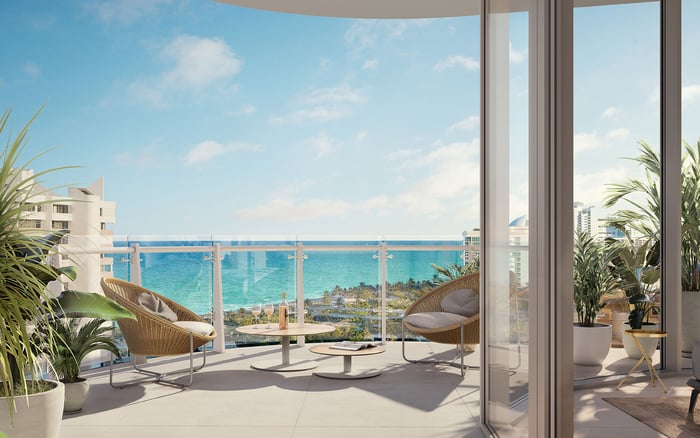
At The Ritz-Carlton Residences® Pompano Beach, restaurant access is an important advertised amenity. Yet access, exclusivity, priority reservations and guaranteed seating are distinct concepts. Buyers should evaluate each through the language of the governing documents and operating policies, rather than assuming that a branded residential privilege carries an unconditional booking right.

At The Ritz-Carlton Residences® Pompano Beach, dining is presented as part of a broad, resort-style residential experience. The two shoreline towers occupy a property extending from the Atlantic Ocean to the Intracoastal Waterway, pairing an oceanfront Beach Club with a Marina Yacht Club and private resident marina. Within this setting, the restaurant is not a peripheral convenience; it contributes to the property’s daily rhythm and social identity.
The important question is not whether restaurant access has been advertised. It has. The more precise issue is what that access means when an owner wants a particular table at a particular hour. The amenity program identifies a restaurant bar and grill with indoor and outdoor seating, alongside beach-level food-and-beverage service and lounge areas. It does not define a reservation quota, guaranteed seating time, owner booking window or unconditional priority-reservation right.
Access describes who may use an amenity, while a guarantee defines what must be delivered.
For buyers accustomed to branded residences, that distinction is especially relevant. Luxury hospitality vocabulary often conveys attentive service, privileged spaces and elevated recognition. Those qualities can be meaningful without creating an absolute right to availability on demand.
Four concepts are easily blended in a sales conversation, but they should be separated during diligence.
Access
means an owner is eligible to use the restaurant, subject to the rules governing it. Standing alone, access does not address capacity, hours, reservations, closures, guest policies or availability.
Exclusivity
concerns who else may enter. The private beach club and restaurant are described in some language as reserved solely for residents. Elsewhere, the beach restaurant is described as available to residents and their guests. Those formulations are not interchangeable. A resident-focused venue can remain private in character while allowing invited nonresidents.
Priority reservations
would ordinarily involve a defined preference, such as earlier booking access or precedence over another category of diner. No such mechanism is specified for this property.
Guaranteed rights
are stronger still. A guarantee would require language sufficiently clear to establish what is promised, under which conditions and with what limitations. There is no stated guarantee of peak-time seating or an unconditional reservation right for owners.
Consider a Saturday evening when many residents want to dine at the same time. The right to request a reservation differs from a contractual obligation to provide one. Likewise, access to indoor and outdoor seating does not mean every seating area will always be open, nor that an owner may select any table without regard to capacity or operations.
The phrase “reserved solely for residents” may sound conclusive, but it leaves material questions. Does it include household members, tenants or personal guests? Must guests be accompanied? Can management impose limits during high-demand periods? Is walk-in service offered? May policies change with seasonal operations? The available language does not settle those details.
This is not merely semantic. Restaurant availability can shape how an owner imagines the lifestyle of an oceanfront home: breakfast near the beach, lunch after time in a chaise lounge, or dinner without leaving the property. The more central that ritual is to the purchase decision, the more precisely the buyer should understand its operational basis.
The dining proposition should be viewed as a collection of related experiences rather than a single promise. The offerings include a restaurant beach bar and grill, indoor and outdoor seating, a separate breakfast bar, beach-level food-and-beverage service, beach towel and wait service, an owners’ lounge and bar, outdoor grilling and in-residence dining service. A seasonal menu has also been contemplated for the beach restaurant.
These offerings may reduce reliance on one dining room, but one service should not be assumed to substitute contractually for another. In-residence dining, for example, is a different experience from a confirmed restaurant table. A breakfast bar does not resolve dinner availability. Beach wait service does not establish reservation precedence.
The same disciplined reading applies when comparing Armani Casa Residences Pompano Beach, W Pompano Beach Hotel & Residences or Waldorf Astoria Residences Pompano Beach. These links provide useful starting points for a local search, but each property’s amenity language should be evaluated on its own terms. Brand familiarity is not a substitute for project-specific documentation.
A buyer who considers dining access material should request a direct explanation of the reservation system, then compare that explanation with the controlling documents and current written policies. The review should establish who may book, how far in advance reservations open, whether owners receive a preferred window and whether guest reservations draw from the same capacity.
It is equally important to clarify whether seating is first come, first served; whether per-residence limits apply; whether minimum spending, service charges or separate fees may apply; and how private events, maintenance or seasonal schedules affect access. Buyers should also ask who operates the venue and which entity may amend its rules.
The governing condominium documents, purchase materials, amenity rules and restaurant policies deserve coordinated review with qualified legal counsel. The intended experience may be described elegantly, but enforceable rights generally depend on the operative language, including reservations, limitations and amendment powers. Oral assurances should be reduced to writing when material to the decision.
The appeal of the Pompano Beach setting is clear: Atlantic frontage, Intracoastal access, a private resident marina and dining integrated into the beach experience. Careful document review does not diminish that proposition. Instead, precision allows a buyer to distinguish a valuable amenity from a service level that has not been expressly guaranteed.
The prudent conclusion is straightforward. Restaurant access is an advertised component of the residential program. Resident-oriented wording may establish a private context, yet it does not by itself define whether personal guests are permitted. Most importantly, neither access nor exclusivity should be translated into guaranteed seating, preferred times or unconditional booking priority unless the controlling language expressly provides those rights.
For discreet guidance on South Florida’s finest residences, connect with MILLION.
If branded residences are on your mind — as a home or as an allocation — we would be glad to share what we are seeing, privately.
Begin a quiet conversationYes. The restaurant is presented as part of the development’s broader residential amenity program.
No guaranteed table is stated in the project descriptions. Access and confirmed availability are separate concepts.
The project descriptions do not define an owner priority window or unconditional reservation preference.
Some property language says it is reserved solely for residents, while another description includes residents and their guests. The controlling documents should clarify the operative guest policy.
One description contemplates access for residents and their guests. Buyers should confirm any accompaniment, capacity or booking restrictions in writing.
The amenity program includes a restaurant bar and grill with indoor and outdoor seating, plus a separately described breakfast bar.
Yes. The descriptions include beach-level food-and-beverage service, as well as beach towel and wait service.
No. In-residence dining is a distinct service and should not be treated as a contractual substitute for restaurant seating.
Confirm booking windows, capacity rules, guest access, residence-level limits, fees, seasonal schedules and management’s authority to change policies.
Buyers should review the governing condominium documents, purchase materials, amenity rules and restaurant policies with qualified legal counsel.