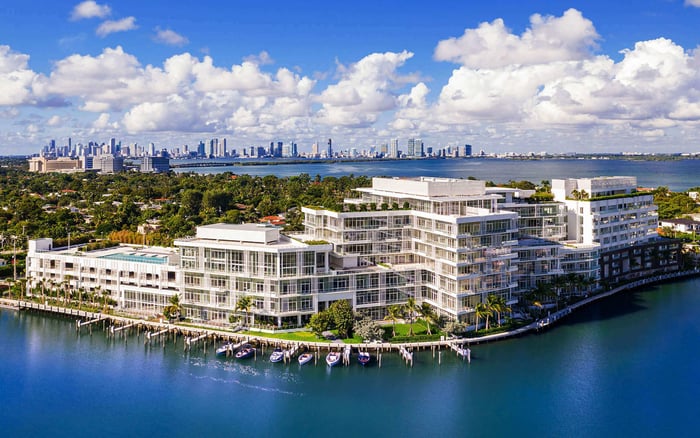
At The Ritz-Carlton Residences® Miami Beach, discerning ownership begins with separating a licensed name from contractual obligations, daily service costs, and long-term replacement funding. A document-led review reveals how those commitments fit together without assuming that prestige guarantees financial performance.

At 4701 North Meridian Avenue, The Ritz-Carlton Residences® Miami Beach sits on Surprise Lake. Its appeal invites a familiar luxury calculation: architecture, waterfront access, and attentive service weighed against the responsibilities of ownership. The more consequential calculation unfolds over time, as daily operations and eventual replacement work compete for an owner's capital.
Prestige is not a substitute for a funding plan. Nor are substantial operating expenses, by themselves, evidence of poor management. The buyer's task is to establish whether the service promise, contractual commitments, and capital schedule form a coherent ownership proposition.
That review must remain property-specific. The Ritz-Carlton Residences® South Beach is a different project; its financial information should not be used to draw conclusions about North Meridian Avenue.
The residences are not owned, developed, or sold by The Ritz-Carlton Hotel Company, L.L.C., or its affiliates. The name is licensed; the developer is 4701 North Meridian, LLC, a partnership of Lionheart Capital and Elliott Management Corporation. These distinctions matter because a brand relationship does not establish who funds a future expense.
A buyer should distinguish developer identity, brand licensing, management responsibilities, and association obligations. The name alone does not establish the current management agreement's duration, fees, minimum staffing, inspection rights, or mandatory refurbishment cycles. Nor is it evidence of a financial guarantee.
Ask counsel to examine the operative agreements, including amendments, renewal provisions, termination rights, and any standards incorporated by reference. If a material change in service or finishes requires approval, identify who grants it and who bears the cost. These are questions for the contracts, not conclusions about this property's arrangements.
Historical service offerings included two attended lobbies, 24-hour personalized concierge services, and valet parking. The concierge offering encompassed arrangements for air travel, ground transportation, in-residence dining or catering, personal shopping, and absentee-owner services. For an owner who travels frequently, those details can be central to the purchase decision.
Those historical offerings do not establish current availability or inclusion in association dues. Arranging a service is also distinct from paying for it. Confirm the present scope, operating hours, staffing coverage, owner charges, and vendor responsibilities before assigning financial value to any offering.
Then read the adopted budget alongside the service schedule. Request current financial statements and compare actual expenditures with budgeted amounts across comparable periods. Where material variances appear, ask whether they reflect timing, a recurring cost change, or a revised service commitment. Operating discipline means understanding what expenditure delivers-not assuming the lowest figure represents the strongest result.
The development includes 111 residences and 36 private moorings. Historical amenities also included a landscaped roof deck, private cabanas, and a rooftop pool. Each feature warrants two questions: what does it take to operate today, and how will its eventual renewal be funded?
Do not divide a projected expense by 111 and call the result an owner's liability. The residence count is not a verified assessment denominator. Governing documents must establish which assets belong to which entity, who benefits from them, and how costs are allocated. Mooring rights and obligations warrant separate examination; do not assume every owner shares them equally.
A useful reserve review connects the asset inventory to condition, estimated remaining useful life, replacement cost, and the proposed funding schedule. Ask whether the relevant roof, pool, landscape, and marina components are addressed, and confirm responsibility for each. This is a diligence framework, not a finding that any component is absent from the property's planning.
The project incorporates the reclamation of four existing buildings. That adaptive-reuse history makes component-level records especially useful: buyers should establish what was retained, what was replaced, and what maintenance or renewal has occurred since. The history alone establishes neither a defect nor a reserve shortfall.
Historical amenities included a pet salon suite, art and music rooms, a library/conference room, and a barbecue and dining area. A thoughtful capital review should distinguish safety and functional work from aesthetic renewal, then examine whether contractual design standards affect specifications or timing. A beautiful common room and a sound building system serve different purposes, even when both require funding.
For a buyer also considering Setai Residences Miami Beach, the useful comparison is documentary rather than visual. Apply the same questions to each property's actual agreements and financial schedules without assuming equivalent services, allocation rules, or replacement obligations.
Operating expenditure supports present service; replacement reserves prepare for future capital needs. Evaluate them together, but do not treat them as interchangeable. A polished arrival experience does not demonstrate reserve adequacy, and an impressive reserve balance says little without the associated schedule of work and responsibilities.
Ask the association's financial and engineering advisers to explain how planned contributions relate to projected expenditures. Review any applicable structural integrity reserve study, or SIRS, alongside other reserve schedules and studies. Counsel should determine which requirements apply to this property rather than rely on a general statement about Florida condominiums.
Insurance deserves a parallel review. Examine coverage, exclusions, deductibles, and the documents governing responsibility for uninsured costs. Request assessment records and distinguish adopted obligations from preliminary discussions. Without current documents, neither a conclusion of underfunding nor reassurance about future assessments is warranted.
Finally, test timing. Ask how the ownership picture would change if a major replacement occurred earlier than projected or service costs rose faster than budgeted. These scenarios evaluate resilience; they do not predict an expense increase here.
Before committing, assemble the current financial statements, adopted budget, reserve schedules and studies, any applicable SIRS, insurance documents, management and licensing agreements, governing documents, and assessment records. Have the relevant advisers reconcile them: the assets being funded should match the ownership obligations, and the services being purchased should match the contractual commitments.
The objective is not to eliminate the cost of luxury. It is to understand its structure well enough to choose it deliberately. At this address, brand prestige should begin the conversation; documented operating discipline and credible replacement planning should complete it.
For a considered approach to South Florida luxury ownership, explore MILLION.
If branded residences are on your mind — as a home or as an allocation — we would be glad to share what we are seeing, privately.
Begin a quiet conversationThe property is at 4701 North Meridian Avenue in Miami Beach, on the shores of Surprise Lake.
The residences are not owned, developed, or sold by The Ritz-Carlton Hotel Company, L.L.C., or its affiliates. The Ritz-Carlton name is licensed.
The developer is identified as 4701 North Meridian, LLC, a partnership of Lionheart Capital and Elliott Management Corporation.
No. Current management and licensing agreements must establish the applicable responsibilities, fees, service standards, and renewal provisions.
Historical descriptions do not establish current availability or inclusion in dues. Buyers should confirm service scope, owner charges, and responsibility for third-party costs.
No. The count of 111 residences does not establish the assessment base or allocation formula; those must be confirmed in the governing documents.
The development includes 36 private moorings. Buyers should separately verify access rights, ownership responsibilities, and cost allocation.
No. Incorporating four existing buildings makes component histories useful to review, but it does not establish a defect or funding shortfall.
Request current financial statements, the adopted budget, reserve schedules and studies, any applicable SIRS, and assessment records. Governing documents, insurance documents, and management and licensing agreements help establish the related obligations.
No. The Ritz-Carlton Residences® South Beach is a different project, and its financial information should not be used to draw conclusions about the North Meridian Avenue property.