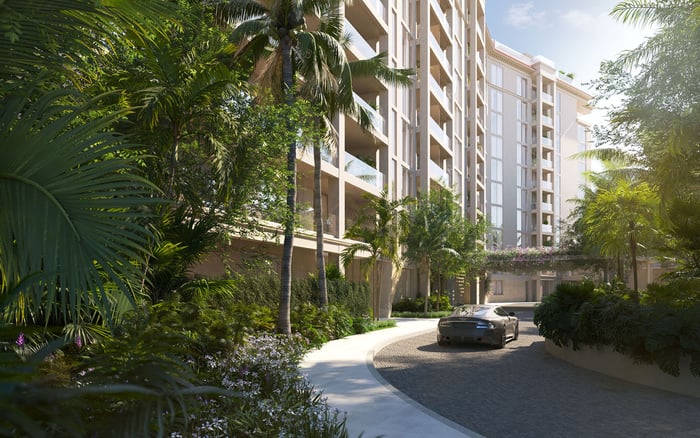
Private garages distinguish The Links Estates from a valet-centered condominium arrival, but parking capacity is only part of the ownership equation. Vehicle classifications, estate-specific layouts and confirmed EV infrastructure deserve equal attention before purchase.

At The Links Estates at Fisher Island, the first parking distinction is architectural. The collection comprises 12 single-family residences, not a condominium development, with homesites along the golf-course fairway on the island’s north side. Private garages and driveways make arriving home materially different from entering a shared, valet-served residential building.
That distinction matters for a household with several drivers, golf carts or a carefully chosen collection of cars. Yet a private driveway does not mean unrestricted vehicle storage, and a generous garage does not establish multi-EV readiness. The ownership question is not simply how many vehicles fit, but which vehicles may stay where-and how they will be charged.
A thorough purchase review separates three subjects: the estate’s physical parking layout, the island’s vehicle rules and any services used away from home. Treating them as a single amenity risks overlooking the details that determine daily convenience.
Mandatory valet use at The Links Estates is not established. Its private-garage arrangement should not be described as a condominium-style valet operation, nor should another development’s valet arrangements be assumed to apply to these homes.
Dedicated parking with valet services is offered at The Mansions on Fisher Island. That offering does not establish a mandatory policy at The Links Estates or across Fisher Island. For buyers also considering The Residences at Six Fisher Island, the comparison should begin with each property’s written arrival and parking arrangements, not assumptions about a shared island standard.
At the estate, review how drivers reach the garage, where guests would park and whether everyday departures require moving other vehicles. For destinations elsewhere on the island, ask separately about self-parking, any valet requirements, operating hours and vehicle acceptance. None of these venue-specific details should be inferred from the home’s private parking allocation.
Independence at the front door does not answer every question about an evening out.
The stated private-parking provision is a minimum of six cars, plus golf carts. Buyers should confirm the allocation for the particular estate, including how much is enclosed and how much is outside.
One seven-bedroom, 8.5-bath estate is described as having a five-car garage and parking for up to nine cars. Those figures describe different capacities, not interchangeable promises. Five enclosed spaces and nine total spaces have different implications for a household whose vehicles require garage accommodation under the island’s rules.
Request a parking plan identifying enclosed bays, outdoor positions and golf-cart accommodation. Then test it against the household’s actual fleet. Door clearance, maneuvering room and the ability to retrieve one car without moving another are practical inspection questions-not features established by a headline count.
The wording around climate control also deserves scrutiny. Specified garage features include air-conditioned storage; that does not establish that the entire garage is air-conditioned. Buyers planning to keep temperature-sensitive belongings or a prized automobile should confirm precisely which area is conditioned and what equipment serves it.
The operative vehicle restriction is category-based. It covers trucks, motorcycles, vehicles with shells or camper attachments, commercial vehicles, campers, mobile homes, motor homes, trailers, recreational vehicles, boats and vans. Vehicles in these categories may not be parked or stored on Fisher Island except in enclosed garages or specifically designated spaces, if any.
For an estate buyer, the enclosed-garage exception is central. Stated outdoor parking capacity should not be treated as unrestricted driveway storage for a truck, van or trailer. A space can be physically available without being permissible for the intended vehicle.
“Oversized,” meanwhile, is an imprecise shorthand. The stated rule supplies no numerical height, length or weight threshold and does not establish that every large SUV is prohibited. If a vehicle’s classification is uncertain, obtain written clarification for that specific vehicle rather than relying on its appearance or a general description such as family transport.
Keep parking and access separate, too. A restriction on parking or storage is not, by itself, a blanket prohibition on vehicle entry, deliveries or temporary drop-offs. Those uses warrant their own questions. Before closing, obtain the current governing rules and confirm whether amendments or estate-specific provisions affect the intended arrangements.
Garage parking and storage are specified, but installed EV-charger counts, charging power and electrical capacity for multiple EVs are not established. A substantial home and several parking spaces do not resolve those questions.
For an EV household, start with the delivered condition: whether charging hardware is installed, where it is located, which vehicles it supports and what output is available. If equipment is proposed rather than installed, clarify what the purchase includes and what remains the owner’s responsibility.
Next, have a qualified electrical professional assess the available service and intended charging arrangement. The relevant question is whether the household’s vehicles can charge as needed while the residence operates normally. Ask about simultaneous charging, any load-management requirements and the approvals needed for installation or alteration.
Treat shared charging as a separate inquiry, not an assumed fallback. Confirm availability, access conditions and operating arrangements before relying on it. For two or more EVs, a written charging plan is more useful than a broad assurance that a property is EV-ready.
The estate offering includes access to golf, racquet sports, beach facilities, spa and wellness facilities, and dining. These amenities frame the appeal, but the ownership review should follow an ordinary day: leaving home, reaching a destination, returning with guests and preparing vehicles for the next morning.
If Palazzo della Luna is also on the shortlist, apply the same questions without assuming identical parking rights or service arrangements. Compare documented home access, guest accommodation, vehicle eligibility and charging provisions. The most useful comparison is how each property would serve the same household routine.
Before committing, assemble an estate-specific parking schedule, written vehicle-classification answers, current governing documents and an electrical assessment where charging matters. Distinguish existing features from proposed work and confirmed services from expectations.
Private garages are a meaningful part of The Links Estates’ appeal. Their value to a particular buyer becomes clearer when capacity, permitted use and charging capability are assessed together, rather than inferred from the scale of the residence.
For a discreet discussion of Fisher Island ownership and property selection, connect with MILLION.
If branded residences are on your mind — as a home or as an allocation — we would be glad to share what we are seeing, privately.
Begin a quiet conversationNo. It is a collection of 12 single-family residences with homesites along the golf-course fairway on Fisher Island’s north side.
Mandatory valet use is not established. The estates have private garages and driveways, while parking arrangements at island destinations should be confirmed separately.
Project marketing advertises private parking for a minimum of six cars, plus golf carts. Confirm the enclosed and outdoor allocation for the particular estate.
No. One advertised seven-bedroom, 8.5-bath estate specifies a five-car garage and total parking for up to nine cars.
The cited vehicle rule permits parking or storage of covered categories only in enclosed garages or specifically designated spaces, if any. Outdoor capacity alone does not establish permission.
The stated restriction does not establish that every large SUV is prohibited and provides no numerical size threshold. Obtain clarification for the specific vehicle if its classification is uncertain.
A parking or storage restriction does not by itself establish a blanket ban on entry, deliveries or temporary drop-offs. Confirm those arrangements separately.
Advertised features include air-conditioned storage, which does not confirm whole-garage air conditioning. Verify the boundaries of the conditioned area.
Installed charger counts, charging power and multi-EV electrical capacity are not established. Verify hardware and available service for the specific estate.
Request an estate-specific parking plan, current governing rules and written clarification for uncertain vehicle categories. If EV charging matters, obtain an electrical assessment and confirm any installation approvals.