At Onda Bay Harbor, purchase deposits and association contributions belong on different lines of a buyer’s cash plan. Understanding historical payment schedules, current governing documents and closing credits is essential to calculating the first year accurately.

A carefully chosen residence deserves an equally careful liquidity plan. At Onda Bay Harbor, distinguishing payments toward the purchase price from payments in addition to it is essential to understanding the first-year cash requirement. A staged deposit and an association contribution may both require a transfer of funds, but their economic effects differ.
Purchase deposits advance payment of the agreed price. A separately required capital or working-capital contribution can increase the cash needed beyond that price. The practical question is not simply how much is due at closing, but which amounts have already been credited, which remain payable and which are genuinely additional.
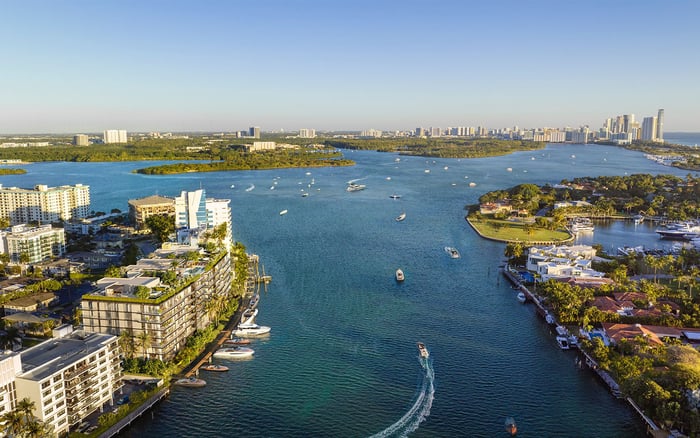
Onda is a 41-residence, eight-story condominium at 1135 103rd Street in Bay Harbor Islands. Developed by CMC Group and Morabito Properties, it was completed in 2024. That date matters: its original construction-linked payment schedules are historical, not automatic instructions for a purchase today.
One historical Onda schedule called for 20% at contract, 10% at groundbreaking, 10% at top-off and 60% at closing. Another split the initial commitment into 10% at reservation and 10% at contract, followed by the same two 10% construction milestones and 60% closing balance.
Both structures required 40% in staged deposits before closing. Under the version beginning with 20% at contract, a further 20% became payable as construction milestones were reached. Onda’s topping off in March 2023 provides a historical reference for one of those triggers, not a future payment event for a current buyer.
The distinction is especially important when reviewing an older sales presentation. The 60% closing balance represents the unpaid purchase price after 40% in deposits. It does not establish final cash to close, which must also account for financing, other closing expenses and any separately required association contributions.
Nor should deposits be added to the full purchase price when calculating total acquisition funding. They are part of that price, not a surcharge. For a transaction today, use the executed agreement and applicable amendments to establish payment timing.
In general condominium-closing practice, a working-capital fund contribution is an additional buyer payment at closing intended to support building operations or other purposes specified in governing provisions. Its amount and permitted use depend on the building’s documents.
One or two months of common charges is sometimes used as a general condominium benchmark. It is not an established Onda charge and should not be treated as a Florida-wide requirement. Applying that benchmark without a governing provision turns a planning assumption into an unsupported obligation.
The phrase “capital contribution” also requires context. Do not assume it is interchangeable with “working capital,” or that the presence of both terms necessarily creates two separate charges. Onda’s exact amounts, calculation bases and treatment as separate or overlapping obligations require confirmation in the applicable transaction and association documents.
For each proposed charge, ask which provision authorizes it, how it is calculated, when it is payable and whether it is already included elsewhere in the closing estimate. Confirm whether it receives any credit against another amount. The label alone answers none of those questions.
Two useful planning windows answer different questions. The first 12 months after signing measure near-term acquisition liquidity. A period beginning at closing and extending through the following 12 months measures closing funding plus the initial ownership period.
For a signing-based window, include only deposits and other payments actually due within those dates. Do not assume every construction milestone and closing falls within the same year. For a closing-based window, previously paid deposits remain relevant as purchase-price credits, but they are not fresh cash outflows within that window.
Use a dated ledger rather than a single percentage of price. Include:
Deposits actually payable during the selected period.
The remaining buyer-funded purchase balance, after deposit credits and financing applied to the price, if closing occurs within the period.
Other closing expenses payable during the period.
Separately required association contributions not already included in those expenses.
Current ownership carrying costs falling within the period.
Track applicable lender reserve requirements alongside the ledger. Reserves can affect the liquidity a buyer must retain without necessarily being money spent at closing. Separating required retained funds from actual payments makes the cash plan clearer.
Onda’s historical HOA estimate was $1.29 per square foot. That figure is not a verified current association budget and should not anchor an occupancy-year forecast.
Obtain the current association budget and confirm the charges applicable to the particular residence. If a contribution is expressed as a multiple of common charges, identify exactly which charge and period form the calculation base. Do not substitute an older maintenance estimate for the amount specified by the governing provision.
Apply the same discipline when comparing Onda with Bay Harbor Towers. Keep recurring charges and one-time contributions in separate columns for each property. A monthly figure alone cannot establish which acquisition requires less first-year cash, and no contribution formula should be transferred from one building to another.
For a resale purchase, ask whether each contribution provision applies to the specific transfer. Do not assume an original developer-sale term carries forward unchanged. Reconcile the buyer’s contract, applicable condominium provisions and itemized closing statement before assigning a final funding amount.
Buyers extending their search to Bal Harbour and Rivage Bal Harbour can use the same comparison structure without assuming matching terms. Set the same time horizon, distinguish price payments from additional charges and identify confirmed versus provisional figures. The result is a comparison of liquidity requirements rather than unlike marketing estimates.
The document review should bring together the executed purchase agreement, applicable condominium disclosures and amendments, current association budget and itemized closing statement. Ask the closing team to connect every capital or working-capital line item to its controlling provision and show the calculation.
Then reconcile the ledger: credit deposits once, count each additional contribution once and separate retained lender reserves from cash disbursements. A contribution already included in the closing-cost total must not be added again. The objective is a funding schedule with clear dates and no duplicated obligations-not a reassuring but incomplete percentage.
For a considered approach to South Florida condominium purchases, explore MILLION.
If branded residences are on your mind — as a home or as an allocation — we would be glad to share what we are seeing, privately.
Begin a quiet conversationOnda was marketed as a 41-residence, eight-story condominium at 1135 103rd Street in Bay Harbor Islands. Developed by CMC Group and Morabito Properties, it was completed in 2024.
One schedule required 20% at contract, 10% at groundbreaking, 10% at top-off and 60% at closing. Another split the initial 20% into reservation and contract payments of 10% each.
Not automatically. A current buyer should establish payment timing from the executed purchase agreement and applicable amendments.
Purchase deposits advance payment of the agreed price and reduce the remaining price balance. Adding them to the full purchase price would double count them.
In general condominium-closing practice, it is an additional buyer payment at closing supporting operations or purposes specified in governing provisions. Its amount and use depend on the building’s documents.
That range is general context, not an established Onda obligation or Florida-wide requirement. Confirm the applicable provision before assigning an amount.
No such assumption should be made for Onda. The applicable documents must establish whether the terms describe separate obligations or overlap.
Choose either the first 12 months after signing or a period beginning at closing and extending through the following 12 months. Count only payments falling within the selected window, while preserving credits for earlier deposits.
That figure is a marketing-era estimate, not a verified current association budget. Obtain current charges applicable to the residence before forecasting ownership costs.
Review the executed purchase agreement, applicable condominium disclosures and amendments, current association budget and itemized closing statement. Reconcile each contribution and deposit credit to avoid counting any amount twice.