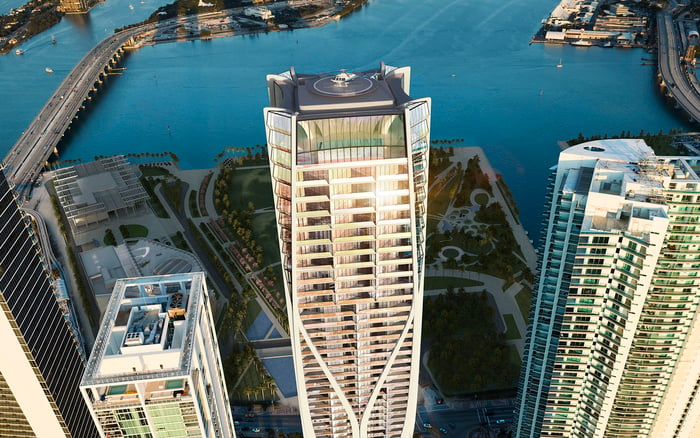
For buyers at Faena Residences Miami, the important insurance question is not simply whether the association has coverage. It is how a storm deductible could become an owner assessment, how that expense is allocated, and what an individual policy would actually reimburse.

At Faena Residences Miami Downtown Miami, the appeal is a branded, fully serviced luxury condominium in a Downtown Miami riverfront setting. Alongside that lifestyle proposition is a less visible ownership consideration: how the association’s storm deductible could become a personal cash obligation after a major claim.
Association insurance does not necessarily absorb every dollar of a covered loss. A deductible remains to be funded, and an owner’s individual insurance may not reimburse the resulting assessment in full. For a buyer, the objective is not to avoid every contingency, but to understand the potential obligation before committing capital.
This discussion concerns the Downtown Miami project, not Faena House or Faena Hotel residences in Miami Beach. No illustrative percentage or dollar amount below should be read as Faena’s insurance terms. Those must be established through the applicable project documents and bound coverage.
Under Florida condominium law, association property-insurance deductibles and damages exceeding association property-insurance coverage are generally common expenses, subject to statutory exceptions. A deductible can therefore move from the association’s insurance paperwork to an owner’s balance sheet through a special assessment.
That does not mean every storm automatically produces an assessment equal to the entire deductible. The relevant loss, policy provisions, available permitted funding and allocation rules all require review. It does mean that “the building is insured” is not a complete answer to the question of personal exposure.
Approach the review in three stages: establish the association’s applicable deductible, determine how any assessed amount would be allocated to the residence, and confirm what the owner’s policy would reimburse. Skipping a stage can yield a reassuring number that does not reflect the actual obligation.
Florida condominium master policies commonly use percentage-based hurricane deductibles. The critical detail is the value to which the percentage applies. It may be the building’s insured value, rather than the residence’s purchase price or the amount of damage to an individual unit.
Illustrative only:
a building insured for $50 million with a 5% hurricane deductible has a $2.5 million deductible. These are not verified Faena figures, and the calculation does not predict an assessment. It shows why an apparently modest percentage can represent a substantial sum at the association level.
Before evaluating that sum, ask the insurance adviser to identify the exact insured-value base in the policy and confirm how the deductible schedule applies to the claim being modeled. Do not substitute a sales valuation for an insurance value.
For buyers also considering Aston Martin Residences Downtown Miami, the comparison discipline is straightforward: request the same insurance inputs for each residence. Comparable questions do not imply comparable policies, deductibles or owner obligations.
Windstorm, named-storm and hurricane deductibles are not interchangeable labels. They can have different triggers, so an estimate should begin with the provision that applies to the event being considered. A hurricane deductible applies to loss caused by a hurricane, but that definition alone does not resolve every policy question.
Ask for the complete deductible schedule and endorsements, not merely a verbal description of “storm coverage.” Have the adviser explain the relevant trigger and whether the applicable deductible repeats with another qualifying event.
Commercial residential insurers must offer condominium associations a choice that includes a separate deductible applicable to each hurricane. That requirement does not establish which option a particular association selected. The planning distinction matters: one modeled claim should not be mistaken for a confirmed ceiling on exposure across a storm season.
Dividing a master-policy hurricane deductible by the unit count provides an equal-share screening estimate-not a verified bill for a particular residence. Actual exposure depends on the applicable allocation of common expenses and the amount ultimately assessed.
The recorded condominium declaration and assessment-allocation provisions should anchor the calculation. Ask counsel to identify the share applicable to the residence and explain any relevant exceptions. A simple average can support an initial conversation, but it should not replace document review.
Keep the funding question separate from the allocation question. Review the association budget and reserve information, then verify which funds may be used for the loss. Do not assume a reserve balance is available to satisfy a deductible or eliminate an assessment.
The buyer’s working estimate should clearly distinguish the policy deductible, the amount proposed to be assessed and the residence’s share. These are related figures, not synonyms.
An individual condominium policy, commonly called an HO-6 policy, may provide property loss-assessment coverage. Qualifying Florida unit-owner policies issued or renewed on or after July 1, 2010 must include at least $2,000 of that coverage, with a deductible no greater than $250 for that coverage. This minimum is not a tailored measure of a luxury owner’s needs.
More importantly, a headline loss-assessment limit may not be fully available for an assessment arising from the association’s deductible. A separate sublimit can apply to that portion of the claim. An owner can therefore carry loss-assessment insurance and still face substantial unreimbursed expense.
Request a written explanation of the applicable limit, any master-deductible sublimit, the coverage deductible and the conditions that determine eligibility. Ask the adviser to test the same assessment scenario used in the association review. Do not assume every special assessment is insured or that a higher headline limit removes every gap.
Begin with the recorded declaration and association insurance declarations page. Then obtain the complete master policy, endorsements, deductible schedule, assessment-allocation provisions, budget and reserve information. Where arrangements are still being developed, distinguish proposed insurance from coverage that is actually bound.
A buyer extending the search into Brickell at Baccarat Residences Brickell can use the same checklist without assuming the projects share insurance arrangements. Compare each residence’s documented exposure and available reimbursement, not simply the deductible percentage quoted in isolation.
For Faena buyers, the review should culminate in a written assessment scenario reviewed by insurance and legal advisers, with assumptions clearly identified. That turns fine print into an ownership decision: what the association could owe, what share could reach the residence, and what cash the owner might need after insurance responds.
For a considered perspective on South Florida luxury ownership, explore MILLION.
If branded residences are on your mind — as a home or as an allocation — we would be glad to share what we are seeing, privately.
Begin a quiet conversationYes. Association property-insurance deductibles are generally common expenses under Florida condominium law, subject to statutory exceptions, and may be funded through a special assessment.
No. The $50 million insured value, 5% deductible and $2.5 million result are illustrative only; Faena’s applicable terms must be established from project documents and bound coverage.
Not necessarily. It may apply to the building’s insured value rather than your residence’s purchase price or the damage to your unit.
That provides only an equal-share screening estimate. Your actual share depends on the applicable common-expense allocation and the amount assessed.
No. They can have different triggers, so the deductible schedule and endorsements must be reviewed for the event being modeled.
Yes. Insurers must offer condominium associations a choice that includes a separate deductible for each hurricane, but the association’s selected terms require confirmation.
Qualifying policies issued or renewed on or after July 1, 2010 must include at least $2,000 in property loss-assessment coverage, with a deductible no greater than $250 for that coverage.
Not necessarily. A separate master-deductible sublimit or other policy conditions can restrict reimbursement, and an eligible assessment may exceed the applicable limit.
No. Review the budget, reserve information and permitted funding sources before treating any reserve balance as available for a deductible.
Start with the recorded declaration and association insurance declarations page, then obtain the complete policy, endorsements, deductible schedule and allocation provisions. Also review the budget and reserves, distinguishing proposed arrangements from bound coverage.