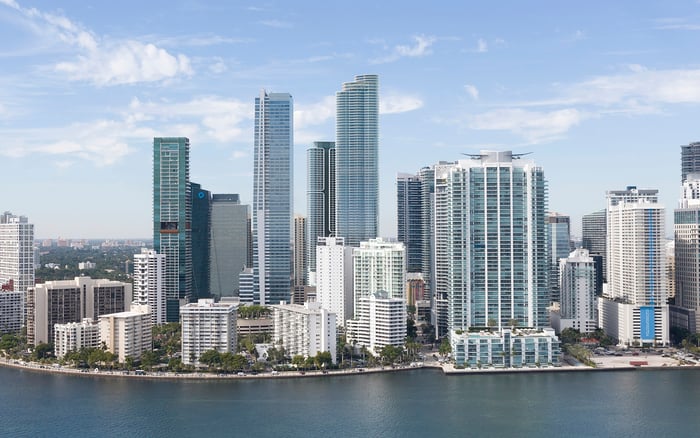
Airport proximity is only part of the ownership equation at 2200 Brickell. Advertised 20-25-minute access deserves a closer reading against peak-hour planning estimates, seasonal congestion and the realities of a specific building-to-terminal journey.

For a buyer whose calendar moves between residences, boardrooms and international departures, airport access is more than a location benefit. It is a measure of how reliably a home supports the life around it. At 2200 Brickell, the distinction is between a short advertised drive and a journey that remains manageable when timing matters most.
The luxury residential development is located at 2200 Brickell Avenue, Miami, FL 33131. Advertised driving times are 20 minutes to Miami Airport and, separately, 25 minutes to Miami International Airport, or MIA. Neither figure establishes a measured peak-hour journey from the building to a particular terminal, and neither is explicitly identified as off-peak.
That does not make the figures inherently wrong. It makes them incomplete for a purchase decision centered on frequent flying. The buyer's question is less whether a 20-minute trip is possible than whether a typical departure window supports the required schedule.
Planning estimates for the wider Brickell-MIA corridor place off-peak travel at 15-25 minutes and rush-hour travel at 30-50 minutes. Another neighborhood-level estimate, specifically for MIA to Downtown/Brickell, allows 15-20 minutes normally and 35-50 minutes at rush hour.
A further inbound estimate allows 20-30 minutes off-peak via SR-836 and I-95, with morning and evening congestion adding 15-25 minutes. These ranges reflect different assumptions and directions. They should not be averaged into a supposedly precise number for 2200 Brickell, nor should the highest figure be treated as a guaranteed ceiling.
These figures are planning estimates rather than verified traffic measurements for the building. Their value is to challenge a single-number expectation, not to replace one promise with another. For purchase planning, 30-50 minutes is a useful peak-period corridor range to investigate-not verified building-to-terminal performance.
The same discipline applies when comparing Una Residences Brickell: use the same flight schedule and destination before drawing conclusions about relative convenience. Neighborhood proximity alone does not establish identical journeys.
The relevant rush-hour windows extend beyond a single congested hour. Estimated weekday morning pressure runs from around 7-9:30 a.m., with evening pressure around 4-7 p.m.; narrower estimates identify 7-9 a.m. and 4:30-7 p.m. The evening period deserves particular attention when testing for delays.
For a buyer who routinely departs during those windows, a midday drive after a property tour is not the appropriate test. Request routing estimates for the intended weekday and departure time, then, where practical, make trial journeys under comparable conditions. Record the starting point, terminal destination and direction so the results remain meaningful.
Peak-period planning allowances include roughly 20-30 additional minutes for Downtown/Brickell trips relative to an off-peak baseline, or a separate 25-minute rush-hour buffer for inbound travel. These are alternative approaches, not allowances to stack automatically on top of every rush-hour estimate. Choose a baseline deliberately and confirm what it already includes.
Art Basel in December, the Miami Open in March and spring break in March-April are seasonal ground-transport congestion periods. Friday afternoons after 3 p.m. are another pressure point throughout the year. For a second residence used around cultural events or weekend arrivals, these windows deserve explicit attention.
The timing estimates in this article do not establish a measured 2200 Brickell-MIA journey during any particular event weekend. It would therefore be misleading to label 35-50 minutes, or 50-plus minutes, as a verified event-specific benchmark. Ordinary rush-hour estimates are not event-weekend measurements.
A more useful approach is to test the travel pattern associated with ownership: the Friday arrival, the Sunday return or the departure during an event stay. When considering Cipriani Residences Brickell alongside 2200 Brickell, keep those calendar assumptions consistent. Otherwise, the comparison may reveal more about the travel dates than the properties.
Several estimates discussed here cover MIA to Brickell, not Brickell to MIA. That distinction should remain explicit in any buyer's comparison. An inbound transfer estimate does not establish an outbound journey, and neither necessarily measures travel between the exact building entrance and terminal curb.
Construction deserves equally precise treatment. Dated overnight restrictions for the I-395/SR-836/I-95 construction project apply to specific periods. In August 2026, for example, closure of the southbound I-95 ramp to westbound SR-836 was scheduled from 9 p.m. to 5:30 a.m. on August 24, with August 25 as an alternate date. That schedule does not establish an ongoing closure or quantify daytime delay.
Check current restrictions for the actual travel date rather than turning an old alert into a permanent assessment of the address. The scheduled route matters as much as the existence of construction somewhere in the corridor.
Airport arrival is another distinct stage. Estimated congestion on the arrivals drive can add 10-15 minutes inside the airport perimeter. That is not a universal departures allowance and should not be added automatically to every corridor estimate. Keep road travel, arrivals pickup conditions and airline-required airport time separate.
The strongest airport-access assessment uses a small, consistent set of scenarios rather than a single favorable drive. For each property, use the same airport destination, direction, weekday and time window. Include an ordinary off-peak trip, the peak period most relevant to the household and an event-related journey if that reflects intended use.
For buyers also considering The Residences at 1428 Brickell, this creates a fairer comparison without assuming any building has a demonstrated traffic advantage. Keep predicted times distinct from completed journeys, and check live routing again on the day of travel.
At 2200 Brickell, the informed conclusion is not that airport access lacks value. It is that its value should be judged against the owner's calendar. Advertised 20-25-minute access is an introduction; peak-period reliability, event exposure and terminal-specific planning are the details that make the location workable.
For a discreet comparison of Brickell residences through the lens of your travel priorities, connect with MILLION.
If branded residences are on your mind — as a home or as an allocation — we would be glad to share what we are seeing, privately.
Begin a quiet conversation2200 Brickell is a luxury residential development at 2200 Brickell Avenue, Miami, FL 33131.
Advertised airport driving times include 20 minutes and, separately, 25 minutes to MIA. These figures do not establish measured peak-hour building-to-terminal travel.
The advertised times discussed here are not explicitly labeled as off-peak. Buyers should not assume that qualification was disclosed.
Planning estimates for the wider Brickell–MIA corridor include 30–50 minutes at rush hour. This is a planning range, not a measured result or guaranteed maximum for 2200 Brickell.
Estimated weekday rush-hour windows extend approximately from 7–9:30 a.m. and 4–7 p.m. Friday afternoons after 3 p.m. also deserve testing for congestion.
Art Basel in December, the Miami Open in March and spring break in March–April warrant congestion checks. Their relevance depends on the buyer's actual travel dates.
No measured building-specific event-weekend time is established here. Ordinary rush-hour ranges should not be presented as verified event benchmarks.
Inbound estimates are not exact equivalents for departures. Several estimates cover MIA to Downtown/Brickell, so outbound travel should be checked separately for the actual building and terminal.
That estimate concerns congestion on the arrivals drive. It should not be applied automatically to departures or added to a journey estimate that may already include airport access.
Use consistent directions, terminal destinations, weekdays and departure windows, including relevant peak and event periods. Check current route restrictions and live routing before each actual trip.